Request a Demo
Data from China Customs suggests that growth in China’s wine trade has suffered significantly this year. In the first half of 2014, the volumes and price of imported wines dropped by 6.2% and 6.5% respectively compared to those of 2013. This year’s poor performance is sharply contrasted with the excellent growth of recent years.
A Summary of Wine Market Performance in China
1. Changing consumer preference trends
Chinese consumers are increasingly seeking quality but affordable options and have decreased their purchase of high end wines.
2. Volatility in monthly import volume
Monthly comparisons suggest considerable variability in the volume of wines imported month by month. January saw the largest amount of wine imported contrasted with the low seen in February.

3. Changes in distribution and logistics
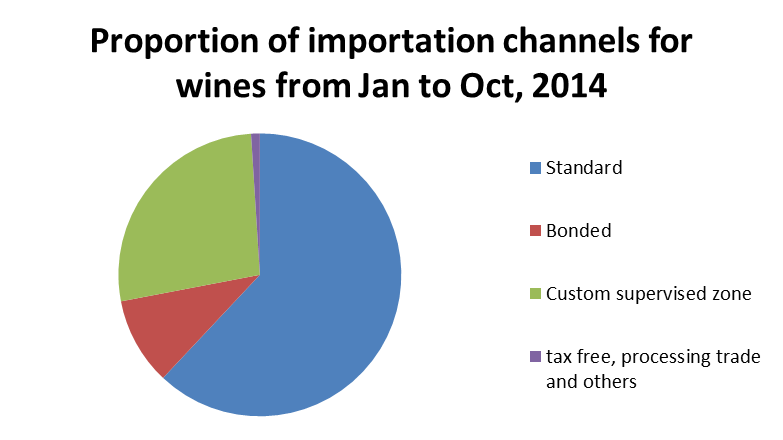
In the past ten months, approximately 62% of wines were imported through standard importation channels however data shows a 14.7% year-on-year decline in import volume by standard importation channels. Whereas wines imported as bonded goods experienced a sharp rise reflected in the 52.7% increase this year. This can be understood if you consider the efforts taken by the Chinese government’s to propel the development of bonded areas in China. Besides bonded goods importation, local governments are also supportive to the new wave of cross-border e-commerce in which bonded areas will serve as a bridge.
4. Regional disparity in import volume
Shanghai, Guangdong and Shandong are the leading ports for wine imports, the three of which dominate more than 60% of imported wines.
Old World VS New World
France is still the largest exporter of wine to the Chinese wine market followed by Chile, Spain and Australia. Wines from new world countries are catching up with the old world primarily due to their affordability.
China’s tax policy could be one important factor. China implemented a China-Chile Free Trade Agreement under which Chilean wines will be granted a zero-tariff treatment in 2015. The same policy will began to benefit Australian wines in the next year as China and Australia have just signed a FTA. It is estimated that by 2019 the tariff rate of wines from Australia will eventually drop to zero. Chilean and Australian wines are perfectly positioned to dominate China’s low end market. However, the supremacy of France is unlikely to be challenged. The current price range of new world wines is already low and thus there is not much room left for further price cuts irrespective of tariffs. At the same time, prices of French wines are gradually becoming more competitive. Considering the high brand awareness of French wines in China as well as Chinese consumers preference for French wines it is unlikely that any countries will supplant France from its top spot.
 We provide full-scale global food market entry services (including product registration, ingredient review, regulatory consultation, customized training, market research, branding strategy). Please contact us to discuss how we can help you by