

 Request a Demo
After pricing its IPO at $17 a share, turning the Swedish plant-based milk giant into a $10 billion brand, on May 20, 2021, oat milk maker Oatly made its market debut. Oatly entered the Chinese market in 2018 by promoting its products through coffee and tea shops. By the end of 2020, Oatly’s products were sold at more than 9,500 food service and points of sale in China, with a growth rate of over 450%. 1
Oatly’s success mirrored the prosperity of the Chinese plant-based milk market. In fact, in addition to Oatly, players at home and abroad rushed into the market in the past years. Domestic dairy giants like Mengniu and Yili have already joined the game years ago. More and more global brands are also getting in on the action. 2 For example, French dairy giant Danone introduced two brands Provamel and Alpro to the Chinese plant-based milk market in 2020, then debuted another brand VEGA ONE in the market earlier this year. According to the "2020 Plant-based Protein Beverage Innovation Trend Report" released by Tmall, the plant-based protein beverage market grew 800% in 2020, contributing 15.5 percent of growth to the beverage market.3
After the Boom, Comes the Challenge
The Growing Homogeneity
Beneath the booming plant-based milk industry, there are some underlying challenges. The biggest one is homogeneity. In the Chinese market, most enterprises choose to invest the majority of their efforts to branding and channel marketing, for example, after Oatly making it big by promoting on social media, many other domestic brands including startups followed similar marketing strategy, which inevitably caused the homogenization of target audiences. On the contrary, they put little effort on product innovation, which can be proved by the fact that the products on the market are too similar in terms of raw materials, formula, processing technology and selling points. This homogeneous trend is notably reflected when it comes to raw materials. Currently, most plant-based milk products are made of traditional materials like peanut, walnut, almond and grains such as oats. There are hardly any new materials or products on the market.
The Battle with Dairy
Oatly’s most popular catchphrase—“Like Milk, but Made for Humans”—has generated controversy over the years. The company was sued by the Swedish Dairy Association for implying that cow’s milk is unhealthy, and lost the case in 2015. 4 Undeniably, the tie with dairy is indispensable for plant-based alt milk brands like Oatly. Many brands astutely set appealing selling points, such as “lactose-friendly” and “free of sugar, animal fat, cholesterol”, which hits the pain points of dairy products .
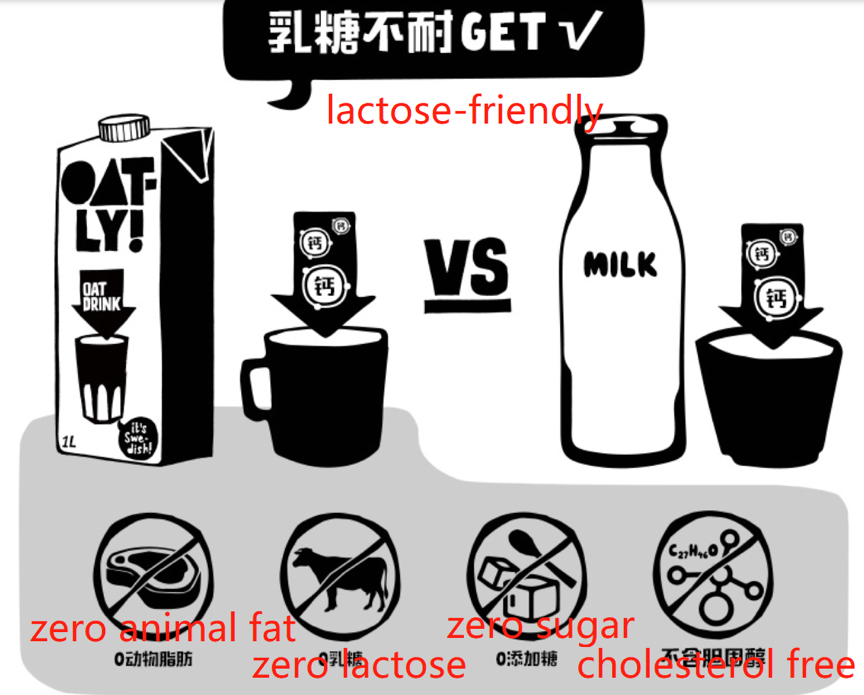 *The image is from Oatly’s promotional materials on Taobao
However, is plant-based milk indeed the perfect alternative to animal milk? Fan Zhihong, an associate professor at China Agricultural University, pointed out that compared to animal milk, plant-based milk has a much lower content and quality of protein, and lacks Vitamin A and Vitamin D.5 In the context of Chinese consumers' growing health awareness, the prospect of less nutrient product in the market may not be that bright. In addition, another minus factor for plant-based milk to challenge animal milk is its unfriendly price. The unit price of plant-based milk is generally higher than that of animal milk in retail shops and online platforms, which is bound to weaken its competitiveness to some degree.
Regulations to be Improved
While the market scale keeps increasing, incomplete regulations may impede the market development. Behind the popularity of plant-based milk, some issues such as obscure product definitions are emerging. For instance, there is no clear definition of "plant milk" in GB standards but only some standards applicable to “plant protein beverage”. Leave aside the definition and terms, only several major plant-based milk products have standards to refer to, including soybean milk (GB/T 30885-2014), almond milk (GB/T 31324-2014), walnut milk (GB/T 31325-2014) and peanut milk (QB/T 2439—1999).6 However, the emerging plant-based milk products such as oat milk and quinoa milk still have no available standards for reference, which might hinder the emergence, management and control of new products in the plant-based milk industry.
ChemLinked’s Suggestion
Even though plant-based milk is a great growth market, players need to be aware of the problems which might hold back the market development in the long run. To sum up, against the irresistible tendency of homogeneous competition, plant-based milk makers should focus on product innovation, improve the nutritional value of the product, and adopt a differentiation strategy on the marketing. Furthermore, the market image of plant-based milk should be altered from “the substitute for dairy” to “the supplement to dairy”. ChemLinked believes that the healthy and rapid development of the plant-based milk industry will be bound to push the regulations forward for further improvement, which will boost the industry conversely.
 We provide full-scale global food market entry services (including product registration, ingredient review, regulatory consultation, customized training, market research, branding strategy). Please contact us to discuss how we can help you by








