Request a Demo
To help overseas coffee SMEs expand their business and increase profits, this article introduces how overseas SMEs can enter China by leveraging the e-commerce. Carlos Aldeco Reyes-Retan & Melissa Jamin Beyer once raised this strategy1 in 2021, who served as Mexican officials and participated in the negotiation of various agricultural products that gained sanitary access to China in the period 2014-2019. Carlos Aldeco Reyes-Retan introduced that E-commerce has grown so well in China, that to some extent the middlemen can be eliminated, which is absolutely a strong attractive point for overseas coffee enterprises as the profit can be raised directly. But how’s the market potential of coffee products in China? Do people prefer to buy coffee products via e-commerce platforms? How to enter China via e-commerce platforms? How to ensure compliance? Answers are given in this article.
China, a booming coffee market
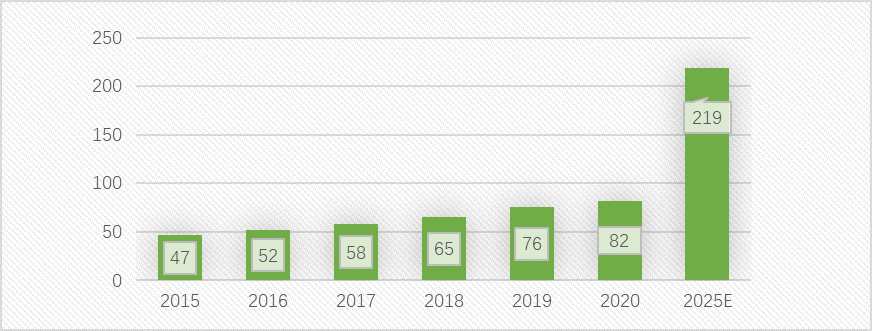
Driven by the consumption of the young generation and office workers in first and second-tier cities, China’s coffee market is now recognized as a fast-growing sector in recent years. According to Daxue Consulting2, the market value of the coffee industry almost doubled from 2015 to 2020, and it is expected to rise to RMB 219 billion (around USD 32 billion) by 2025 with an estimated compound annual growth rate (CAGR) of 22%. Given the varying classification of coffee by different agencies, the coffee categories in this report encompass major categories such as instant coffee, ready-to-drink (RTD) coffee, and freshly-ground coffee.
Figure 1: The market value of Chinese coffee industry in 2015-2020 and expectations for 2025 (Unit: bn RMB)
Source: Daxue Consulting2
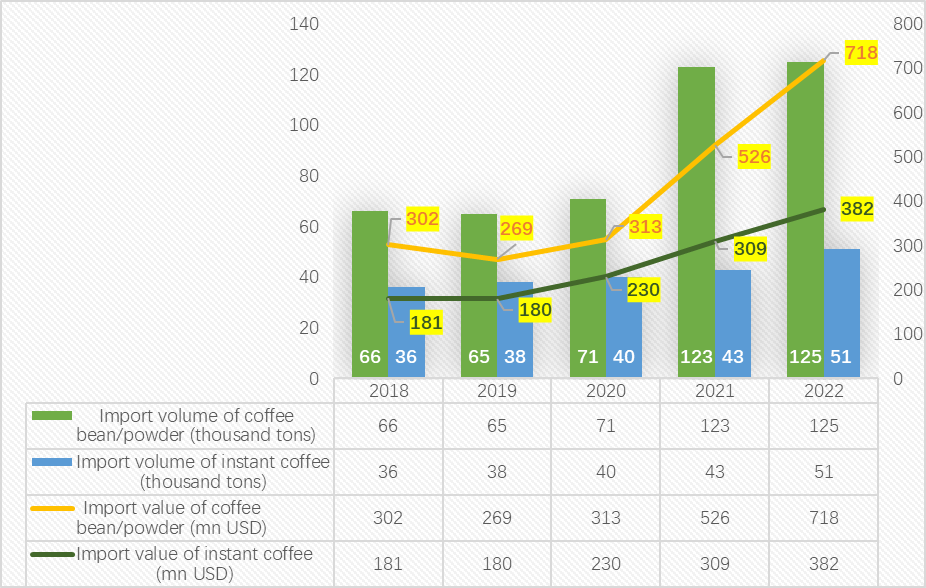
Regarding the performance of imported coffee products, the overall situation can be reflected by the data from the General Administration of Customs of China3 (GACC). GACC roughly divided coffee imports into coffee beans/powder and instant coffee. It unveils that both the import volume and value of coffee bean/powder and instant coffee have been taking on an upward trajectory, which began to soar since 2019, especially the import value of these two kinds of coffee products.
Figure 2: China's coffee imports, in 2019-2022
Source: Data from the General Administration of Customs of China3
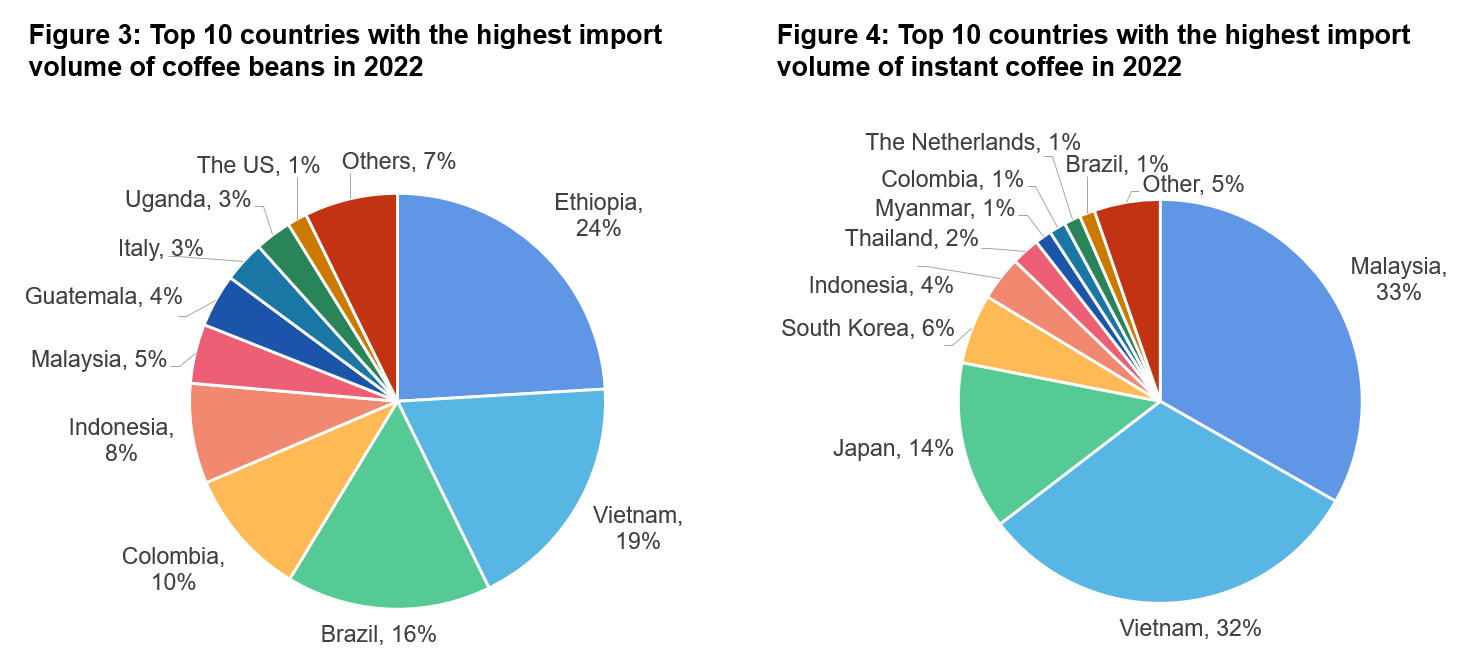
Among the total coffee imports in 2022, 24% of coffee beans are from Ethiopia and 19% from Vietnam. Regarding imported instant coffee, Malaysia (33%), Vietnam (32%) and Japan (14%) are the top 3 countries with the most exportation quantity in 2022.
Source: Data from the General Administration of Customs of China3
Popular products and sales channels in China
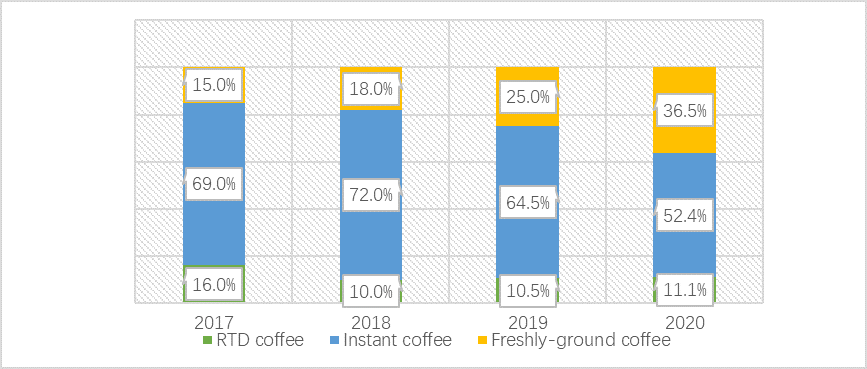
Among the coffee categories divided by Daxue Consulting2, instant coffee remains the most popular coffee category in China compared to RTD coffee and freshly-ground coffee, due to the low price and portability. It is analyzed that instant coffee accounts for over 50% of the market share of these three categories. Pingan Securities Research Institute4 comes to the similar conclusion that the market share of instant coffee reaches 52.4%, while freshly-ground coffee and RTD coffee accounted for 36.5% and 11.1% in 2020, respectively.
Figure 5: Market share of RTD coffee, instant coffee and freshly-ground coffee, in 2017-2022
Source: Pingan Securities Research Institute4
However, as the coffee industry in China develops, consumers are increasingly choosing coffee products with higher quality, such as freeze-dried coffee, liquid coffee concentrate, and coffee capsule. This can also explain the increasing market share of freshly-ground coffee. Additionally, some consumers who pursue an exquisite lifestyle prefer to buy coffee beans and make coffee themselves. As disclosed by CBN Data5, a market data research institution whose data are mainly from Alibaba group, the top 10 origin places of coffee beans are Jamaica, Ethiopia, China, Indonesia, Colombia, Panama, Costa Rica, Brazil, Honduras and Vietnam. Among these countries, the consumption of coffee beans from Honduras and Vietnam are increasing fast, making them attractive coffee bean suppliers.
Regarding the sales channels, coffee products are universally purchased in both offline and online channels. Offline channels are represented by supermarket chains, convenience stores and café, while online channels can be diverse, such as popular E-shopping platforms like Taobao, Tmall, JD, social e-commerce platforms like Little Red Book and live-streaming apps. O2O delivery platforms like Ele.me and Meituan offer consumers another solution to place orders online and receive the products within 30-60 minutes, but these products are essentially from offline stores like cafés, supermarkets, and convenience stores. Compared to other coffee products, the sales channel of coffee beans is slightly different. Overseas companies can trade them to other companies in China. During the 5th China International Import Expo, under the guidance of Shanghai government, an international coffee trade platform6 was launched. Overseas coffee bean suppliers can publish trade information on the platform.
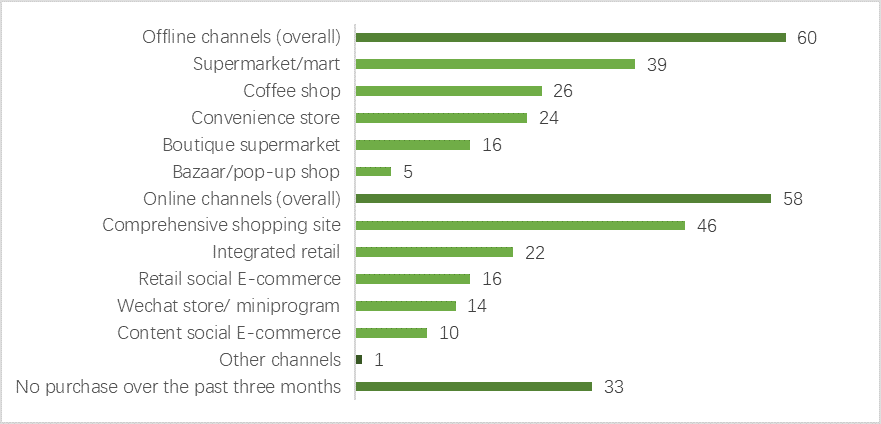
But how many consumers will buy coffee in online platforms? As per the survey conducted by Mintel in 2021, 60% consumers purchase coffee products via offline channels, while 58% via online channels, which conveys that offline channels and online channels show roughly the same importance in the sales of coffee products. In addition, data of Tmall data and Ele.me7 revealed that the number of consumers who purchase coffee products online in 2021 is 1.5 times the number in 2019.
Figure 6: Over the past three months, by which of the following channels have you purchased coffee products? (Multiple-choice) (in percentage)
Source: KuRun Data/Mintel
How can traditional e-commerce platforms help overseas companies?
E-commerce platforms are a great option for overseas companies to enter the Chinese market, as they are an important sales channel (as explained above) with less operation cost. From a regulatory perspective, products sold on e-commerce platforms are considered as commodity goods and subject to the same supervision requirements for general trade. But please note, there is another channel in China called cross-border e-commerce (CBEC). Although CBEC products are also traded online, they are recognized as goods for personal use and subject to a loose supervision environment (explained in the following part). Therefore, the term “traditional e-commerce” is used in this part to distinguish it from the sales mode under CBEC.
Basically, the major ways for overseas companies to enter the traditional E-commerce sector are summarized as below. Taking Tmall as an example, enterprises can:
open an official flagship store, which can help raise brand awareness.
open an exclusive store.
open a franchised store to trade products with different brands. In this situation, enterprises need to obtain the authorization of different brands.
However, at present, Tmall only accepts the application by Chinese enterprises for being a merchant on Tmall. Hence, enterprises can find an agent in Chinese Mainland to operate the store instead. Detailed requirements can be found on Tmall platform: Rules for opening stores on Tmall8.
Besides opening stores on Tmall, overseas enterprises can also sell products via Tmall Supermarket. Currently, Tmall Supermarket mainly focuses on targeted investment, which means that the Tmall Supermarket team will actively contact companies to cooperate as the supplier. But for companies that already have a Tmall store, they can first contact the customer service person responsible for the coffee sector on Tmall, who can help communicate with the Tmall Supermarket team about being the supplier of Tmall Supermarket. Companies can also apply for the entry directly.
Tmall Supermarket has two modes to cooperate with companies: distribution mode and consignment sale mode.
Mode | Property of goods | Explanation |
Distribution | After warehousing, the ownership of the goods is transferred to Tmall Supermarket. | Tmall Supermarket purchases goods from the supplier first and then sells the goods as a distributor. |
Consignment sale |
| Tmall Supermarket pays for the goods only when the product is purchased by consumers. |
In practice, most merchants sell the products on Tmall Supermarket via the distribution mode, where the platform buys goods directly from suppliers. Rules to be a supplier of Tmall supermarket can be read here9.
Besides Alibaba group, JD.com10 is also a competitive giant in e-commerce sector, providing similar services for overseas companies. Enterprises can open stores on both platforms to gain better revenue.
Cross-border e-commerce (CBEC), a powerful channel to help SME enterprises
In addition to traditional e-commerce, it is essential for enterprises to know CBEC as well considering the following benefits.
Since products sold via traditional E-commerce platforms are recognized as commodity goods, they shall meet regulation in China; while the products sold via CBEC are recognized as goods for personal uses, so it is not necessary to follow the regulations in China but only the laws in the exporting country. However, please note that CBEC platforms may raise their own requirements to CBEC products sold on their platforms.11
To be specific, CBEC products can be exempted from Chinese labeling. But to ensure consumers’ rights, the merchants shall display the product label translated into Chinese on the product introduction page.
Overseas enterprises can directly open stores on CBEC platforms without entrusting an agent.
CBEC imported products are eligible for preferential tax policy, where the import tariff rate is fixed at 0.0%, and the import VAT as well as the consumption tax are levied at 70% of the statutory tax payable. The calculation rule is: Tax Payable = [(VAT + Consumption tax) ÷ (1 - Consumption tax)] × 70%. But once the transaction exceeds certain conditions, it will be calculated as general trade. I.e., for a single transaction over 5,000 RMB but within the annual limit of 26,000 RMB, it is allowed to be imported via CBEC but is subject to full tax. In addition, any excess beyond the annual limit will be regulated as general trade: Tax Payable = Tariff + VAT + Consumption tax.
Please note that according to the List of Import Goods through Cross-border E-commerce12, only coffee products imported under the following HS codes are permitted to be traded via CBEC:
09011100 Coffee, not roasted and not decaffeinated;
09012100 Coffee, not decaffeinated but roasted;
09012200 Coffee, roasted and decaffeinated;
09019010 Coffee husks and skins;
09019020 Coffee substitutes containing coffee;
21011100 Extracts, essences and concentrates, of coffee;
21011200 Preparations with a basis of extracts, essences and concentrates of coffee, or coffee;
21013000 Roasted coffee substitutes and extracts, essences and concentrates thereof.
For enterprise who intends to become a merchant on CBEC platforms, taking Tmall Global as an example, there are four modes to choose.
Mode | Explanation | Benefit |
Flagship Store | Merchant can operate and manage the store with their own team or a third-party agent. | Brand awareness building |
Direct Import | Tmall Global has an official store on the platform where merchants become the suppliers. Tmall Global purchases the goods from merchants, which is similar to the distribution mode adopted by Tmall. |
|
Ministore |
| Incubation of SMEs brands |
Overseas Fulfillment |
|
|
Read more details and corresponding logistic methods at Tmall Global13.
Key regulatory steps to know before the exportation
For stakeholders that are interested in China’s coffee market, it is crucial to understand the local regulations as well, which can help businesses make informed decisions about whether to enter the market or not and how to enter it. Unlike the loose supervision environment of CBEC products (as analyzed above), products sold via traditional e-commerce must adhere to strict requirements for general trade as below.
Firstly, only coffee beans from the exporting country listed in the “Catalogues of Foods Exported to China from Countries/Regions That Meet the Assessment and Examination Requirements and Conduct Traditional Trade with China”14 are permitted to be sold in China. Countries like Honduras and Brazil are listed in the Catalogue.
Secondly, according to the Decree 24815 and Decree 24916 released by GACC, overseas food enterprises shall finish the manufacturer registration with GACC first, then label the facility registration number on the inner and outer package of product. Please note: CBEC products are exempted from this requirement as explained above.
Thirdly, besides the overseas food manufacturer registration, both the exporters in exporting countries and the importers in China shall get filed with GACC.
Fourthly, coffee products shall go through inspection or/and quarantine after arrival at port based on their product categories. Eg, coffee beans from Honduras need to comply to the inspection and quarantine requirements as specified in GACC Notice No. 67 in 202317.
Fifthly, products must follow relevant national standards to ensure product compliance. Other requirements for food safety, labeling, advertising, etc. must also be followed.
Category | Related national standard |
Coffee beans |
|
Coffee powder, including ground coffee and instant coffee (Notes: Instant coffee includes 3-in-1 coffee and freeze-dried coffee; ground coffee include drip coffee) |
|
RTD coffee |
|
Organic products | Additionally to satisfy GB/T 19630 Organic products—Requirements for production, processing, labeling and management system |
For further food consulting or registration services, please email the team at [email protected].
 We provide full-scale global food market entry services (including product registration, ingredient review, regulatory consultation, customized training, market research, branding strategy). Please contact us to discuss how we can help you by