Request a Demo
Background: According to China’s Anti-dumping Regulation [1]: An anti-dumping investigation shall be conducted and measures shall be taken where imported products enter the market of China by way of dumping, and cause material damage or constitute a threat of material damage to an already established domestic industry, or cause a material impediment to the establishment of a domestic industry. |
On August 18, 2020, China’s Ministry of Commerce (MOFCOM) released the No. 34 Notice [2] revealing an anti-dumping investigation into the imported wine from Australia in containers holding 2 liters or less (HS code: 22042100). Certain wine products imported from January 1, 2019, to December 31, 2019, are subject to the anti-dumping investigation. The investigation of industry damage will focus on wine imported from January 1, 2015, to December 31, 2019.
The investigation started on August 18, 2020, and will end prior to August 18, 2021. If necessary, the investigation period may extend to February 18, 2022.
Industrial Influence
Immediately following this notice, the share price of Treasury Wine Estates, Australia’s largest wine company, fell by 14.3% on that day on the worries of the prospect of an import tax on Australian wine. Many insiders consider that this investigation might have a huge impact on Australian wine industry since China is currently Australia’s largest wine consumption market.
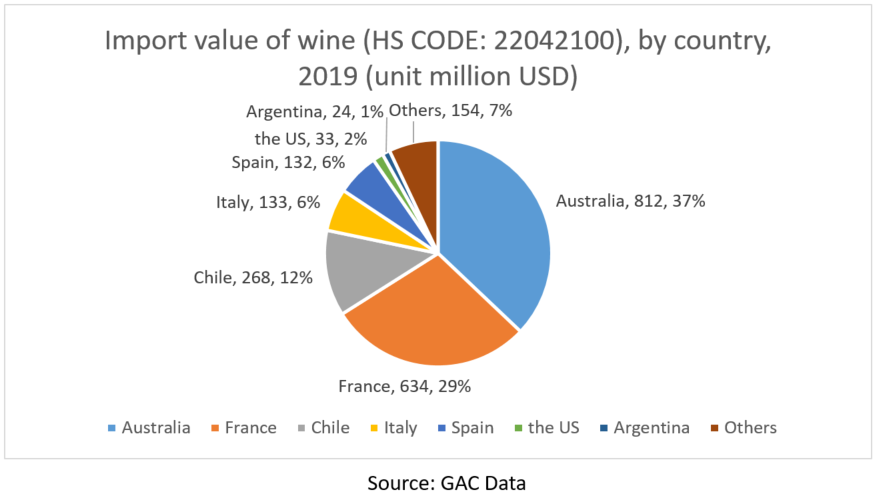
In 2019, China accounted for over 37% of the wine exports and was three times the size of the US which is Australia’s No. 2 export market. [3] Furthermore, as revealed by the GAC data, Australia exported 812 million USD of wine in containers holding 2 liters or less to China in 2019 which makes China its largest exporting country.
Attitudes of both sides
“This is a very disappointing and perplexing development,” Trade Minister Simon Birmingham said, “Australian wine is not sold at below-market prices and exports are not subsidized.” James Hall, a Victorian wine consultant, said the average market price of Australian wine was three times more expensive than local wine produced in China, and consider the investigation “a decision that seems to be political.” [4]
Zhao Lijian, the spokesman of China’s Foreign Department, rejected such speculation and stated, “this is a normal case of anti-dumping. And Chinese competent authority will conduct the investigation in a legal, fair, and just manner.”
How did the probe start?
In light of the MOFCOM Notice, the application of this anti-dumping investigation was raised by China Alcoholic Drinks Association (hereinafter “CADA”) in July 2020. As revealed by the open document, CADA named ten manufacturers, who were also the wine exporters at that same time, including Treasury Wine Estates Limited, Australian Vintage Limited, Casella Wines Pty Limited, etc.
Price concerns
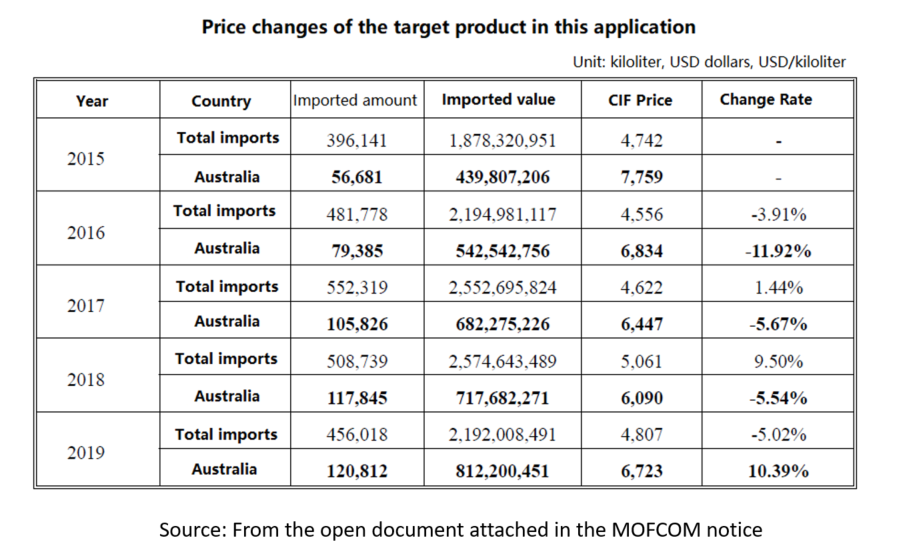
CADA stated that it’s obvious to see the rising imported volume and the falling imported price of the targeted wine category from the GAC data. The imported amount of certain wine rose from 56.7 thousand kiloliters in 2015 to 120.8 thousand kiloliters in 2019, with a rapid growth rate of 113%. The CIF (Cost, Insurance, Freight) price fell from 7,759 USD/kiloliter in 2015 to 6,723 USD/kiloliter in 2019, a drop of 13.36% which restrained the pricing of domestic enterprises in China.
From 2015 to 2019, the market share of Australian wine in China also expanded from 3.66% to 13.36%. By the calculation of CADA, the dumping profit margin reached 202.7%.
Damage concerns
The output of similar products in China dropped by 61.11% from 1.16 million kiloliters in 2015 to 0.4515 million kiloliters in 2019. As a result, both the sales income and profit dropped drastically from 2015 to 2019, with a decrease of 68.87% and 79.71%, respectively.
Governmental subsidies
Moreover in the open document released by CADA, it also deems that the fast development of the Australian wine industry is closely related to Australian governmental support. It listed 40 support programs as examples, such as:
- Wine equalization tax rebate, WET
- The Export and Regional Wine Support Package
- Regional Program
- Managing Farm Risk Program
- Export Market Development Grants
- Commonwealth On-Farm Further Irrigation Efficiency Program
- Drought Concessional Loans Scheme
- AgriGrowth Concessional Loan Scheme, etc.
Notes for all stakeholders in this case
Now that the investigated has started, all stakeholders shall register with China’s Trade Remedy and Investigation Bureau to attend this anti-dumping investigation within 20 days. Corresponding materials shall also be submitted to the e-platform [5] of this Bureau in time or it may influence the decision according to Point 8 of the notice.
For stakeholders who want to submit comments, any comments should be sent to China’s Trade Remedy and Investigation Bureau in written form within 20 days after the release date of this notice.
 We provide full-scale global food market entry services (including product registration, ingredient review, regulatory consultation, customized training, market research, branding strategy). Please contact us to discuss how we can help you by