Request a Demo
[Updated] On Nov. 2, 2021, the ASEAN Secretariat announced that it has received Instruments of Ratification/Acceptance from six ASEAN Member States – Brunei Darussalam, Cambodia, Lao PDR, Singapore, Thailand, and Viet Nam – as well as from four non-ASEAN signatory States – Australia, China, Japan, and New Zealand. According to the Agreement, the Regional Comprehensive Economic Partnership (RCEP) agreement will enter into force for the ten countries first on Jan. 1, 2022.
The Secretary-General of ASEAN Dato Lim Jock Hoi said, "The implementation of the RCEP Agreement starting 1 January next year will give tremendous boost to the post COVID-19 economic recovery efforts."
On Nov. 15, 2020, 15 countries, namely, 10 ASEAN members, together with China, Japan, South Korea, Australia and New Zealand, officially signed[i] a landmark Regional Comprehensive Economic Partnership (RCEP) Agreement to make it the world’s largest free trade agreement.
Content of RCEP, Purpose and Its Influence
The content of the RCEP agreement includes 20 chapters and four associated documents, including commitments on customs procedures and trade facilitation, sanitary and phytosanitary measures, trade remedies, temporary movement of natural persons, investment, intellectual property, E-commerce, etc. View the Chinese full version here[ii] for reference (and here is the English version[iii]).
Initiated by ASEAN early in 2012, RCEP agreement aims to create a unified free trade agreement among 16 countries (India didn’t sign the Agreement this time). Measures include but are not limited to tariff tax reduction, customs procedures and trade facilitation, further opening-up of the market via setting negative list, decreasing the standard barrier, etc.
Experts[iv] denoted that unlike TPP (Trans-Pacific Partnership), RCEP didn’t raise a high standard of IP protection, labour, environment, etc. Based on the free trade agreement ASEAN signed with other countries, RCEP is more an upgrade to the current agreements. This new unified trade rule system will help reduce the cost of importers and exporters and decrease the uncertainty risk during business operation.
The largest free trade agreement in history
Even without India, RCEP is still the world’s largest free-trade region. In 2019, the total population of the 15 countries involved amounted to 2.27 billion, with a GDP of USD 26,000 billion. The export volume totalled USD 5,200 billion in 2019, which takes up around one-third of the global market. Hence, experts said the form of the RCEP region also signs the establishment of a unified market containing one-third of the global economy.
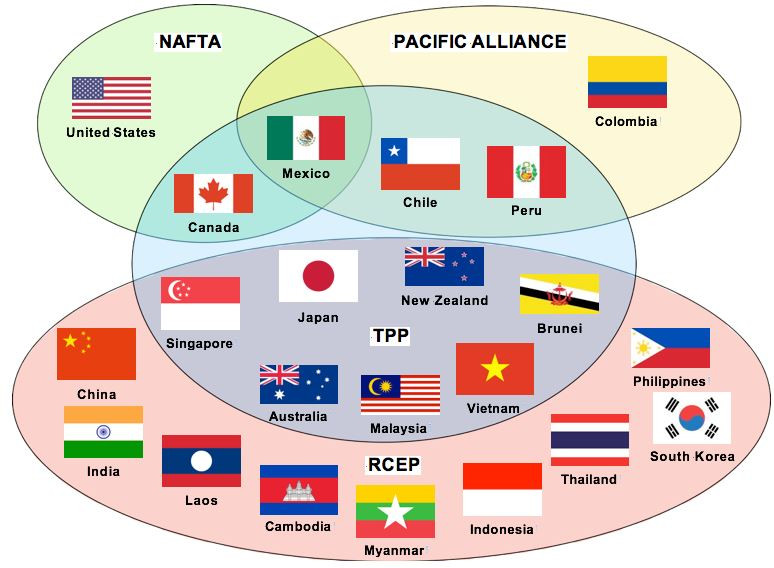 Picture from the New Viet
The Big Four - Comprehensive, Modernity, High-quality, Mutually beneficial
Wang Shouwen, the Vice Minister of MOFCOM (China’s Ministry of Commerce) interprets[v] RCEP is a comprehensive and a modern agreement that features reciprocity and high quality and that's besides the large economic and trade scale that it is.
Comprehensive — With 20 chapters, it covers almost every aspect of free trade, investment and their facilitation, including cargo trade, service trade, investment, competition policy, government procurement, etc. For example, disclosed by “Chapter 4 Customs Procedure and Trade Facilitation”, in general cases, the customs clearance of perishable goods like fruits, and other fresh foods should try to be finished within 6 hours after the arrival of goods and the submission of the provided information. The required materials that need to be provided will also be decreased as much as possible.
Modernity — It adopts the rules of origin to support the industry and supply chain development in the region; By taking advantage of new technologies, customs procedures will be facilitated; the adoption of the negative list for investment access will greatly enhance the transparency of investment policies; In order to meet the demand of digital era, content related to E-commerce and IP protection are also included.
High-quality — Over 90% of cargo trade[vi] can enjoy zero tariffs based on the agreement eventually, which is an improvement even over WTO. To consumers and countries that rely on imported raw materials and parts, the cancellation of tariff tax and non-tariff barriers will lead to a significant reduction of cost. Therefore, consumers can buy imported products at lower prices, and it would also be easier for enterprises to enter the countries in the region. Besides, due to the signing of the RCEP Agreement, China gets to have free trade with South Korea and Japan.
Reciprocity — With members ranging from developed, developing and underdeveloped countries, the RCEP Agreement managed to balance the benefits to satisfy the demands of each party. Preferential policies are provided for underdeveloped countries.
 Influence on Food Industry in South Korea, Japan, China and ANZ Countries, Especially on Dairy, Meat, Fruits, Alcohol Drinks and Pet Food
Details of Japan and South Korea regarding imported foods
The schedules of Japan and S. Korea are quite similar in their tariff tax setting for imported food products. Experts[vii] in China also believe the successful signing of RCEP can promote the establishment of Free-Trade Agreement (FTA) among China, South Korea and Japan.
Out of the protection of domestic manufacturers, both Japan and South Korea exclude following products from any tariff reduction or elimination commitment of this Agreement: meat of bovine animals (fresh/chilled/frozen), meat of swine (except for imported wild boars to Japan), dairy products (South Korea gave the privilege for several products like cheese, dairy spread and whey product for feeding), infant formula, etc.
As for aquatic products and fruits, only a small amount of them can enjoy free tariff tax immediately after the implementation of this Agreement. Others will be subject to an annually reduced tax or be free from the tax reduction commitment of this Agreement.
Imported pet food to Japan and South Korea can enjoy a gradually reduced tariff tax every year. The tariff tax of pet foods exported to Japan will reduce to zero in the 16th year after the implementation, and it’s ten years for pet foods exported to South Korea before they are reduced to zero.
In Japan, imported beer made from malt and spirits are subject to zero tariff tax, and most wine products can enjoy a tax reduction. While in South Korea, none of these alcoholic drink products can be free from the tariff tax. But part of them can enjoy the zero tax from the 10th year onward.
Details of Australia and New Zealand regarding imported foods
Australia sets zero-tariff tax for almost all meat products, aquatic products, fruits, dairy products, infant formula, pet food and beer. Most wine and spirits products are subject to a low tariff tax (within 5%).
New Zealand specifies zero-tariff tax for meat of bovine animals, most aquatic products, all dairy product, and beer. Meat of swine, pet food, most wine and spirits products are subject to a low tariff tax (within 5%).
Details of China regarding imported foods
As for the setting of tariff tax, the situation is very similar to Japan and South Korea. The setting for New Zealand, Australia and ASEAN members share another similar model.
As analyzed below, frozen pork, pet food and its feed additives, beer and spirits are four categories ChemLinked believes will have a broader market exposure in China with faster growth rates.
At the same time, we can also see China’s protective measures on domestic dairy products and infant formula, the tariff tax of which will remain to be 5% for a minimum of 21 years. Different from other countries, ASEAN members can enjoy a reduced tax reduction annually on dairy products.
To countries that have signed the FTA with China before, if there is no explanation specified in the following official document, then FTA will still work for certain products.
For countries | Beef (chilled, fresh, frozen) | Pork (chilled, fresh, frozen) | Other meat products | Aquatic products | Dairy products | Infant formula | Pet foods | Fruit | Alcoholic drinks |
Japan | Excluded from the tax reduction or elimination commitment of this Agreement | Tax reduction (most of them will be reduced to 0% tariff tax in the 16th year) | Tax reduction (most of them will be reduced to 0% tariff tax in the 16th year) | Tax reduction (most of them will be reduced to 0% tariff tax in the 11th year) | Excluded from the tax reduction commitment (except for whey product, butter and cheese) | Excluded from the tax reduction or elimination commitment of this Agreement | Tax reduction (will be reduced to 0% tariff tax in the 11th year) | Tax reduction | 0% tariff tax for beer;
Most wine and spirits are subject to tax reduction. |
South Korea | Tax reduction (most of them will be reduced to 0% tariff tax in the 10th year) | Tax reduction (will be reduced to 0% tariff tax in the 10th year) | |||||||
Australia | Excluded from the tax reduction or elimination commitment of this Agreement | 0% for frozen pork; Chilled and fresh pork enjoy the tax reduction (reduced to 0% tariff tax in the 10th year) | Tax reduction (most of them will be reduced to 0% tariff tax in the 10th year) | Zero tariff tax to a large number of aquatic products | Tax reduction (some of them remain the same tariff tax in the first ten years) | 5% for 21 years minimum | 0% | Tax reduction; Many enjoy 0% tariff tax | 0% for beer and most of the spirits; tax reduction for wine products |
New Zealand | Tax reduction | ||||||||
ASEAN countries | Tax reduction; some are subject to zero tariff tax | Tax reduction | |||||||
Check the schedules of ASEAN countries here.
When will it Come into Effect?
After being signed, the RCEP agreement still needs to undergo the law approval procedures in each RCEP member countries. The RCEP Agreement will enter into force 60 days after six ASEAN Member States and three non-ASEAN Member States[viii] have ratified the Agreement.
 We provide full-scale global food market entry services (including product registration, ingredient review, regulatory consultation, customized training, market research, branding strategy). Please contact us to discuss how we can help you by