Request a Demo
Terms:
Free Trade Port: There is no unified definition, but it generally refers to a special economic area located in a country/region which falls outside standard customs administration in which trade activities are subject to specific exemptions and where people, products, and capital flow are subject to free entry and exit. Most products are exempt from import duties.
Single Window: All parties involved in international trade and transportation can submit documents or electronic data required for import, export, or transshipment of products to various government agencies through a single platform.
Combined Transport B/L: A document issued by the intermodal operator to the cargo shipper that certifies that the goods have been received and is responsible for the entire transportation when handling container transportation.
On June 1, 2020, the Central Committee of the Communist Party of China and the State Council issued the Master Plan for Hainan Free Trade Port to support the establishment of a Free Trade Port System in steps and stages [1].
Hainan Free Trade Port Law, the laws and regulations of the Special Economic Zone, and a diversified commercial dispute resolution mechanism are expected to be enacted in the future.
Key Policies in the Master Plan
1. Product Import and Export Management
1) Policies between Hainan Free Trade Port and Countries/Regions outside the Chinese Mainland
Formulate the list of products that are prohibited or restricted from import and export in the Hainan Free Trade Zone. Products outside the list can be imported or exported freely. |
|
Special shipments shipped with Combined Transport B/L are not taxed or inspected. |
Transshipment goods shipped from overseas, reloading, sorting and assembling through Hainan Free Trade Port, then shipped to other countries or regions, the customs procedures can be simplified. There is no limitation on the storage period and location. |
Implement convenient and efficient customs supervision and establish a “Single Window”for international trade. |
2) Policies between Hainan Free Trade Port and the Rest of the Chinese Mainland
Products entering the rest of the Chinese Mainland from the Hainan Free Trade Port will, in principle, go through the relevant procedures following the import regulations, and levy taxes under rules.
Imported products consumed by residents in Hainan are subject to positive list management, allowing duty-free purchase. The quota for offshore duty-free shopping is raised to 100,000 RMB (14,062 USD) per person per year, and the variety of duty-free products will be expanded. |
Products manufactured by encouraged enterprises without imported materials or products whose added value exceeds 30% after the domestic processing of imported intermediary products are exempt from taxes when entering the rest of the Chinese Mainland. |
Postal items entering the rest of the Chinese Mainland from the Hainan Free Trade Port are taxed according to relevant regulations. |
Facilitate customs clearance and strengthen transportation between the rest of the Chinese Mainland and Hainan Free Trade Port through more air routes and ship registration support. |
2. Investment in Hainan Free Trade Port
1) Significantly relax market access for Hainan Free Trade Port
For industries with compulsory standards, replace the licenses and reviews with filing management. As long as the market entities commit to meet the requirements and submit required documents, the investment and business activities can be conducted.
Implementation of pre-market national treatment plus negative list management for foreign investment, significantly reducing prohibition and restriction clauses.
Focus on process supervision, provide enterprises with establishment facilitation based on electronic licenses, operation, cancellation, and bankruptcy facilitation.
2) Simplify the tax system and lower the tax rate. Enterprises that are operating in Hainan Free Trade Port enjoy preferential tax rates.
The Master Plan also details requirements on the cross-border capital flows, people and transportation liberalization, and facilitation, secure and orderly flow of data, the modern industrial system, social governance, risk prevention, and control, etc.
"The special policy of the Hainan free trade port is of great significance, especially given the impact of the COVID-19 pandemic. It reflects China's firm determination to expand its opening up and will bring more opportunities to global investors," said Han Shengjian, director of the Hainan International Economic Development Bureau [2].
Implementation Timeline
Li Shijie, deputy dean at the School of Economics at Hainan University, pointed out that the construction of the Hainan Free Trade Port will take at least 5-10 years. The initial stage will start with the pilot operation, allowing the free flow of products, people, capital, and data in specific zones such as the Yangpu Economic Development Zone, Haikou Comprehensive Bonded Zone, Boao International Medical Pioneer Zone [3]. Timeline specified in the Master Plan is as follows:
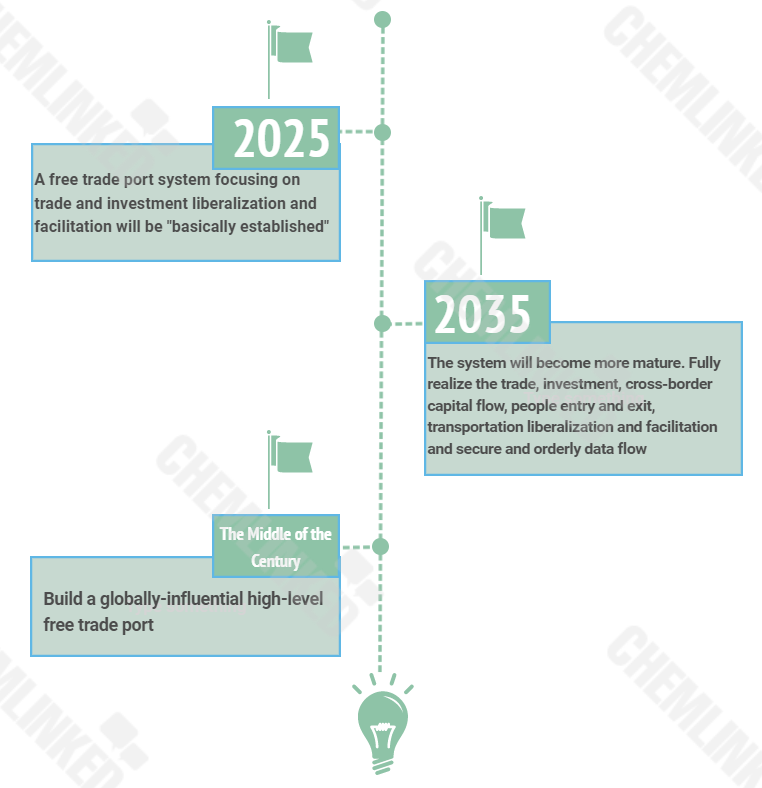
Some Measures Implemented or to be Implemented by 2025
Imported products consumed by residents in Hainan are subject to positive list management, allowing duty-free purchase. The quota for offshore duty-free shopping is raised to 100,000 RMB (14,062 USD) per person per year, and the variety of duty-free products will be expanded.
Designated imported products are subject to the "Zero-Tariff” policy.
Items | Management Model | Note |
Imported raw and auxiliary materials for production | "Zero-Tariff" positive list | Exempt from the import duties, import VAT and consumption tax |
Imported production equipment for own use | "Zero-Tariff" negative list | |
*Except for the products not subject to tax exemption and prohibited from import stipulated by laws and regulations | ||
Formulate and enact Catalogue of Imported Taxable Products, List of Products Restricted or Prohibited from Importation, and List of Products Restricted or Prohibited from Exportation.
Clarify the documents’ format and operation rules of customs clearance between Hainan Free Trade Port and the rest of the Chinese Mainland.
Hold China International Consumer Products Expo. Overseas exhibit imports and sales enjoy tax exemptions during the exhibitions.
Simplify the investment system and formulate a special list of sectors subject to relaxed market access and a negative list for foreign investment access to Hainan Free Trade Port.
Encouraged industrial enterprises registered and operated in Hainan Free Trade Port, the corporate income tax will be reduced to 15%. Enterprises will be exempt from corporate tax on income from new foreign direct investment for tourism, modern services, and high-tech industry enterprises.
Implement more open shipping and air transport policies.
 We provide full-scale global food market entry services (including product registration, ingredient review, regulatory consultation, customized training, market research, branding strategy). Please contact us to discuss how we can help you by