Request a Demo
Editor's Note: This article summarizes the latest legislative progress discussions in Japanese food contact materials regulation, as per the latest developments. Previous contents can be seen at the bottom of the article.
According to the latest meeting discussion process on March 19, 2024, Japan is planning to revise the Positive List, including synthetic resins and their additives.
Synthetic resins
For the management of base resins, the initial list of substances regulated as per polymer form has been continuously integrated and revised. The management approach in the current plan will be updated to a model that classifies substances according to monomer/raw material form.
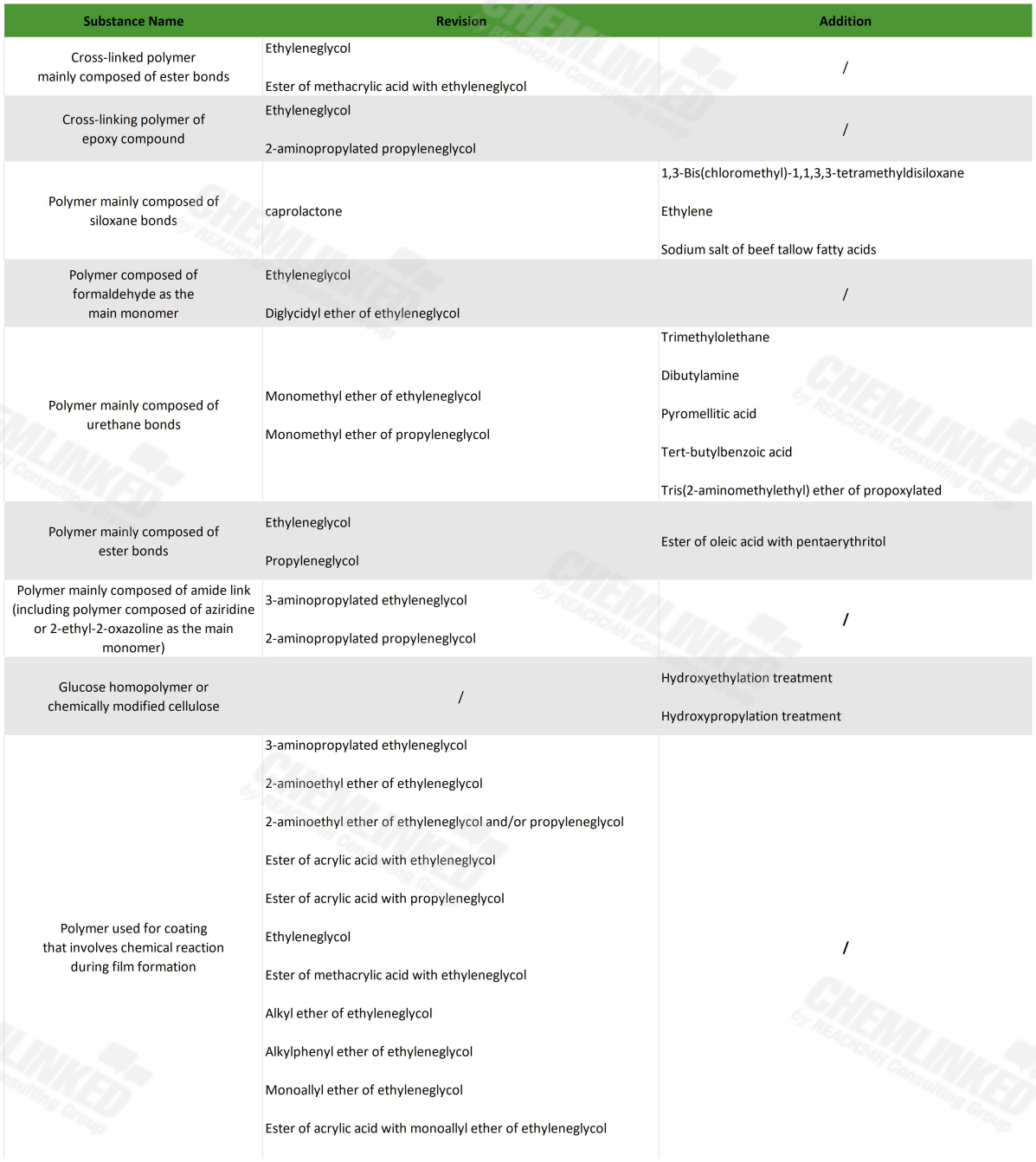
The discussion outcomes indicate that revisions will be made to the classification descriptions and monomer/raw material requirements for various resin categories listed in Appendix 1 of the synthetic resin list. Furthermore, some substances will be newly added to the list. Here are the specific details:
Additives
The Positive List of additives was updated to include new categories of additives, along with changes in usage restrictions for multiple substances and usage limits within different polymer groups.
Proposed addition of 13 new additives
Serial No. | Substance name |
828 | Polymer mainly composed of 2-hydroxyethyl acrylate / butyl acrylate |
829 | Polymer mainly composed of indene / benzofuran |
830 | Ester of sulfosuccinic acid with ethoxylated alkyl alcohol, sodium salt |
831 | Polymer mainly composed of epichlorohydrin / bisphenol A |
832 | Amide of oleic acid with tetraethylenepentaamine |
833 | Hydrolyzed N-[3-(trialkoxysilyl)propyl]-ethylenediamine |
834 | Polymer mainly composed of xylene / formaldehyde |
835 | Acetic acid, cobalt salt |
836 | Polymer mainly composed of vinyl acetate / dicyclopentadiene |
837 | Polymer mainly composed of dimethyl siloxane / 3-hydroxypropylmethylsiloxane / hydroxymethylsiloxane / methylsilsesquioxane and/or methylhydrosiloxane |
838 | (2-ethylhexyl thioglycolate) mono-n-octyltin sulfide |
839 | Bis(nonylphenyl)amine |
840 | Sodium N-hydroxyethyl-ethylenediaminetriacetate |
Proposed restrictions on one additive
The restriction indicating "It is limited to ethylene oxide and/or propylene oxide adducts with a total of four or more units" for ethoxylated and/or propoxylated glycerol will be removed.
Proposed updates to usage limits of 3 additives in different polymer groups
Serial No. | Substance name | CAS Registry No. | Use limit by Polymer Group | |||||
Polymer Group 1 | Polymer Group 2 | Polymer Group 3 | Polymer Group 4 | Polymer Group 5a | Polymer Group 5b | |||
129 | polymer mainly composed of 2-ethylhexyl acrylate / diethylenetriamine / valerolactone / 2-phenoxyethanol / hexamethylene diisocyanate, ethoxylated and/or propoxylated | 1428963-42-1 | 3.0
Modified to 5.0 | 2.0
Modified to 5.0 | 4.0
Modified to 5.0 | -
Modified to 5.0 | 4.0
Modified to 5.0 | 4.0
Modified to 5.0 |
147 | polymer mainly composed of toluene diisocyanate / butanol / N,N-dimethyl-1,3-propanediamine, ethoxylated and/or propoxylated | 0162568-21-0 | 0.90 Modified to 0.95 | 0.30
Modified to 0.40 | 2.0 | - | 2.0 | 2.0 |
698 | dibutyl fumarate | 0000105-75-9 | 1.6 | 1.0 | 0.50
Modified to 1.0 | - | 1.6 | 1.0 |
a. heat resistant temperature: ≧150℃ b. heat resistant temperature: < 150℃ | ||||||||
 We provide full-scale global food market entry services (including product registration, ingredient review, regulatory consultation, customized training, market research, branding strategy). Please contact us to discuss how we can help you by