Request a Demo
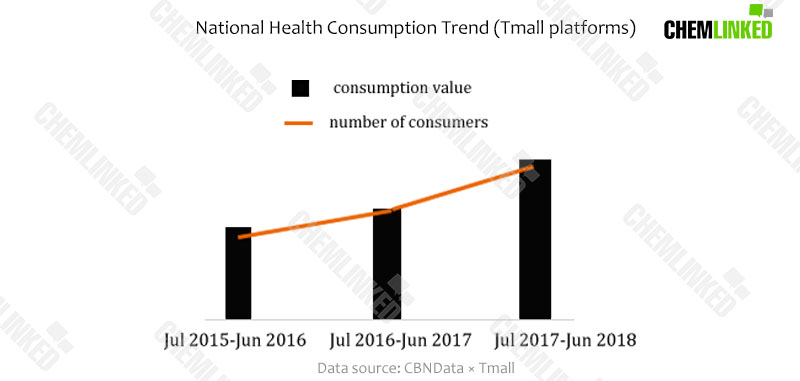
A consumption report jointly released by CBNData and Tmall Global shows the growing popularity of health-related products on cross-border ecommerce platform Tmall Global. [1]
Those born in the 1980s and 1990s are major consumers of health-related foods/products. Sales value driven by the post-95s outstripped other groups, reflecting the overwhelming importance attached to health and wellness by China’s young generations.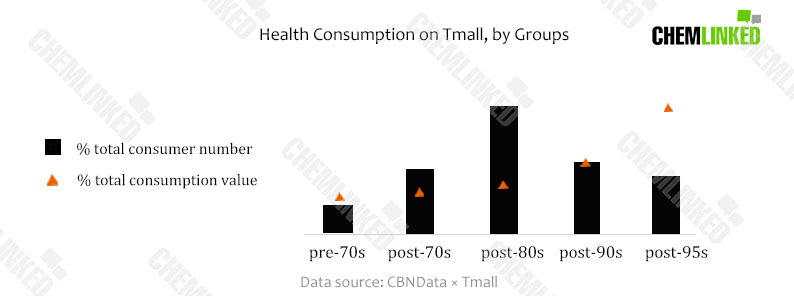 Those born in the 1980s and 1990s are major consumers of health-related foods/products. Sales value driven by the post-95s outstripped other groups, reflecting the overwhelming importance attached to health and wellness by China’s young generations.
Top 10 Imported Health Related Foods List
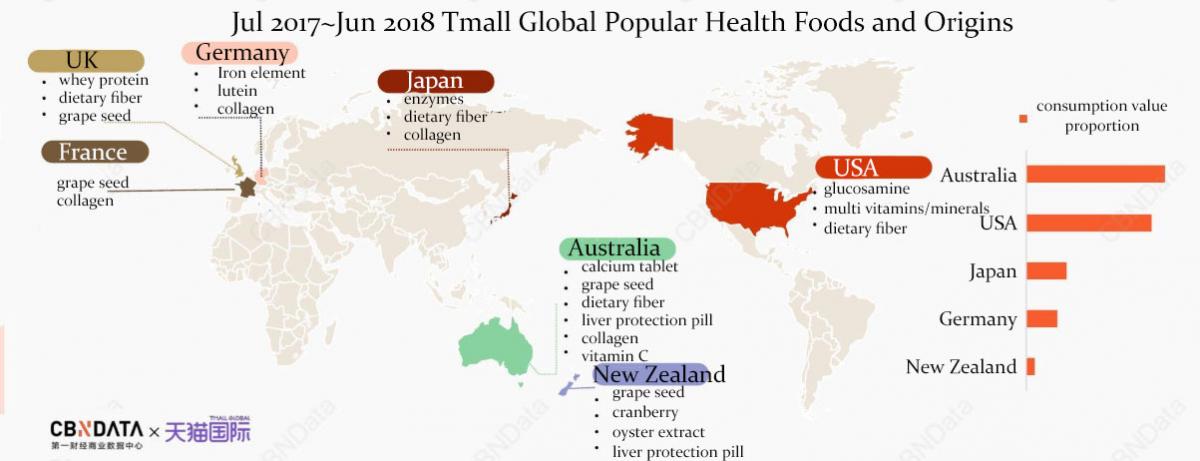
In all segments of health-related foods sold on Tmall Global, calcium supplements, vitamin C, and multi-vitamin/mineral supplements ranked #3, #4, #8 by consumer number.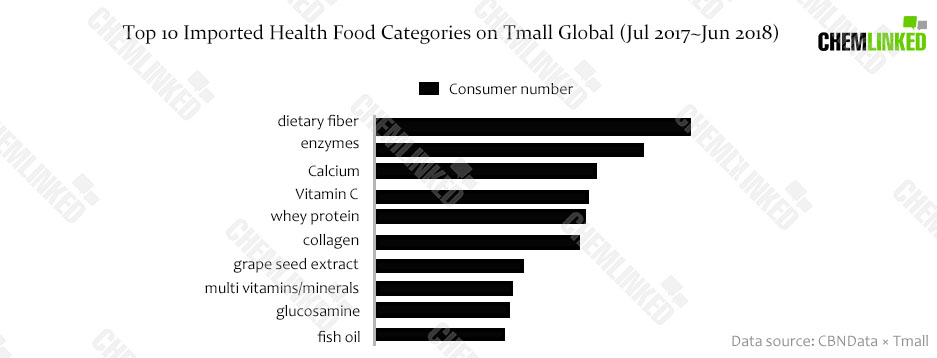 Australia, America and Germany were major exporters of nutrient supplements sold on China’s cross-border ecommerce platforms.
 Sales data derived from cross-border ecommerce transactions is a useful surrogate marker for trends and changes in consumer preference in the wider Chinese market. The reason is that when compared with the wider domestic market in China, CBEC is a much purer business environment with less trade barriers (registration/filing of special foods, compliance with Chinese quality and labeling standards are not required). CBEC offers consumers unfettered access to a wide range of imported products and the freedom to buy things based solely on labels, claims, packages, advertisement or brand reputation. This contrasts sharply with the situation in bricks and mortar retail in which the government tightly regulates the sector and only allows sale of certified products bearing the “blue hat” certification mark. According to one report, over 98% of Chinese consumers pay attention to nutrition labels when purchasing foods, and roughly 75% consumers would alter a purchasing decision based on the nutritional information.[2]
Blue Hat Certified Products Vs Non-Blue Hat
China has two broad categories of foods bearing the “Blue Hat” certification mark namely health foods and nutrient supplements. Health foods are products bearing the certification mark and one of twenty-seven health related labeling claims purporting to alter a specific physiological parameter or reduce or improve specific disease risk factors. Nutrient supplements also use the certification mark and are basically vitamin/mineral supplements that supply a standardized amount of a specific vitamin or mineral.
Outside of these two regulated categories there are also general foods which can also bear health related labeling claims, specifically nutrient content claims and nutrient function claims. These products do not require registration or filing, however the nutrient claims used must comply with the stipulations laid down in China’s nutritional labeling of prepackaged food standard, GB28050. The table below helps illustrate some of the key distinctions between Blue Hat certified health food/nutrient supplement products and general foods with health claims.
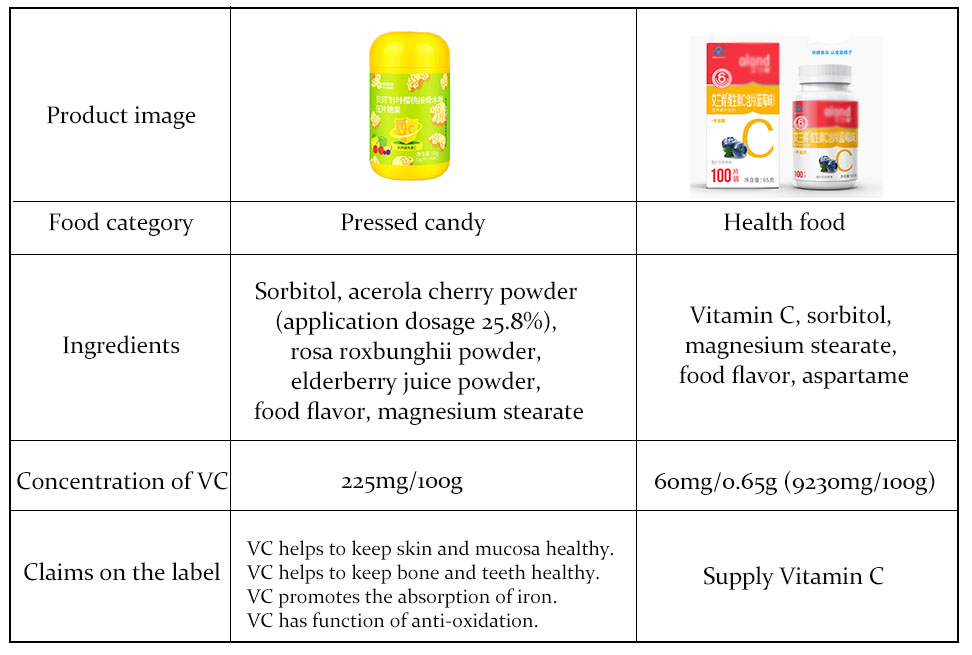 The difference between function claims of blue hat products such as “supplement Calcium” and nutrient function claims of general food such as “Vitamin E has antioxidant properties” lies in the subject of the claim.
| Type | Blue-hat nutrient fortifier | Non-blue hat products |
| Claim | supplement Calcium | Vitamin E can anti oxidation |
| Subject of the claim | The Product | The nutrient |
GB 28050-2011 National Food Safety Standard General Rules for Nutrition Labeling of Prepackaged Foods is applicable to prepackaged food except for health food and special dietary food. Products that are rich in certain nutrients usually will highlight nutrition concentration and function of these nutrients, which should comply with the following requirements:[3]
| Labeling item | Expression | Requirements for concentration | Limitations |
| Vitamins | Vitamin X source or contain Vitamin X | Per 100g: ≥15% NRV Per 100mL: ≥7.5% NRV Per 420kJ: ≥5% NRV | Containing “multiple vitamins” refers to three or more vitamins that comply with the concentration requirements |
| High concentration of Vitamin X | Per 100g: ≥30% NRV Per 100mL: ≥15% NRV Per 420kJ: ≥10% NRV | Having high concentration of “multiple vitamins” refers to three or more vitamins that comply with the concentration requirements | |
| Minerals (except for sodium) | X source or contain X | Per 100g: ≥15% NRV Per 100mL: ≥7.5% NRV Per 420kJ: ≥5% NRV | Containing “multiple minerals” refers to three or more minerals that comply with the concentration requirements |
| High concentration of X | Per 100g: ≥30% NRV Per 100mL: ≥15% NRV Per 420kJ: ≥10% NRV | Having high concentration of “multiple minerals” refers to three or more minerals that comply with the concentration requirements |
If the concentration of specific nutrients in a product reaches a minimum of 15% NRV per 100g (or 7.5% NRV per 100mL or 5% NRV per 420kJ), the product is eligible to use nutrient content and nutrient function claims, as per the stipulations laid down in GB 28050 Appendix D.
Appendix D Standard Expressions of Function Claims Regarding Energy and Nutrients (excerpt)
| Nutrient | Function claim (in Chinese) | Function claim (in English) |
| Vitamin A | 维生素 A 有助于维持暗视力。 维生素 A 有助于维持皮肤和黏膜健康。 | Vitamin A helps maintain darkness visual acuity Vitamin A helps maintain health of skin and mucosa |
| Vitamin D | 维生素 D 可促进钙的吸收。 维生素 D 有助于骨骼和牙齿的健康。 维生素 D 有助于骨骼形成。 | Vitamin D facilitates absorption of calcium. Vitamin D is good to bone and tooth health. Vitamin D helps formation of bones. |
| Vitamin E | 维生素 E 有抗氧化作用。 | Vitamin E features anti-oxidation function. |
| Vitamin B2 | 维生素 B2有助于维持皮肤和黏膜健康。 维生素 B2是能量代谢中不可缺少的成分。 | Vitamin B2 helps maintain the health of skin and mucosa. Vitamin B2 is an indispensable component for energy metabolism. |
| Vitamin B6 | 维生素 B6有助于蛋白质的代谢和利用。 | Vitamin B6 helps metabolism and use of protein. |
| Nicotinic acid B3 (Niacin) | 烟酸有助于维持皮肤和黏膜健康。 烟酸是能量代谢中不可缺少的成分。 烟酸有助于维持神经系统的健康。 | Nicotinic acid helps maintain the health of skin and mucosa. Nicotinic acid is an indispensable component for energy metabolism. Nicotinic acid helps maintain the health of neural system. |
| Folic acid | 叶酸有助于胎儿大脑和神经系统的正常发育。 叶酸有助于红细胞形成。 叶酸有助于胎儿正常发育。 | Folic acid helps development of brain and neural system of the fetus Folic acid helps the formation of RBC. Folic acid helps the development of the fetus |
| Calcium | 钙是人体骨骼和牙齿的主要组成成分,许多生理功能也需要钙的参与。 钙是骨骼和牙齿的主要成分,并维持骨密度。 钙有助于骨骼和牙齿的发育。 钙有助于骨骼和牙齿更坚固。 | Calcium is the major component for human bone and tooth; many physiological functions require calcium. Calcium is the major component of bone and tooth, and it maintains bone density. Calcium helps development of bone and tooth. Calcium makes the bone and teeth firmer. |
| For full list, please refer to GB 28050 | ||
To be noted, when using function claims of nutrient(s) (except for protein, fat, carbohydrate and sodium), “nutrition facts” table should also include the concentration and its ratio to daily nutrition reference value, for example: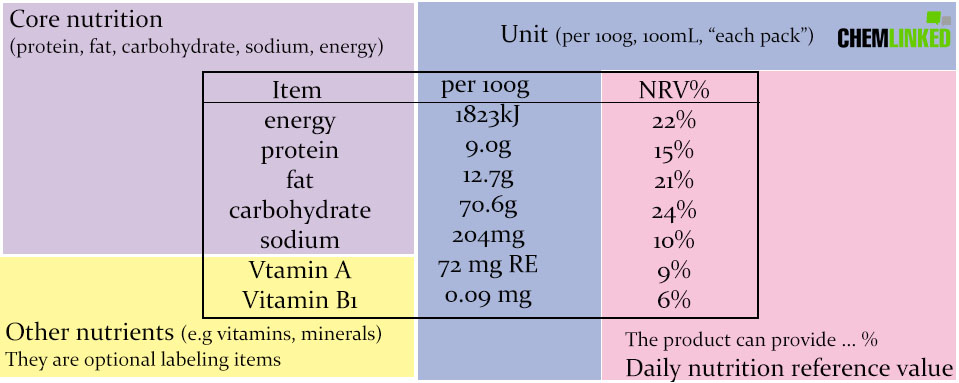
Briefing of Discussion with Food Regulatory Expert
To help us figure out the key differences between Blue Hat health foods and general foods with function claims ChemLinked interviewed Rock Luo, a food regulatory expert of REACH24H Consulting Group.
Q: As you can see, the pressed candy product and the health food (as mentioned above in this passage) both have a high concentration of Vitamin C, can the pressed candy product apply for blue hat mark through filing?
A: After analyzing the ingredients in the pressed candy we can see one of its raw materials is acerola cherry which is not in the Directory of Health Food Raw Materials. Inclusion in this directory is a prerequisite for filing, meaning the product would require registration to use the blue hat mark. To gain a health food certificate, a product must comply with standards including daily intake amount (refer to table below).
| Name of raw material | Daily dose | Function | ||||||
| Vitamin C | L-ascorbic acid | GB14754 | All groups | Vitamin (on L-ascorbic acid basis, mg) | 1—3 | 6 | 60 | Supplement Vitamin C |
| 4—6 | 10 | 100 | ||||||
| L-Ascorbic Acid Sodium Salt | GB1886.44 | All groups | 7—10 | 10 | 100 | |||
| 11—13 | 15 | 150 | ||||||
| L-Ascorbic acid Calcium salt | GB1886.43 | All groups | 14—17 | 20 | 200 | |||
| adult | 30 | 500 | ||||||
| Ascorbyl palmitate | GB1886.230 | Groups aged over 4 | pregnant | 25 | 250 | |||
| lactating | 30 | 300 | ||||||
Q: What if that health product had not undergone filing and did not use the blue hat mark? Can it be sold as a general food?
A: In a general food product, Vitamin C as a nutrition fortifier should be used within certain range, for example, 1000mg/kg~6000mg/kg in pressed candy according to GB 14880 National Food Safety Standard for the Use of Nutritional Fortification Substances. In this case, this product fails to meet the nutrition fortifier standard and would not be eligible for classification as a general food.[4]
Q: What advantages do a blue hat health-food have over a fortified general food bearing a nutrient function claim?
A: This is really a perceptional issue with specific relevance to consumer purchasing preferences. Chinese consumers particularly older generations place a great deal of value in the blue hat certification mark. Another important distinction is that Blue Hat products can be sold through certain high value retail channels such as pharmacies.
 We provide full-scale global food market entry services (including product registration, ingredient review, regulatory consultation, customized training, market research, branding strategy). Please contact us to discuss how we can help you by