Request a Demo
April 27, 2015 saw the official release of the revised China Food Safety Law (FSL) after 2 years of legislative development. The new FSL contains 10 chapters consisting of 154 articles, 50 more than the previous one. Compared to the current law when promulgated the new food safety law will impose a more comprehensive, rigorous and stringent legislative framework to more efficiently and safely regulate food in China.
Major differences between the old and new Food Safety Law
Old | New |
Multi governmental bodies are involved in supervising different sections of food supply chain: | Consolidating food administration powers under the roof of CFDA CFDA will be responsible for regulating all links of China’s food supply chain including production, operation, distribution and post-market surveillance (in article 4). |
National Food Safety Standards (NFSS) are only promulgated by NHFPC (former MOH). | CFDA and NHFPC will co-formulate NFSS (in article 4). |
No requirement for media coverage | The dissemination of exaggerated or false reports made by various media in order to attract public attention has had a negative impact on accurate reporting of food safety issues in China. Under the new law there are specific requirements on how media should conduct itself mandating that publications about food safety must reflect the truth and be impartial. |
No requirement for use of pesticides | Stringent control over use of pesticides Hyper and highly toxic pesticides are prohibited to be applied on corps including vegetables, melons and fruit, tea and Chinese medicinal herbs (in article 49). Effective and low toxic pesticides are encouraged to be applied (in article 11). |
No requirement for e-commerce food | The e-commerce platform providers should review the licenses of food store owners and implement real-name registration system (in article 62). What about imported food sold through cross-border ecommerce sites? The new law doesn’t mention any rules for foods from this channel so at least at this moment these foods will be exempted from the existing imported food regulatory system. According to a local CIQ officer, they do not inspect these foods as consumers normally buy the overseas foods having well-established reputation and good quality abroad. The safety and quality is not a problem. In addition, foods available on the cross-border e-commerce platforms are delivered to consumers directly by express. The flow of foods is recorded. |
No article for labelling of GM food | The GM food should be clearly indicated on labels according to relevant regulations (in Article 69). The vague and chaotic labelling of GM food has been a problem criticized by the public for years, who are longing for an improvement (see CL food news on 25 Sep 2014). |
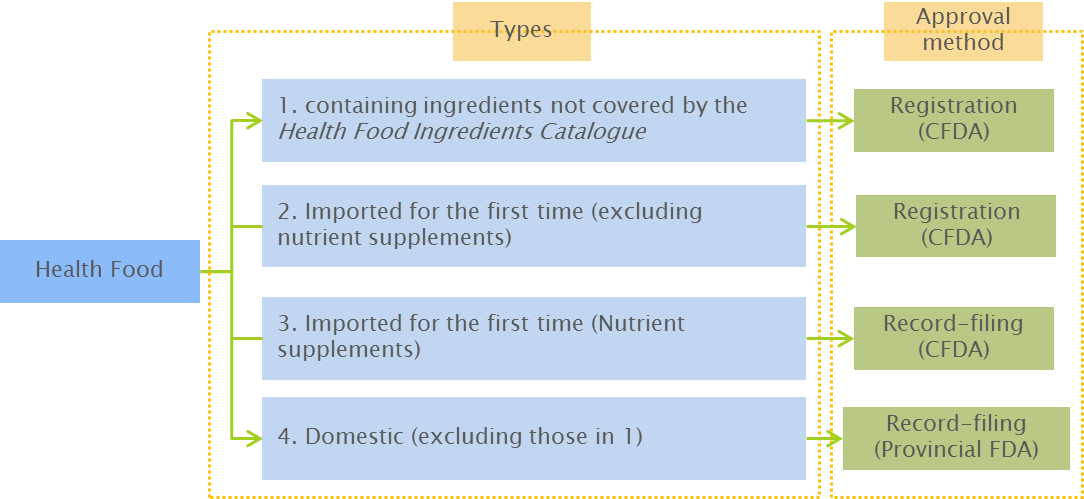
All Health foods should be CFDA-registered. | CFDA will formulate a Health Food Ingredients Catalogue (positive list) detailing the names, dosage and efficacy information of health food ingredients and a new list of permitted claims for health foods. Ingredients listed in the Catalogue will only be allowed for health food use (in article 75). Unlike the existing registration system applied to all health foods, the new regulatory scheme will reduce approval requirements (in article 76). Table 1. Health Food Approval under China’s New FSL
Health food claims is also an emphasis of the new regulation. Any statements relating to disease prevention and treatment on labels or instructions are forbidden and the precautionary statement “The product cannot replace medicine” also needs to be used (in article 78). |
No registration requirement for formula foods for special medical purposes. GB 29922-2013 is the product standard to comply with. | This type of food are required to be registered with CFDA by submitting product formula, production technic, labels, instructions for use and supporting materials for product safety, nutrition adequacy and the clinical effects (in article 80). |
No article for infant formula | Article 81 is specially formulated for infant formula, indicating the government’s strong determination to overhaul the industry and remodel the current undesirable image of domestic products. The following are newly raised requirements for domestic infant formula manufacturers:
|
Imported food without existing national standard should be approved by NHFPC according to Provisions on the Administration of Permits for Import Foods without Governing National Food Safety Standards | A large number of foods that are intended to be exported to China cannot get in due to absence of existing national standards. To gain a pre-market approval from NHFPC is a very technical, arduous and costly process. Under the New FSL, the good news for this type of foods is that NHFPC may temporarily adopt suitable standards formulated by the country where the imported foods come from or other available international standards to solve the problem caused by regulatory gaps (in article 29). |
| No article for food traceability | China is to establish a food traceability systems to cover the entire food supply chain. Food producers and traders shall establish a food traceability system pursuant to provisions of this Law to guarantee traceability of foods. They are encouraged to adopt information technology measures in retaining production and trading information, and establishing a stable food traceability. CFDA will work with MOA and relevant departments to establish a coordinated traceability system for the whole process of food safety (in article 42). |
The new FSL will come into force as of 1 Oct. 2015. Upgraded regulations and more severe penalties are indispensable for ensuring China’s food safety at this stage but what’s more expected to see is the growing conscience and sense of social responsibility of every food company.
 We provide full-scale global food market entry services (including product registration, ingredient review, regulatory consultation, customized training, market research, branding strategy). Please contact us to discuss how we can help you by