Request a Demo
The establishment of Administrative Provisions on Nutrient Supplement (hereinafter Provisions) and Requirements of Application Dossiers (Hereinafter Requirements) can be regarded as the basis of notification scheme to be launched for nutrient supplements in future. The most important rules set out in the two drafts include the revision of positive lists and instruction for the preparation of application dossiers.
Contents |
1. What is “Nutrient Supplement”?
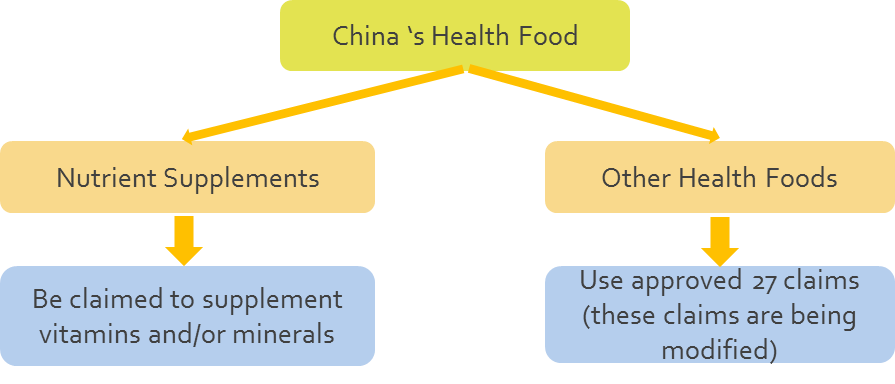
China categorizes nutrient supplements as single substance vitamin and mineral supplements as well as vitamin and mineral complexes. It is a category of China’s health food. Supplements can only carry claims purporting to supplement normal vitamins and/or minerals intake.
Figure 1. Categories of China's Health Food
2. Regulatory Instruments
Figure 2 Nutrient supplements regulatory instruments in accordance with Chinese legal hierarchy
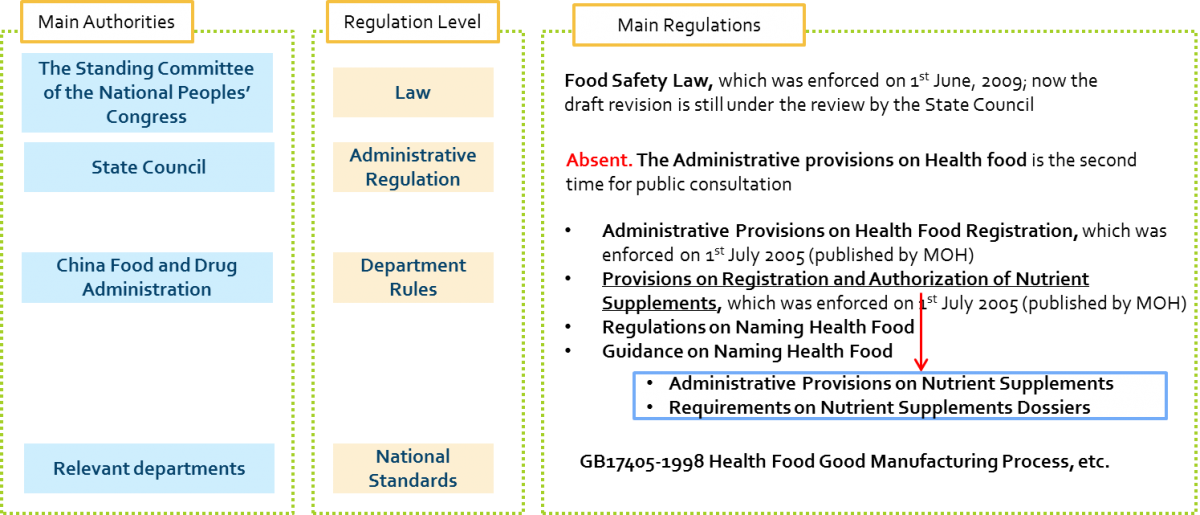
As Figure 2 indicated, the Food Safety Law of People’s Republic of China is the foundation of all regulations and rules pertaining to food. This year’s draft amendment has passed an initial consultation period and is pending promulgation. On the second level, there are no administrative regulations for health foods. The third level concerns department rules. Currently, Administrative Provisions on Health Food Registration establishes a framework for CFDA regulation of nutrient supplements and all other health foods. The forth level relates to normative documents. With regard to the regulation of nutrient supplement, Provisions on Registration and Authorization of Nutrient Supplements plays a vital role and forms the basis for the draft of Provisions and Requirements. After promulgated, Provisions and Requirements are to supplement the above instruments. Administrative Provisions on Nutrient Supplements and Requirements on Nutrient Supplements Dossiers are released for public consultation. The two regulations establish strict technical standards for the nutrient supplements registration.
3. Analysis of Positive Lists Established by Provisions
The most important rules laid down in Provisions include the inclusion of a positive list of additive materials and the modification of the effective positive lists relating to vitamins and minerals as well as chemical substances used as sources of vitamins and minerals in the manufacture of food supplements. Table 1 compares the positive lists in force and their revisions established by draft of Provisions. Furthermore, revised positive lists are comparable to that established for the European vitamin and mineral supplements as regulated by 2002/46/EC. A comparison between the two frameworks is discussed in Table 2.
Table 1: Changes of Positive List Relating to Minerals and Vitamins Used in the Manufacture of Nutrient Supplements
| Provisions | Provisions on Registration and Authorization of Nutrient Supplements | Draft of Provisions | Comparison |
| Positive list। | Categories and Dosages of Vitamins and Minerals |
Categories and Dosages of Nutrient Supplements (Annex ।) | 1. Effective provisions only address the daily recommended intake of vitamins and minerals for adults while draft of Provisions added another 10 groups, including the pregnant, lactating mothers and people less than 18-year old on the basis of the nutrient intake status of Chinese people. |
| 2. The categories of minerals remain the same, amounting to 10 categories whereas that of vitamins reach 17 from 16 due to Vitamin E was divided into natural and synthetic. | |||
| 3. Upper and low safety limits on daily intake of some vitamins and minerals were modified. | |||
| Positive list ॥ | Compound List of Vitamins and Minerals |
Compound List and Quality Requirements of Nutrient Supplements (Annex ॥) | 1. Effective provisions contain 25* vitamins and minerals as well as 111 chemical substances. In contrast, draft of Provisions contain 23 vitamins and minerals with Mo and Cr excluded as well as 57 chemical substances. |
| 2. Each compound was accompanied with its testing method , taking into account National Food Safety Standards. | |||
| Positive list III | Absent |
List and Quality Requirement of Nutrient Supplements (for infant) (Annex III) | Compared to the counterpart list not intended for infant, 9 compounds were removed, which are calcium pantothenate, ferrous lactate, ferrous succinate, calcium lactate, calcium acetate, calcium ascorbate, calcium dihydrogen phosphate, potassium lactate and potassium. |
| Positive list IV | Absent |
List of Additive Materials Approved for the Use of Health Food (Annex IV) | 222 **additive materials were approved for the use in health food. Most of them are approved food additives confined to Chinese standard GB2760-2011 and the rest are food. |
Note: * Vitamin A and β—carotenes were counted separately. **Several substances may appear twice due to the way to organize them.
Table 2: Comparison between China’s and European Positive List Relating to Minerals and Vitamins Used in the Manufacture of Nutrient Supplements
| Provisions | Directive 2002/46/EC on Food Supplements | Draft of Provisions | Comparison |
| Positive list। |
Vitamins and Minerals which may be used in the manufacture of food supplements (Annex ।) |
Categories and Dosages of Nutrient Supplements (Annex ।) | 1. European List contains iodine, sodium, fluoride, chloride, phosphorus and other 10 minerals included in the China's list as well. |
| 2. China's list contains nicotinamide, choline, β—carotene and other 13 vitamins on the European list. | |||
| Positive list ॥ |
Vitamin and mineral substances which may be used in the manufacture of food supplements (Annex ॥) |
Compound List and Quality Requirements of Nutrient Supplements (Annex ॥) | 1.Regarding vitamin substances, China's list specifies 13 categories of vitamins while European list has an extra one-biotin. Besides, the former details 24 vitamin substances whereas the latter contains 32 vitamin substances. |
| 2. Regarding mineral substances, China's list grants 10 categories of minerals, amounting to 33 substances. By contrast, European list approves 80 mineral substances that can be used in food supplements. | |||
| Positive list III | Absent |
List and Quality Requirement of Nutrient Supplements (for infant) (Annex III) | |
| Positive list IV | Absent |
List of Additive Materials Approved for the Use of Health Food (Annex IV) | 222 **additive materials were approve for health food. Most of them are approved food additives confined to Chinese standard GB2760-2011 and the rest are food. |
4. Introduction of Requirements on Nutrient Supplements Dossier
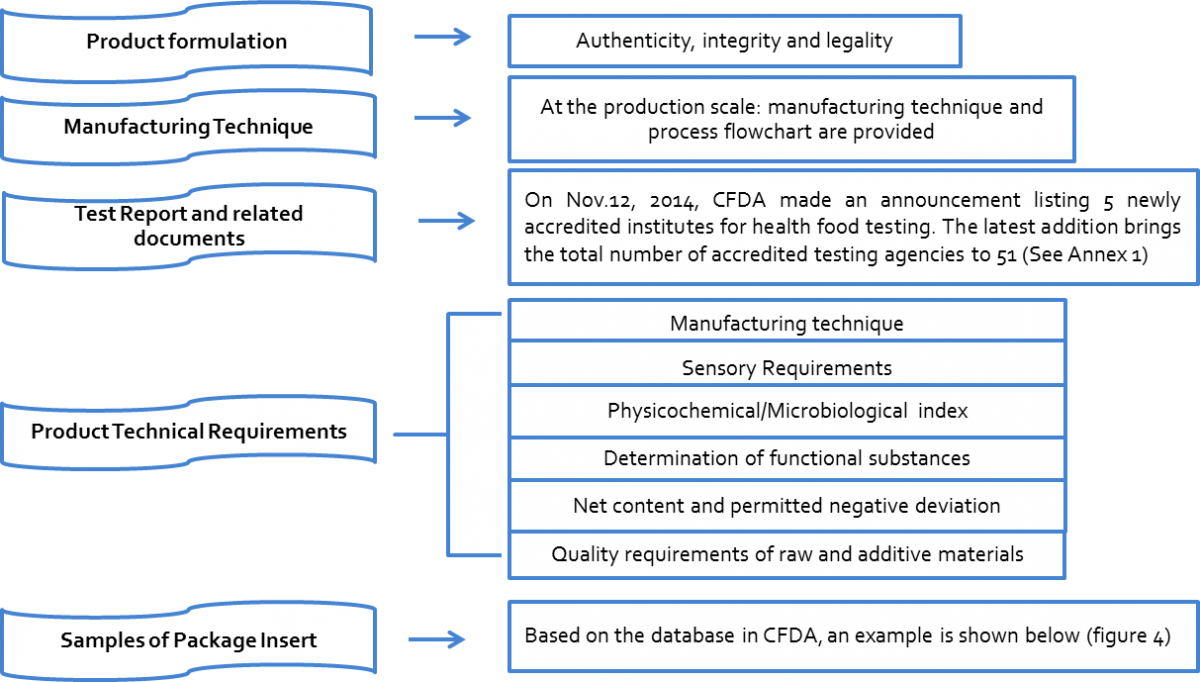
Figure. 4 Example of Package Insert
Terminology and definitions:
Multi-Vitamins/Multi-minerals supplements: Only if three or more vitamins or minerals are contained in the product, it is qualified for being named as multivitamins or multi-minerals supplements
Suitable Group: Product development targets a specific demographic defined as the “suitable group”.
Unsuitable Group:
If consumption of a supplement poses risk to a specific groups this group is define as an “unsuitable group”.
If the product is not suitable for infants and young children, pregnant women and lactating mothers they shall be listed in the “unsuitable group”
For products that are suitable for “adults”, where the recommended daily intake (RDI) associated with specific vitamin and mineral components of the product do not meet the requirements for pregnant women and lactating mothers; they shall be listed in unsuitable group.
Capsule, chewable tablet or large pill products, should not be used for infant and young children supplements.
Product Name: Power Essentials Super Adult Multi-vitamin product
Labelling Rationale:
This is a multi-vitamin and multi-mineral supplement. All the raw materials (Vitamin A, Vitamin C……) and additive materials (Stearic Acid, Magnesium Stearate……) shall be indicated and must be consistent with the product formulation.
The description of functional substances and corresponding contents, the information on nutrient values should be expressed based on the minimum units of consumption and explicitly numerical. Any expression of range shall not be included. As it declares in figure 4 each single dose softgel contains Vitamin A 0.33 mg, vitamin C 59.4 mg……;
Suitable and Unsuitable Group -The product is aimed at adults who need to supplement multi-vitamins and multi-minerals, but is not aimed at young children.
The intake amount and instruction for use should be expressed precisely like presented in Figure.4. It should be consumed after a meal, 1 time/day and 1 tablet /time. The intake amount goes first, followed by usage that is suggested.
To describe the product specification it is necessary to list the net content of the minimum unit of consumption. This product is solid, so the quality is measured with the measurement gram, 2.2 g/tablet.
The Shelf life as well as the Product Storage is decided on the basis of features and stability of the product. The shelf life of the product is 18 months with the storage condition of room temperature 15-30 ℃(59-86F).
The product must bear the following disclaimer: this product cannot replace medicine; consumers should not exceed the recommended intake or should not be taken with other nutrient supplements of the same kind.
Other notes are required based on relevant standards and product properties.
5.Time Scale for Health Food Registration
For the registration of health foods (not including than nutrient supplements), it usually takes 2 ~ 2.5 years while for nutrient supplements it usually takes 1.5 years . More details on the explanation of the time scale are shown in Table 3.
Table 3 The Health food Registration Time Scale
Health Food Registration Time Scale | ||
CFDA/ Testing Laboratory (TL) | Testing items | Time Scale |
TL | Hygiene Testing | 120 days |
TL | Stability Testing | |
TL | Testing on substances that characterise product | |
TL | Toxicology Testing | 150 ~ 330 days (not required for vitamins/minerals supplements) |
TL | Claims Testing | |
Above only concerns the 1st assessment | ||
CFDA | Review dossiers | 5 days |
CFDA | Take samples for 2nd assessment | 15 days |
TL | 2nd assessment | 50 days |
CFDA | Organize final evaluation | 85 days |
CFDA | Final evaluation | 150 days |
CFDA | Administrative approval | 60 days |
Rough estimate | ||
Health foods other than vitamins/minerals supplements | 635 ~ 815 days | |
Vitamins/minerals supplements | 485 days | |
Annex 1 51 Testing Agencies accredited by CFDA
National Food Safety Risk Assessment Center
Chinese Academy of Inspection and Quarantine Comprehensive Testing Center
General Logistics Department of the Ministry of Health Drug and Instrument
Tianjin CDC
Liaoning Institute for Food & Drug Control
Liaoning disease Prevention and Control Center
Shanghai Institute for Food & Drug Control
Shanghai Municipal Center for Disease Control and Prevention
Jiangsu Institute for Food & Drug Control
Jiangsu Provincial Center for Disease Control
Anhui Institute for Food & Drug Control
Fujian CDC
Jiangxi Provincial Institute for Food & Drug Control
Jiangxi Province CDC
Henan Provincial Institute of Food & Drug Control
Hubei Institute for Food & Drug Control
Hubei CDC
Hunan Institute for Food &Drug Control
Hunan CDC
Hunan Hospital for Occupational Disease Prevention
Sichuan Institute for Food & Drug Control
Sichuan CDC
National Institute for Food & Drug Control
Beijing Institute for Food & Drug Control
Beijing CDC
Tianjin Institute for Drug Control
Zhejiang Institute for Food & Drug Control
Zhejiang CDC
Guangdong Institute for Food & Drug Control
Guangzhou Drug Control
Shenzhen Institute for Drug Control
Nanjing Medical and Health Analysis Testing Center
Hebei Institute for Food & Drug Control
Jilin Institute for Food & Drug Control
Jilin Provincial Center for Disease Control and Prevention
Heilongjiang Provincial Center for Disease Control and Prevention
Fujian Institute for Drug Control
Shandong Institute for Food & Drug Control
Shandong Center for Disease Control and Prevention
Henan Center for Disease Control and Prevention
Center for Disease Control and Prevention of Guangdong Province
Guangxi Institute for Food & Drug Control
Guangxi Center for Disease Prevention and Control
Sanitary Inspection Center of Harbin Medical University
Center for Sanitary Analysis and Testing of Shandong University
Center for Analysis and Testing of West China School of Public Health of Sichuan University
Hebei Center for Disease Prevention and Control
Jilin Chinese Medical University
Zhejiang Medical University
Medical Testing and Safety Evaluation Center of Shandong Medical University
Food and Cosmetics Inspection Center of Shanxi Chinese Medical Research Center
 We provide full-scale global food market entry services (including product registration, ingredient review, regulatory consultation, customized training, market research, branding strategy). Please contact us to discuss how we can help you by