Request a Demo
Before marketing products in Malaysia, particularly nutraceuticals, it's crucial to determine whether they are classified as drugs (such as health supplements or natural products regulated by the National Pharmaceutical Regulatory Agency - NPRA); or as food (regulated by the Ministry of Health - MOH). This distinction is important because different regulatory requirements apply to each category. Products that don't fall clearly into either the "food" or "drug" category, including various health products, are referred to as "food-drug interphase" (FDI) products.
Definition of FDI products
Generally, FDI products are consumable items combining food ingredients with active ingredients.
Examples of food ingredients include fruits, vegetables, meat, poultry, milk, cocoa, and cereals.
Examples of active ingredients include vitamins, minerals, herbs, enzymes, probiotics, prebiotics, amino acids, peptides, coral calcium, fatty acids, collagen, chia seeds, astaxanthin, lutein, and other ingredients that are not traditionally consumed as food.
In addition, FDI products can come in various forms, such as powders, liquids, semi-solids (like gels or jellies), chewable tablets, drops, or granules.
Notably, the following product types are not considered FDI products as they fall clearly into either the "food" or "drug" category.
| No. | Product types |
Regulated by the Ministry of Health (MOH) as foods |
|
Regulated by the National Pharmaceutical Regulatory Agency (NPRA) as drugs |
|
Classification Criteria
The general classification process involves the following steps:
Step 1: Ingredient analysis
Does the FDI product contain any ingredients listed in the Negative List for FDI (Table 1)?
Ø Yes → Classified as a drug (regulated by NPRA)
Ø No → Proceed to Step 2
Table 1: Negative List For FDI
No. | Ingredient | Common/Other name |
1 | Actaea racemosa | Black Cohosh, Cimicifuga racemosa |
2 | Antiaris toxicaria (Pers.) Lesch. | Bark cloth tree, antiaris, false iroko, false mvule, upas tree |
3 | Artemisia Spp. (all species) | Wormwood, Mugwort |
4 | Aspidosperma Quebracho-Blanco Schltdl | Kebrako, White Quebracho |
5 | Atropa Spp. (all species) | Antropa belladonna (deadly nightshade) |
6 | Azadirachta indica | Nimba, Neem |
7 | Bile | |
8 | Brucea javanica, Brucea amarissima | Sumatrana amarissimus, Java brucea |
9 | Bufo gargarizans Cantor, Bufo melanostictus Schneider, Bufo vulgaris Lour | Toad, Samsu, kodok, kerok |
10 | Calotropis Spp. (all species) | Apple of Sodom, Crown flower |
11 | Cannabis Spp. (all species) | Marijuana, Hemp |
12 | Catharanthus Spp. (all species) | Periwinkle |
13 | Chelidonium majus | Celandine, Great Celandine, Nipplewort |
14 | Chondodendron Spp. (all species) | |
15 | Claviceps Spp. (all species) | Ergot |
16 | Colchicum Spp. (all species) | Autumn crocus, Meadow saffron, Naked lady |
17 | Conium maculatum | Hemlock |
18 | Coptis chinensis, Coptis teeta | Chinese Goldthread |
19 | Croton tiglium L. | Croton |
20 | Datura spp. (all species) | Jimson weed, Devil’s apple, Green Dragon, Zombie’s Cucumber, Moon Weed, Trumpet Lily, Stinkweed |
21 | Digitalis spp.(all species) | |
22 | Dioscorea Hispida | |
23 | Dryobalanops lanceolata Burck | Borneo camphor, Kapur, Malay Camphor, Sumatra camphor |
24 | Dryopteris Spp. (all species) | Mountain woodfern, Spinulose woodfern, Spreading woodfern, Fancy fern |
25 | Euphorbia Spp. (all species) | Spurge |
26 | Fritillaria spp. | Fritillary Bulb |
27 | Gamma-amino Butyric Acid (GABA) | |
28 | Garcinia Morella Desr. | Gamboge |
29 | Gelsemium semperi virens | Palaung Thay |
30 | Glucosamine | |
31 | Glutathione | |
32 | Gypsum Fibrosum | |
33 | Hyaluronic acid | |
34 | Hyoscyamus Spp. (all species) | |
35 | Hypericum perforatum | St. John’s Wort |
36 | Juniperus sabina | Savin, Savine |
37 | Mahonia aquifolium, Mahonia repens, Mahonia nervosa | Mahonia Aquifolium: Oregon Grape, Mountain Grape, Barberry. Mahonia Repens: Creeping Barberry, Creeping Mahonia, Creeping Oregon-Grape |
38 | Melanorrhoea usitata Wall. | Vanish tree |
39 | Monascus purpureus | Red yeast rice |
40 | Mucuna pruriens | Cowhage, Cowage |
41 | Mylabris phalerata, Mylabris cichorii | Blister beatle, Mylabris |
42 | Natto extract | Fermented soy bean extract |
43 | Nerium indicum | Indian oleander, Exile Tree. |
44 | Nerium oleander | Indian oleander, Exile Tree. |
45 | Pearl | |
46 | Phellodendron amurense, Phellodendron chinense | Amur Cork tree |
47 | Placenta | |
48 | Plumbago indica | Rose-coloured leadwort |
49 | Plumbago zeylanica | White leadwort |
50 | Psilocybe cubensis | Boomers, Gold caps |
51 | Rauvolfia Spp. (all species) | |
52 | Resveratrol | |
53 | Sanguinaria canadensis | Bloodroot, Indian Paint |
54 | Scilla sinensis | |
55 | Simmondsia Chinesis | Jojoba |
56 | Sophora tomentosa | Sea coast Laburnum, Silver Bush |
57 | Spigelia marilandica | Worm grass, Pinkroot |
58 | Stichopus spp. | Gamat |
59 | Strophanthus spp.(all species) | Kombe |
60 | Strychnos ignatii, Strychnos lucida, Strychnos roberans | Nux-vomica |
61 | Symphytum peregrinum | Comfrey |
Notes:
This list :
is a compilation by the FDI committee and will be reviewed from time to time.
shall be interpreted alongside current laws, regulations, and other relevant legislation governing pharmaceutical and natural products in Malaysia.
Step 2: Medicinal/health claims assessment
Does the product (which does not contain ingredients from Table 1) make medicinal or health claims (e.g., related to body weight control) or have similar indications?
Ø Yes → Classified as a drug (regulated by NPRA)
Ø No → Proceed to Step 3
Step 3: Product presentation analysis
Does the product labeling imply a medical purpose, or is it packaged in a way that resembles drug packaging (e.g., blister packs)?
Ø Yes → Classified as a drug (regulated by NPRA)
Ø No → Classified as a food product (regulated by MOH)
In summary, the classification flowchart for FDI products is shown below.
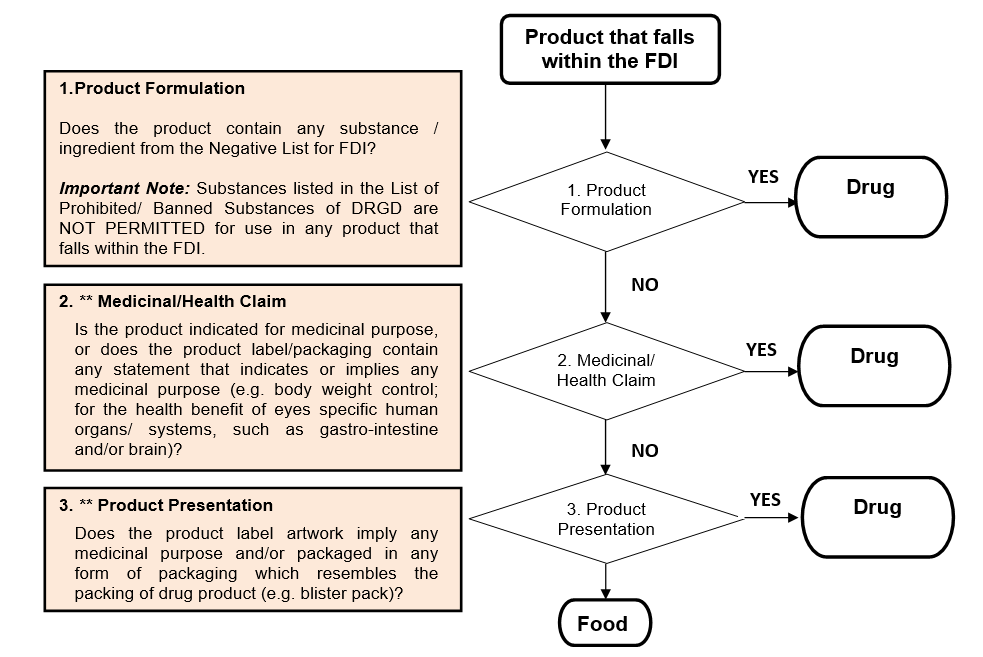
Source: NPRA
Official Service for Product Classification
To better define and regulate FDI products, the NPRA and the MOH Malaysia established the Committee for the Classification of Food-Drug Interphase Products in 2000. The committee's primary role is to assist both divisions in consistently classifying products submitted by the industry that are not clearly defined as either food or drugs.
Applicants can request an official product classification by seeking this service from the NPRA. Application forms can be downloaded (PDF; Ms Word). Moreover, there is a fee of RM 300 per product for this service, and the process typically takes 7-14 working days upon receipt of a complete application. Read more here.
 We provide full-scale global food market entry services (including product registration, ingredient review, regulatory consultation, customized training, market research, branding strategy). Please contact us to discuss how we can help you by