Request a Demo
The United States (U.S.) food market is one of the biggest markets worldwide, expected to reach 833.80 billion USD in 2024 with an annual growth of 4.05%1. With food and beverages from around the globe, this market is full of opportunities and challenges for enterprises to chase. Knowing the food import procedure and essential requirements in the U.S. is vital for new entrants. This article provides an overview of imported food compliance issues, from regulations to practices.
1. Main Authorities
The competent authorities related to food in the U.S. mainly include the FDA and the U.S. Department of Agriculture (USDA). FDA is responsible for the state-to-state trade of both U.S. domestic and imported foods other than meat, poultry, and egg products, to ensure food safety and health. Its responsibility basically includes pre-market management, market management, and punishment implementation. USDA mainly oversees the safety of meat, poultry and egg products, aiming to promote agricultural trade and production.
2. Important Laws
For the U.S. food industry, the Federal Food, Drug, and Cosmetic Act2 (FD&C, also abbreviated as FFDCA and FDCA) is the core of the food safety law, providing the basic principles and framework of food safety supervision.
Background Information When looking for regulations related to U.S. food, enterprises might need clarification with the abbreviations, such as FD&C2, USC, and CFR. Here, ChemLinked compiles the relevant information for enterprises' reference. The United States Code (USC)3 is the official codification of the general and permanent federal statutes of the U.S., containing 53 titles. The general and permanent laws are organized into the USC3 by subject. The FD&C2 and subsequent amending statutes are codified into Title 21, Chapter 9 of the USC3. The Code of Federal Regulations (CFR)4 is the codification of the general and permanent regulations promulgated by the executive departments and agencies of the federal government of the U.S. The CFR4 is divided into 50 titles that represent broad areas subject to federal regulation. The U.S. also provides an online CFR platform5 to provide the public with enhanced access to government information. The FDA lists the section numbers and titles related to food requirements in USC3 to narrow the search scope: FD&C Act Chapter IV: Food6. |
The Food Safety Modernization Act (FSMA)7 is also an important law for the U.S. food industry. It provides a food management system in which the food industry systematically puts measures proven effective in preventing contamination. The FSMA7 gives FDA unprecedented authority to ensure that imported products meet U.S. standards and are safe for U.S. consumers. Under FSMA, importers for the first time have an explicit responsibility to verify that their foreign suppliers have adequate preventive controls in place to ensure that the food they provide is safe.
Other important downstream rules finalized by the FDA include:
Title | Issued Date |
2016/07 | |
2024/05 | |
Food Supplier Verification Programs (FSVP) for Importers of Food for Humans and Animals | 2015/11 |
2013/05 | |
2015/09 | |
Requirements for Additional Traceability Records for Certain Foods | 2022/11 |
2021/12 | |
2018/09 | |
2017/01 | |
Mitigation Strategies to Protect Food Against Intentional Adulteration | 2016/05 |
Mitigation Strategies to Protect Food Against Intentional Adulteration | 2016/04 |
2016/04 | |
2015/11 |
3. Compliance Issues Before Importation
Both imported and domestically-produced foods must meet the same legal requirements in the U.S. If the products are found noncompliant, FDA may detain the relevant products. The below lists some key compliance situations to check:
3.1 Food Facility Registration (FFR)
First and foremost, enterprises shall register the facilities that manufacture, process, pack, receive, or hold food with the FDA. Generally, if compliance is achieved, the FDA will issue an 11-digit registration number to the applicant soon, which is a unique facility identifier used to track products and check compliance statutes. For enterprises with multiple facilities manufacturing foods for the U.S. market, each facility should have a separate 11-digit FDA food facility registration number. The registration needs to be renewed every two years.
Enterprises can apply for FFR via the FDA online system. The necessary items that need to be filed include:
Type of Registration
Name and Address Information of the Facility
Preferred Mailing Address Information (Optional)
Name and Address Information of the Parent Company
Facility Emergency Contact Information
Trade Names
U.S. Agent (Required for the successful registration of foreign facilities)
Seasonal Facility Dates of Operation (Optional)
General Product Categories—Human/Animal/Both
Information of the Owner, Operator, or Agent in Charge
Inspection Statement
Certification Statement
For detailed registration method, please refer to ChemLinked Expert Article: Registration of Food Facility in the U.S. 8
3.2 Food Ingredient Compliance
FDA tightly controls the approval and use of food additives and color additives to ensure the safety and proper labeling of food products for consumers. Violations will result in the food being deemed adulterated.
According to the FDA, food additives are any substances reasonably expected to become a food component that is considered a food additive unless it is GRAS (generally recognized as safe) or meets another exclusion. Food additives require pre-market approval by the FDA unless they conform to a regulation prescribing their use or to an exemption for investigational use. Food additives without approval are deemed unsafe and are considered adulterants, making the food using such additives adulterated under the FD&C2.
Color additives are deemed as any substances added to food to impart color. They are considered unsafe and adulterants unless they are permitted or exempt by FDA regulation. Unlike food additives, there is no GRAS exemption for color additives. Food containing an unsafe color additive is considered adulterated.
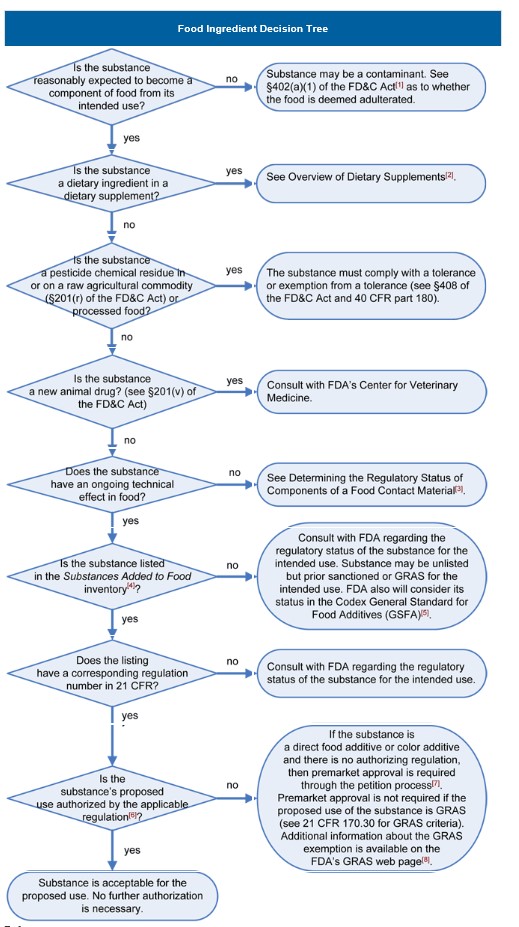
Food manufacturers are responsible for ensuring that all ingredients used are of food-grade purity and in compliance with the specifications and limitations. To help enterprises better determine the regulatory status of a food ingredient, FDA provides a decision tree as a reference:
3.3 Label Compliance
The FDA is responsible for assuring that imported foods sold in the U.S. are properly labeled. Food labeling is required for most prepared foods, such as breads, cereals, canned and frozen foods, snacks, desserts, as well as drinks. All labeling and packaging must be informative and truthful. The labeling language shall be English or the predominant language of a U.S. territory where the language is one other than English, such as Spanish in Puerto Rico.
Two ways to label food packages and containers are specified by the FDA:
Placing all required label statements on the front label panel (the principal display panel or PDP),
Placing certain specified label statements (statement of identity, or name of the food, and the net quantity statement, or amount of product) on the PDP. Placing other statements (the name and address of the manufacturer, packer or distributor, the ingredient list, nutrition labeling, and any required allergy labeling) on the information panel (the label panel immediately to the right of the PDP, as seen by the consumers when facing the product).
The required allergy labeling items include milk, egg, fish, crustacean shellfish, tree nut, wheat, peanuts, soybeans, and sesame.
In addition, health-related claims can be labeled for both dietary supplements and conventional foods. The claims are sorted as health claims and structure/function claims, according to the level of scientific evidence they are supported. For more details, please refer to ChemLinked Article: Health Claims for Foods: Decoding Global Regulatory Landscape9.
3.4 Additional Noteworthy Requirements for Special Food Category
3.4.1. Dietary Supplement
In the U.S., dietary supplement is a special food category with additional requirements. The Dietary Supplement Health and Education Act of 1994 (DSHEA)10 gives the definition of the terms "dietary ingredient" and "new dietary ingredient (NDI)".
To be a "dietary ingredient," an ingredient in a dietary supplement must be one of the following:
a vitamin,
a mineral,
an herb or other botanical,
an amino acid,
a dietary substance for use by man to supplement the diet by increasing the total dietary intake, or
a concentrate, metabolite, constituent, extract, or combination of any dietary ingredient from the above categories.
NDI refers to ingredients that meet the definition of a "dietary ingredient" and were not marketed in the United States before October 15, 1994.
Enterprises engaged in the sale of dietary supplements shall check if the ingredient is an NDI. Under the DSHEA10, a manufacturer or distributor must notify the FDA if the dietary supplement contains an NDI at least 75 days before placing the product into the market. The information about the NDI and the dietary supplement product, as well as the safety information shall be included in the notification.
Besides, dietary supplement manufacturer is required to disclose the product information on the label, including:
the product name and a statement that it is a "dietary supplement" or equivalent term replacing "dietary" with the name or type of dietary ingredient in the product;
the name and place of business of the manufacturer, packer, or distributor;
nutrition labeling in the "Supplement Facts" panel (except for some small volume products or those produced by eligible small businesses);
a list of "other ingredients" not declared in the Supplement Facts panel;
net quantity of contents;
a domestic address or phone number for reporting serious adverse events to the manufacturer, packer, or distributor whose name and place of business are listed on the label.
The Supplement Facts panel shall (1) display the serving size and number of servings per container, (2) declare each dietary ingredient in the product, and, (3) provide information on the amount of the dietary ingredient per serving except for dietary ingredients that are part of a proprietary blend. Depending on the type of ingredient, the amount per serving must be declared as a quantitative amount by weight, a percentage of the Daily Value, or both.
To help manufacturers, retailers, and consumers stay informed about ingredients in dietary supplements, FDA launched an online ingredient directory11 and a list of publicly displayable new dietary ingredient notifications12.
3.4.2. Acidified Foods & Low-Acid Canned Foods
Another noteworthy point is the requirements of acidified foods (AF) and low-acid canned Foods (LACF). For enterprises intending to sell AF or LACF packaged in sealed containers to the U.S., they are required to file the Food Canning Establishment (FCE) registration. A facility’s FCE registration should be linked to its FFR. Besides, AF and LACF facilities must submit unique filings for each production process. Each of these filings is assigned a unique Submission Identifier (SID) number.
Background Information A low-acid canned food (LACF) is any food (other than alcoholic beverages) with a finished equilibrium pH greater than 4.6 and a water activity (aw) greater than 0.85, excluding tomatoes and tomato products having a finished equilibrium pH less than 4.7. An acidified food (AF) is a low-acid food to which acid(s) or acid food(s) are added and which has a finished equilibrium pH of 4.6 or below and a water activity greater than 0.85. |
The information to be submitted to the FDA include:
Product sample
Water activity (aw) and pH records
Production flow chart
Sterilization flow chart
Information related to the sterilization machine
Ingredient list of each product
Test records of product
Information related to the product container
Business license
Product instruction
Production reports
CCP Validation reports
3.5 Accredited Third-Party Certification
According to Section 307 of the FSMA7, the FDA establishes a voluntary program for the accreditation of third-party certification bodies, also known as third-party auditors, to conduct food safety audits and issue certifications for foreign entities and their foods for humans and animals. Importers can use these certifications to establish eligibility for participation in the Voluntary Qualified Importer Program (VQIP), which offers expedited review entry of food.
Background information VQIP is a voluntary program that helps accelerate the review and import entry of human and animal foods into the U.S. Participating importers can import their products more quickly without additional inspection and sample collection. Unexpected delays at the point of import entry can be avoided, enhancing the safety and security of supply chains. To participate, importers must meet eligibility criteria and pay a user fee that covers the FDA’s administration of the program. Please note that only importers with over 3 years of food import experience in the U.S. can apply for participation in VQIP. |
4. Prior Notice of Imported Foods
The “prior notice of imported foods” was jointly implemented by the Secretaries of the Departments of Health and Human Services (HHS) and Homeland Security (DHS) on October 10, 2003, requiring enterprises to notice FDA with the imported food information before the anticipated date of arrival. The “prior notice of imported foods” allows FDA, with the support of the U.S. Customs and Border Protection (CBP), to target import inspections more effectively and help protect that nation's food supply against terrorist acts and other public health emergencies.
“Food” defined under the “prior notice of imported foods” refers to any of the follows:
Articles used for food or drink for man or other animals
Chewing gum
Articles used for components of items listed in the 1st and 2nd bullets
Please note that food contact substances and pesticides are not included in the "food” category.
Foods subject to the prior notice and the exceptions are specified below:
Food Imports Requiring Prior Notice (Unless Exemptions Apply) | Exemptions |
|
|
Manufacturers, exporters, brokers, importers, U.S. agents, and any individual with knowledge of the required information can submit the prior notice. The Submission shall be electronically through either of the following systems:
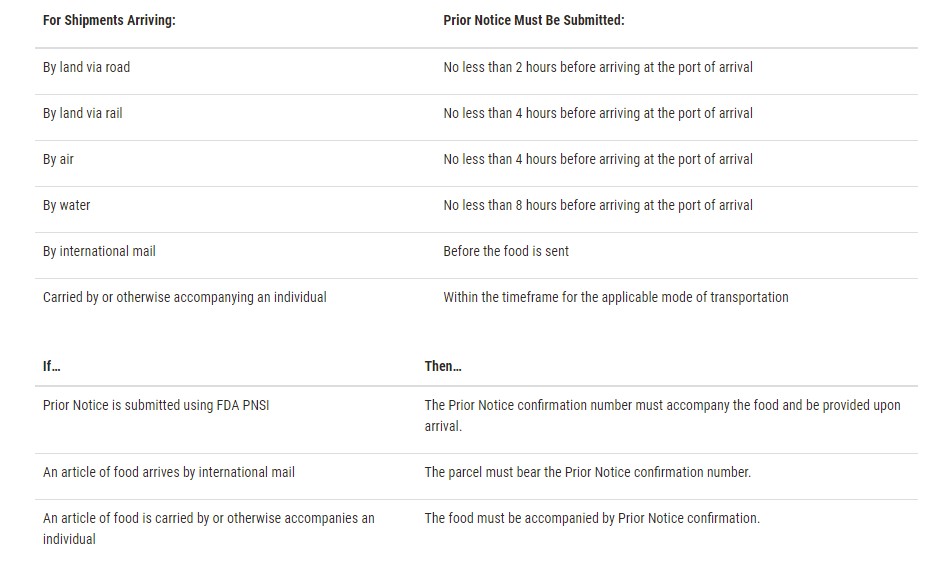
The deadline for submitting the prior notice depends on the mode of transportation for shipment. Except in the case of food arriving by international mail, FDA shall receive and confirm a prior notice: 1) no more than 30 days before a shipment arrives if the prior notice is submitted via ACS system; or 2) no more than 15 days before a shipment arrives, if prior notice is submitted via FDA’s PNSI. See the below table compiled by FDA for additional details:
(source: FDA)
Information submitted for the prior notice shall include:
Name, business address, telephone, and email of the individual submitting the Prior Notice, as well as the firm name and address (if applicable)
Name, firm name (if applicable), and business address, telephone, and email of the individual transmitting Prior Notice (if someone else is transmitting Prior Notice on behalf of the submitter)
Entry type and CBP identifier (if identifier is available)
Identification for each article of food in the shipment (FDA product code, common product name or market name, estimated quantity, lot, code number, or other identifier)
If the food is no longer in its natural state, manufacturer’s name and either 1) the registration number, city, and country of the manufacturer, or 2) both the full address of the manufacturer and the reason the registration number is not provided
If the food is in its natural state: name of grower and the growing location if known
FDA Country of Production
Shipper’s (sender’s, if food is mailed) name and full address
Country from which food is shipped; or, if food is imported by international mail, the anticipated date of mailing and country from which food is mailed
Anticipated arrival information (location, date, and time); or, if food is imported by international mail, the U.S. recipient’s name and address
Name and complete address of importer, owner, and consignee, unless the shipment is imported or offered for import for transshipment through the U.S. under a transportation and exportation entry; or, if food is imported by international mail, the U.S. recipient's name and address
Carrier and mode of transportation (except for food imported by international mail)
Planned shipment information (except for food imported by international mail)
Any country to which the article has been refused entry.
After submitting all of the required information, enterprises will receive a confirmation along with a confirmation number directly issued by the FDA or from FDA through CBP’s ABI/ACS.
5. Custom Clearance and Inspection
As per the FD&C2, the FDA is not authorized to approve, certify, or sanction individual importers, products, labels, or shipments. Importers can bring food into the U.S. without FDA approval as long as the facilities are registered and prior notice of incoming shipments is provided.
However, imported food products are subject to FDA inspection when offered for import at U.S. ports of entry. The FDA will decide whether or not to allow the product into the country and may detain products if any noncompliance issues are found.
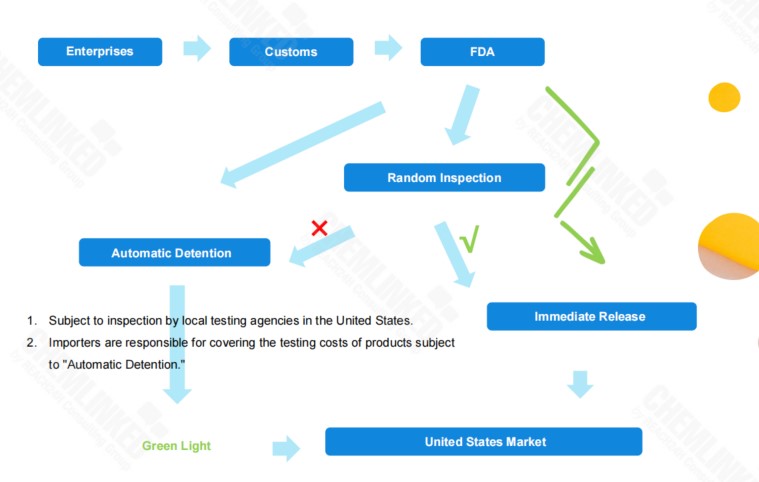
The FDA will inspect the imported food in three ways: "immediate release," "random inspection," and "automatic detention.
Most imports are released immediately, but once the product enters the marketplace, the FDA will conduct random inspections on the imported food to ensure that the food delivered to consumers is safe.
If a shipment is selected for random inspection, an FDA representative will take samples for laboratory evaluation.
The FDA will send an "automatic detention " notice to the owner or recipient if any violation is found. A local U.S. laboratory will test the relevant product once it is shipped to the U.S. Only after being approved by the FDA following a compliance test result, can the product be released to the U.S. market. It is important to note that the importer will be responsible for the cost of testing the product under automatic detention.
(Source: ChemLinked online course: Focus on EU, US, Canada, Australia, and New Zealand: Food Compliance and Import Procedure Interpretation)
 We provide full-scale global food market entry services (including product registration, ingredient review, regulatory consultation, customized training, market research, branding strategy). Please contact us to discuss how we can help you by