Request a Demo
Background
The development of China’s FSMP regulatory framework has followed an interesting path. In the late 80s FSMPs required pharmaceutical registration and most of the products were designed as enteral nutrition and were used almost exclusively in inpatient settings in Chinese hospitals. In other countries, FSMPs are categorized as foods. The stringency of pharmaceutical regulations and the obvious technical capacity mismatch between the food industry and the pharmaceutical industry has meant that for the last 2 decades the FSMP niche in China has been dominated by the pharmaceutical industry. China’s new Food Safety Law categorized FSMPs as a type of special food which requires pre-market approval by a competent authority prior to manufacture. This reclassification combined with China’s large senescent demographic and the inherent cultural appreciation for the role of nutrition in health provides fertile ground for future growth in this industry.
EU FSMP Regulation Moving Towards More Stringent Clinical Efficacy Requirements
Reclassification of FSMPs and regulation as a food is not without problems as evidenced by the numerous issues this sector faces globally. In the EU, FSMP operators are required to notify their respective national competent authorities prior to market circulation. However the growth in this market and the increased number of FSMP applications in the EU is prompting authorities to reconsider their lax regulatory stance in an effort to safeguard the integrity of the sector. In 2015, European Food Safety Agency (EFSA) published a scientific and technical guidance on foods for special medical purposes in the context of Article 3 of Regulation (EU) No 609/2013, which required FSMPs applications to include detailed evidence relating to therapeutic benefit including submission of a literature review documenting any mechanistic and clinically relevant data. Target groups and dosing methods should also be detailed.
Chinese authorities have learned from the problems currently experienced In the EU and China’s new FSMP regulatory framework reflects policymakers’ efforts to provide a scientifically solid foundation for future growth in the market. Another major factor in China’s decision to impose stringent regulatory requirements is future plans to include FSMPs in the national health insurance medical reimbursement scheme. China’s new regulation attempts to find a happy medium which caters to the technical capacities of the food industry but utilizes scientific standards that will ensure the integrity of products and safeguard the government and consumers from companies attempting to profit from exploiting lax regulation.
FSMP Legislation in China
The “Administrative Measures for Registration of Foods for Special Medical Purpose” came into effect since July 1, 2016. There is still a number of supporting supplementary requirements to be released and as such China has granted a grace period for the registration of FSMPs which will end on Jan. 1, 2018. On July 14, 2016, China Food and Drug Administration (CFDA) finalized four supplementary documents for trial implementation (see CL news on July 15, 2016). Other documents related to FSMP registration are currently being drafted and will be released later.
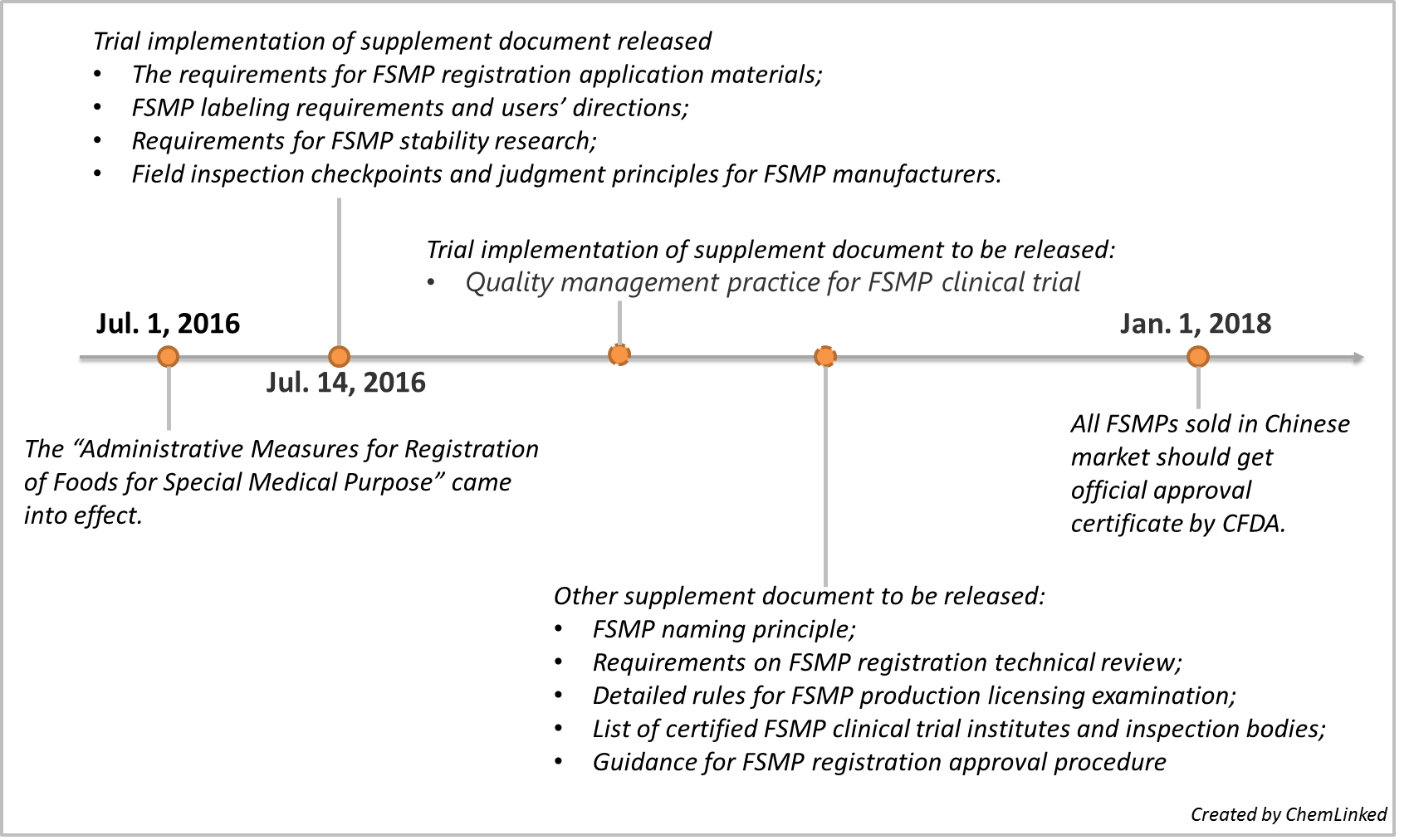
Quality management for FSMP clinical trials is still awaiting finalization by CFDA. According to Mr. Yang Xiaoguang (the former vice-director of the Institute for Nutrition and Health of the Chinese Center of Disease Control) (see CL news on 29 Sep. 2016), there will be no big change in the final version of FSMP clinical trial requirements. The trial implementation has been submitted to the central government for final decision.
Lacking of relevant standard for specific nutritionally complete foods
There are three types of FSMPs:
Nutritionally complete foods
Specific nutritionally complete foods to serve as patients sole nutritional intake
Nutritionally incomplete foods
Specific nutritionally complete foods will be used as the only nutrition source to meet the nutritional requirements of target groups suffering from specific disease or medical conditions, the ”Administrative Measures for Registration of Foods for Special Medical Purpose” stipulates that specific nutritionally complete foods should conduct clinical trials for the registration to prove product clinical efficacy. Currently, there are 13 types of common diseases or medical condition that requires specific nutritionally complete foods including:
diabetes
pulmonary disease
kidney disease
tumors
liver disease
muscle wasting/atrophy
trauma, infection and surgery
IBD
protein allergy
intractable epilepsy
gastrointestinal malabsorption and pancreatitis
fatty acid metabolism
obesity and bariatric surgery
China is the first country that officially requires clinical trials for FSMP evaluation. GB 29922-2013 National Food Safety Standard General Rules for Foods for Special Medical Purposes is the general standard which stipulates the nutrition requirements for all FSMPs. GB 29922-2013 specifies the specific nutrition requirements of “specific nutritionally complete foods” that should be formulated with reference to the general requirements for nutritionally complete foods and should most importantly meet FSMP requirements by demonstrating scientifically substantiated clinical benefit for use on specific populations as verified by clinical trials.
Clinical trial quality management practice for FSMP
As per the Clinical Trial Quality Management Practice for FSMP exposure draft, the clinical trial process is similar to pharmaceutical registration. The clinical trial should follow standardized trial protocol, trial size, observation period, selection of volunteers and observational indices. Statistical significance and clinical efficacy are still the major endpoints to assess the suitability for FSMP registration approval. Currently, there is no standard that applicants can reference which stipulates suitable nutrient forms, dosages, dosing form, dosing regimens etc.
Clinical study content requirements | Clinical trial documents submitted for FSMP registration |
|
|
Clinical Research Organization (CRO) Requirements
Clinical trials for FSMPs should be conducted in medical institutes with relevant nutritional departments and in accordance with Good Clinical Practice (GCP). The institute is responsible for building internal operational standards which should be described in the trial report. Applicants wishing to conduct clinical trials in China must use medical institutes certified by CFDA. Due to a lack of designated FSMP clinical trial institutes, it is also possible that CFDA will recommend industry to use pharmaceutical CROs to conduct FSMP clinical trials as there are already over 800 qualified institutes approved by CFDA. The CFDA has also announced it will recruit a panel of experts and will form a FSMP review committee.
Requirements for samples used in trials
Investigational samples used for clinical trials should be produced under GMP condition, and the formulation and processing should be the same as those used in final products. Prior to use of samples in clinical trials, applicants should submit detailed scientific documentation specifying final product and sample equivalency as assessed under the following criteria: safety, nutritional completeness and clinical efficacy.
Requirements for research protocol
Applicants should provide sufficient explanation for trial process design and control group selection. The authority suggests applicants to use randomized controlled trails. For other trail designs, applicants should explain the benefit compared to randomized controlled trails, and the scientific basis and study controls used. Blind or open label trials are all accepted as long as the applicant can provide a rationale for study design and control selection.
Requirements for volunteer selection: target and control groups
To meet statistical significance requirements, target groups and control groups should contain at least 100 volunteers and observational periods should be no less than 7 days. One of the difficulties facing FSMP clinical trials is managing control groups.
 We provide full-scale global food market entry services (including product registration, ingredient review, regulatory consultation, customized training, market research, branding strategy). Please contact us to discuss how we can help you by