Request a Demo
In July 2022, Health Canada introduced the front-of-package (FOP) nutrition label for food containing high level of saturated fat, sugars and/or sodium (click for more details). On May 16, 2023, Health Canada released an updated guidance document to help stakeholders in complying with the FOP nutrition labeling requirements which will be implemented from January 1, 2026. However, products imported to or manufactured in Canada, or packaged at retail before the implementation date can remain in the warehouse and continue to be sold on shelves.
Foods are subject to the new FOP labelling rules
As per the Food and Drug Regulations (FDR), the FOP symbol is necessary for most prepackaged foods that are sold in Canada, regardless of whether they are domestically-produced or imported. The FDR specifies how the symbol should be presented when it is required on a food label. Foods that have an exemption may display the symbol voluntarily but in accordance with the FDR's requirements.
Foods prohibited from displaying the FOP nutrition symbol
Products that are meant for infants aged six months or older but less than one year of age
Human milk fortifiers
Human milk substitutes (infant formula)
Foods represented as containing a human milk substitute
Formulated liquid diets
Meal replacements
Nutritional supplements
Foods represented for protein-restricted diets
Foods represented for low (naming the amino acid) diets
Foods represented for use in a very low energy diet
Foods exempt from the FOP nutrition symbol requirements
There are two types of exemptions of the FOP labeling: full exemptions and conditional exemptions.
Full exemption means that a product is never subject to the FOP label requirement, even if its saturated fat, sugar, or sodium content exceeds the threshold. Specific situations are as follows:
Shipping containers not sold as a single unit to consumers at retail
Products with an available display surface < 15 cm2
Individual portions of food for serving by restaurant or other commercial enterprise with meals or snacks
Ready-to-serve multiple-serving products for commercial or institutional use only
Products used solely as ingredients in prepackaged products for retail sale or in commercial/industrial/institutional food preparation
Cow/goat's milk sold in refillable glass containers, including flavored milk and cream
Sweetening agents, such as sugar, agave syrup, corn syrup, maple syrup, table syrup, honey, and molasses
Salt and seasoning salt that includes salt in its common name, such as table salt, celery salt, garlic salt, and onion salt
Fats and oils, such as butter, margarine, coconut oil, and canola oil
Individual rations for military personnel engaged in operations or exercises
For some products, the conditional exemption is based on their conditional exemption from the Nutrition Fact table (NFt) requirement. For other products, the conditional exemption is nutrient-specific based on their ingredients. Details are as follows:
Prepackaged products are conditionally exempt from the FOP symbol when they are also conditionally exempt from carrying an NFt, such as beverages with an alcohol content > 0.5%, raw single ingredient fish and seafood products, as well as products that have an available display surface < 100 cm2.
Foods subject to nutrient-specific conditional exemption associated with ingredients can be divided into two types:
(1) Foods with health protection benefits, such as fresh/frozen/canned/dried fruits or vegetables and milk from any animal, in liquid or powdered form.
(2) Foods that are important sources of calcium, including cheese, yogurt, kefir and buttermilk.
Presentation of the FOP nutrition symbol
In most cases, FOP labels are presented in a bilingual format, with English and French information being displayed in the same symbol, which can be printed directly or affixed to the label. The FOP label is black and white, featuring a black magnifying glass icon on the left and at least one bar chart on the label indicating whether the product is "high in saturated fat", "high in sugar", or "high in sodium". An example is shown below:
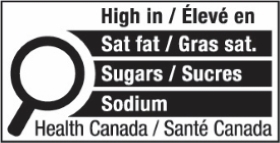
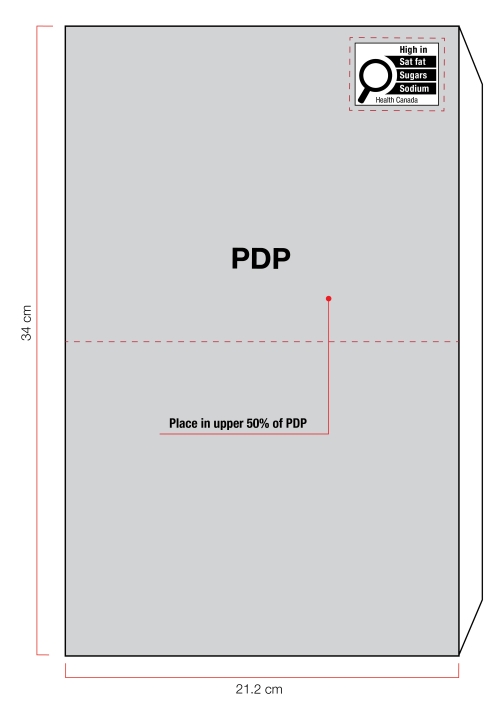
The FOP label must be displayed on the main display panel (PDP). For rectangular PDP, when the height of the PDP is equal to or greater than its width, the label must be displayed in the upper half (50%) of the PDP, as shown in the following figure.
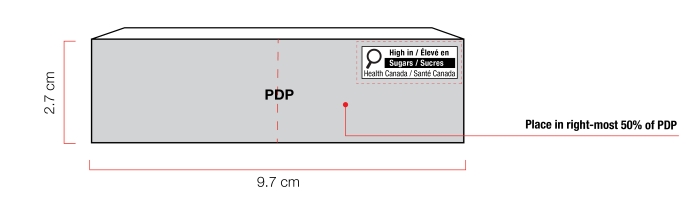
When the height of the PDP is less than its width, the label must be displayed in the right half (50%) of the PDP, as shown in the following figure. The guidance also specifies the marking methods for other shapes.
Nutrient and health-related claims and the FOP nutrition symbol
When a product displays FOP labels, most health-related claims are permitted on the PDP. This includes claims unrelated to saturated fat, sugar, and sodium (such as protein, fiber, or energy) and "high in" claims that are not related to saturated fat, sugar, or sodium on the PDP. For instance, if a product is labeled as "high in saturated fat," it may be allowed to claim "low sodium" on the PDP. However, if the PDP states "high in sugar," claiming "unsweetened" is prohibited, and only rational claims such as "reduced sugar content" may be made on the PDP.
 We provide full-scale global food market entry services (including product registration, ingredient review, regulatory consultation, customized training, market research, branding strategy). Please contact us to discuss how we can help you by