Request a Demo
On March 4, 2025, China’s Ministry of Agriculture and Rural Affairs (MARA) opened public consultation on two drafts:
Catalogue of Feed Materials (Draft Revision for Public Consultation); and
Regulations on the Administration of Fermented Feed (Consultation Draft).
Compared with the current effective Catalogue of Feed Materials, the draft makes significant amendments—for instance, it adds roughly 120 new feed materials. Meanwhile, the draft Regulations on the Administration of Fermented Feed designed to standardize manufacturing and operational practices in the fermented feed industry, while addressing a regulatory gap in response to rapid industry development.
Major revisions are outlined below. Public feedback can be sent to [email protected] prior to April 3, 2025.
Key Content
Regarding the draft “Catalogue of Feed Materials”
The draft proposes the following amendments to the current effective “Catalogue of Feed Materials”. (Notes: For feed additives, China has separately formulated a Catalogue of Feed Additive Varieties.)
1. Adding a definition for fermented feed and establishing its usage rules to Part 1, “General Rules”
Status | Current regulation | Proposed regulation |
Addition | / |
|
2. Introducing a new processing technique—“Crude Extraction” to Part 2
Currently, Part 2 of the Catalogue specifies 66 processing terms. The draft adds “crude extraction,” which is defined as extracting active ingredients from natural plants using appropriate solvents or alternative methods, followed by concentration and/or drying, without further separation and purification.
3. Amending Part 3, the positive list of feed materials
The proposed changes to Part 3 are summarized by ChemLinked in four tables (Details can be found by checking the free report below).
Table 1 – Newly proposed feed materials (119 items)
Table 2 – Feed materials deleted from the Catalogue (13 items)
Table 3 – Feed materials with revised mandatory labeling requirements (53 items)
Table 4 – Feed materials with updated characteristic descriptions (61 items)
#Reports
Draft Revisions to Part 3 of Feed Material Catalogue — the Positive List of Feed MaterialsThe proposed changes are summarized by ChemLinked in four tables: Table 1 – Newly proposed feed materials (119 items); Table 2 – Feed materials deleted from the Catalogue (13 items); Table 3 – Feed materials with revised mandatory labeling requirements (53 items); Table 4 – Feed materials with updated characteristic descriptions (61 items).Notably, items under “mandatory labeling requirements” served as quality standard or hygiene characteristic indicators should be reflected in the “guaranteed analytical value” section on ingredient labels.
4. Revising Part 4, the list of permitted single feed varieties
Under China’s Regulation on the Administration of Feeds and Feed Additives, single feed refers to feed produced from one type of animal, plant, microorganism, or mineral for use in feed product manufacturing. Compared with feed materials, single feed varieties are managed differently from a regulatory standpoint. To be specific, imported single feed varieties are required to obtain an import registration certificate in accordance with the Administrative Measures for Imported Feed and Feed Additives Registration, and any single feed product without such a certificate must not be used in the production, handling, or application of feed raw materials.
Specific revisions to single feed varieties proposed by this draft include:
1) Renaming three feed varieties
No. | Current name | Proposed name |
1 | Bean meal | Bean meal [Soybean meal] |
2 | Tetraselmis | Tetraselmis powder |
3 | Glutamic acid residue
| Glutamic acid residue [MSG residue] |
2) Adding 18 new single feed varieties
No. | Material No. | Feed name | No. | Material No. | Feed name |
1 | 2.13.7 | Cottonseed protein concentrate | 10 | 10.2.3 | Enzymatically hydrolyzed shrimp paste |
2 | 7.5.4 | Spirulina platensis | 11 | 10.2.4 | Enzymatically hydrolyzed shrimp soluble pulp |
3 | 7.5.6 | Spirulina maxima | 12 | 10.3.2 | Enzymatic hydrolysis of squid paste |
4 | 9.2.7 | Dried black soldier fly (powder) | 13 | 10.4.4 | Red fish meal |
5 | 9.2.8 | Frozen black soldier fly | 14 | 10.4.5 | Enzymatically hydrolyzed fish paste |
6 | 9.2.9 | Enzymatically hydrolyzed black soldier fly paste (powder) | 15 | 10.4.6 | Enzymatically hydrolyzed fish viscera paste |
7 | 9.2.10 | Defatted black soldier fly powder | 16 | 10.4.7 | Enzymatically hydrolyzed fish soluble pulp |
8 | 9.3.6 | Enzymatic hydrolysis of animal viscera (powder) | 17 | 12.1.4 | Fermented ____ |
9 | 9.6.5 | Bone-derived calcium hydrogen phosphate | 18 | 12.1.5 | Fermented feed (____) |
3) Deleting two single feed varieties
No. | Material number | Feed name and its material number |
1 | 9.6.9 | Acidified bone meal [Bone-derived calcium hydrogen phosphate] |
2 | 10.4.4 | Fish meal |
Regarding the Draft “Regulations on the Administration of Fermented Feed”
This new regulation establishes comprehensive requirements for fermented feed management, addressing manufacturers, quality safety management, and labeling requirements during circulation. For example, fermented feed manufacturers must secure a feed production license before commencing production. Most requirements apply to domestic manufacturers in China. For overseas manufacturers, only the following highlighted requirements need to be implemented, while the remainder of the draft may be adopted as reference.
Noteworthy requirements for overseas manufacturers:
1. Fermented feed labels shall comply with the mandatory standards specified in the "Feed Label" and must meet the following provisions:
The product name should, in principle, reference one or more primary raw material types or categories used for fermentation, with the prefix "Fermented" clearly indicated at the beginning. The raw material types or categories should align with those in the "Catalogue of Feed Raw Materials". If it is difficult to list all the primary raw material types or categories individually, the product may simply be named “Fermented Feed”, with the two raw material types that make up the highest mass proportions indicated in parentheses.
The guaranteed analytical values in the product composition analysis must include moisture, pH value, crude protein, crude fiber, crude fat, and at least one quality marker indicator that reflects the product’s characteristics, along with its content.
The raw material composition should list all feed raw material types used in the fermentation process, specifying the name or category of feed raw material, arranged in descending order based on their mass proportions.
Information on the production strains must be provided, including at least the names of all production bacterial cultures used for fermentation, the strain numbers, and the registration and preservation numbers from the microbial standard strain preservation institution that holds the corresponding preservation qualification.
2. Fermented feed manufacturing enterprises must take effective measures to ensure product quality and safety. The feed raw materials used for fermentation must comply with the "Feed Hygiene Standards". Furthermore, when fermented feed products involve multiple feed raw materials, the limit set for the product’s hygiene indicators must not exceed the lowest limit value established for any of the raw materials used in the fermentation process.
For further feed/feed additive/pet food registration, consulting or translation service, please email [email protected].
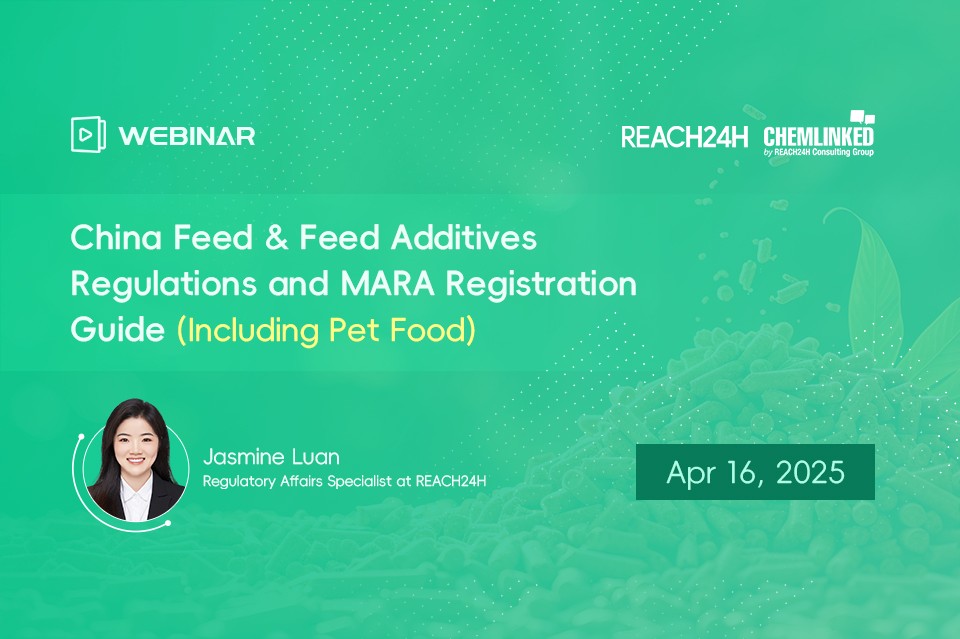
FOR YOUR INFORMATION, ChemLinked is hosting a free webinar on feed compliance on April 16, 2025. Join us for an insightful session on the latest in feed compliance. Click here to register.
 We provide full-scale global food market entry services (including product registration, ingredient review, regulatory consultation, customized training, market research, branding strategy). Please contact us to discuss how we can help you by