Request a Demo
1. Interim Measures for Product Quality Spot Inspections (hereinafter "the measures")
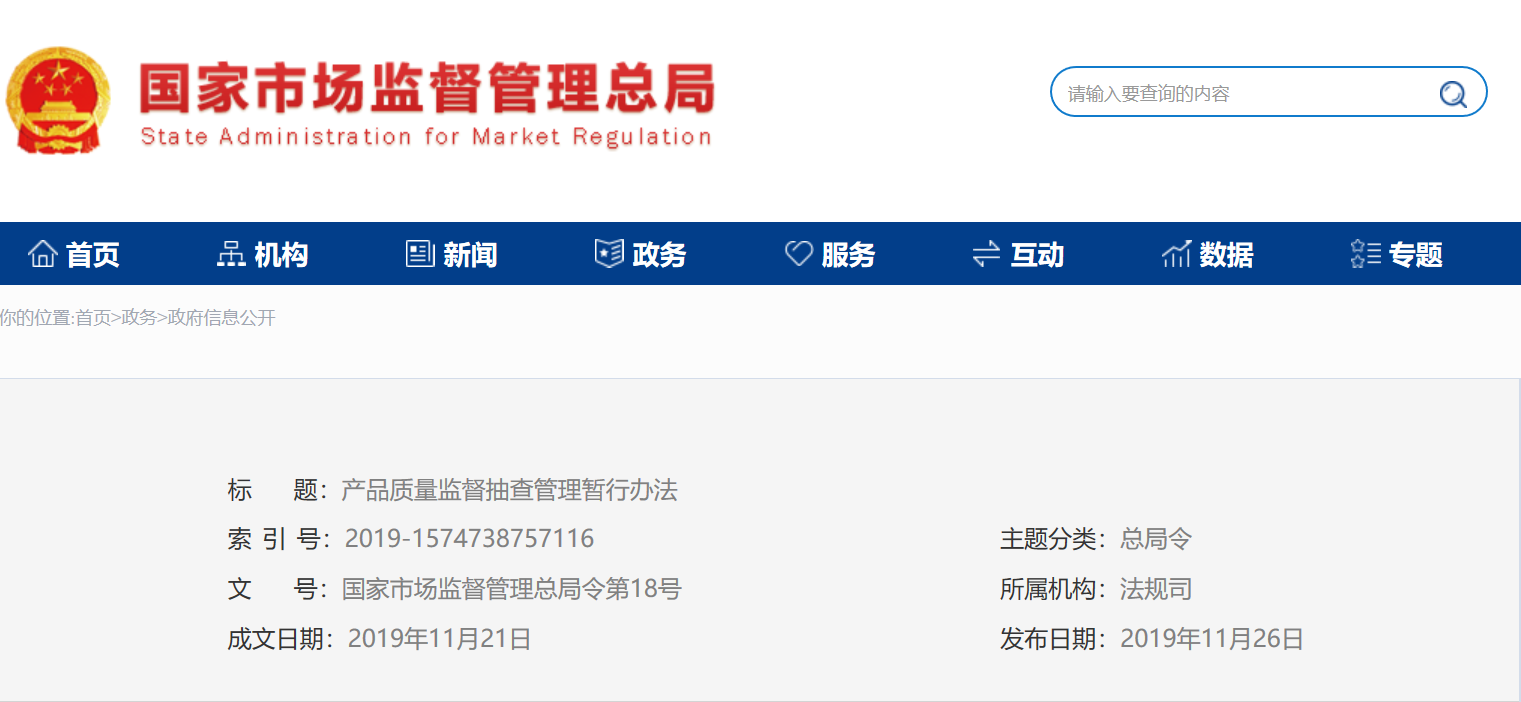
The measures are formulated to strengthen product quality supervision and management, standardize product quality supervision and spot inspection work, and protect the legitimate rights and interests of consumers. The measures apply to all the products manufactured and sold in China including domestic and imported products, food and food related products.
Once it enters into force on January 1, 2020, the following will be abolished:
Administrative Measures for Product Quality Spot Inspections released on December 29, 2010
Measures for the Spot Inspections and Testing of Commodity Quality in the Circulation Field promulgated on February 14, 2014
Measures for the Supervision and Administration of Commodity Quality in the Circulation Field promulgated on March 17, 2016
The measures main contents include:
Chapter 1: General Principles
Chapter 2: Organizations for Supervision and Spot Inspections
Chapter 3: Product Sampling (on-site sampling & network sampling)
Chapter 4: Product Testing
Chapter 5: Objection Handling
Chapter 6: Results Handling
Chapter 7: Legal Liability
Chapter 8: Supplementary Provisions
Among them, the provisions closely related to enterprises are as follows:
Supervision and Spot Inspection Plan Formulation
SAMR is responsible for formulating the annual plan for products' national supervision and spot inspection and notifying the provincial administration for market regulation.
The administration for market regulation at or above the county level shall formulate the local annual plan for supervision and spot inspection and submit it to the higher-level market regulation department for filing. Detailed supervision and spot inspection scheme and implementation rules shall be formulated according to the local annual plan.
Sampling Methods
Sampling is divided into on-site sampling and network sampling.
On-site sampling:
Samples are randomly selected by the sampler from the products to be sold by the manufacturer and seller. The testing samples should be purchased by the sampler at a list price. Spare samples should be provided by the manufacturers and sellers for free and be paid if they are tested. Sealed samples shall be carried or posted to the testing institution by samplers.
Network sampling:
For the sampling of products sold by e-commerce operators, the local administration for market regulation may buy them in the name of consumers. After receiving the sample, samplers shall record the unpacking process by photos or videos, check the shipping packaging, sample packaging, sample labels, sample delivery situation, etc., and carry or post it to the testing institution after sealing.
Objection Handling
Sampled manufacturers and sellers who have objections shall submit written objection applications and submit relevant materials to the administration for market regulation department that organizes the spot inspection within 15 days after receiving written notification of the inspection results.
Results Handling
Products with unqualified inspection results shall be required to immediately stop production, sales, and rectify issues within 60 days.
The administration for market regulation will re-inspect the products within 75 days. Those who still fail to pass the re-inspection will be reported to the provincial level administration for market regulation and announced to the public.
Inspection will be conducted again 60-90 days after public announcement. Unqualified manufacturers and sellers shall be ordered to suspend business for a period of rectification.
Business license will be revoked if the products are still unqualified after the rectification period.
Legal Liability
If any of the following illegal situations happen, the sampled enterprises shall be:
Punished in accordance with relevant laws and administrative regulations
Fined up to 30,000 yuan (4,271 USD) if laws and administrative regulations do not specify the punishments
Transferred to public security organs if they are suspected of constituting a crime and need to be investigated
Illegal Situations:
a) The sampled product has serious quality problems;
b) Obstructing, refusing or failing to cooperate with the supervision and spot inspections;
c) Resuming production and sales of the unqualified products without passing the re-inspection;
d) Concealing, transferring, selling, or destroying sealed samples.
2. Interim Provisions on Consumer Goods Recall Management (hereinafter “the provisions”)
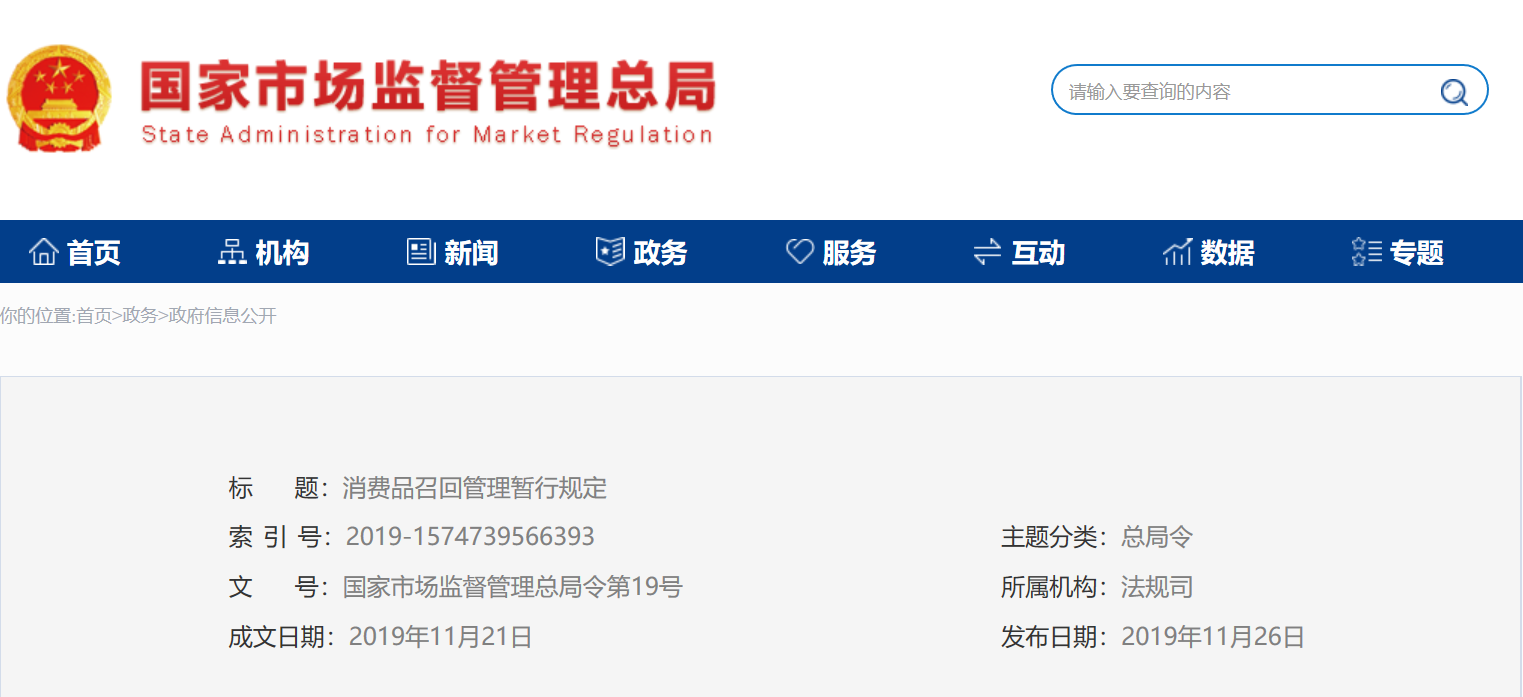
The provisions are formulated to regulate the recall of defective consumer goods, protect human health and the safety of people and property, and is applicable to all the defective consumer goods recall and supervision in China.
Once it enters into force on January 1, 2020, the previous Management Regulations on Recall of Children' s Toys promulgated on August 27, 2007, will be abolished simultaneously.
The provisions closely related to enterprises are as follows:
1) The “Defects” referred to in the provisions mean widespread unreasonable dangers that endanger human life and property safety in consumer goods of the same batch, model, or category due to design, manufacturing, and warning.
2) Manufacturers and other operators engaged in sales, leasing, and repair of consumer goods shall establish systems for the collection, verification, analysis, and processing of consumer goods defect information. And they are encouraged to establish a traceability system for consumer goods.
3) Manufacturers and other operators who discover the consumer goods in one of the following circumstances shall report to the local, provincial administration for market regulation within two working days:
It has caused or is likely to cause death, serious personal injury, or significant property damage;
The product has been recalled outside China.
4) If there are defects found in the consumer goods after investigation and analysis, the manufacturers shall immediately recall the products and shall not conceal the defects.
If a manufacturer considers that there is a defect in a consumer product or is ordered to recall the products, the manufacture, sales, or importation of the defective consumer goods shall be immediately stopped, and the manufacturer shall notify the other operators to stop operations.
If other operators receive the notification from the manufacturer, they shall immediately stop operating the defective consumer goods and assist the manufacturer in recalling products.
 We provide full-scale global food market entry services (including product registration, ingredient review, regulatory consultation, customized training, market research, branding strategy). Please contact us to discuss how we can help you by