Request a Demo
In June 2020, Japan's Ministry of Health, Labour and Welfare (MHLW) officially introduced the Positive List (PL) system for synthetic resin materials, establishing a new regulatory framework for food contact materials, containers, and packaging. After several revisions, the list will reach the end of a five-year transition period on May 31, 2025, by which time products circulated in Japan must fully comply with the PL requirements.
Recently, Japan's Consumer Affairs Agency (CAA) updated Q&A document, providing specific details on the scope and implementation of the list to further facilitate the comprehensive adoption of the PL system.
Introduction to the Positive List
The latest revised PL for synthetic resin materials is divided into two tables:
1. Base Materials (Table 1)
These are typically solid synthetic resins with a molecular weight of ≥1000 Da. The list categorizes these into 21 groups based on material characteristics, with each group listing permissible monomers/starting materials.
2. Additives (Table 2)
This refers to organic low molecular substances with a molecular weight of
Definition of the Application Scope
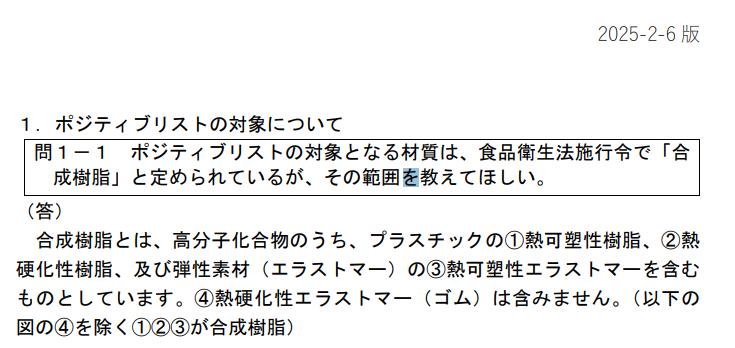
The Positive List applies to synthetic resins, including three main types: thermoplastic plastics, thermosetting plastics, and thermoplastic elastomers. Thermosetting elastomers (rubbers) are not included in the PL management scope.
Classification | Thermoplastic | Thermosetting |
Plastics | Thermoplastic Plastics (e.g., PP, PE) | Thermosetting Plastics (e.g., phenolic resin, melamine resin) |
Elastomers | Thermoplastic Elastomers (e.g., polystyrene elastomers, styrene block copolymers) | Rubber (Thermosetting Elastomers) (e.g., cross-linked butadiene rubber, nitrile rubber) |
Specifically, the following categories of materials are not within the scope of the PL. For these materials, enterprises may continue to use them in compliance with the previous management regulations under the Food Sanitation Act, provided they ensure their safety:
1. Non-synthetic resin materials:
Thermosetting elastomers (rubber)
Inorganic materials (e.g., metals, silicates)
Natural substances (including resins, naphtha extracts, plant fibers, etc.; excluding substances purified from specific components and related substances)
Chemical reaction products from natural substances (excluding chemically modified cellulose)
2. Functional migrating substances:
Substances that migrate from utensils, containers, or packaging into food to exert their intended function. These substances are not managed under the PL system because their purpose is to migrate into food, not to function in the base materials of the utensils or packaging.
3. Surface treatment agents:
Liquids or powders applied to the surface of food contact materials to achieve functions like antistatic or anti-fog effects. These agents, which are similar to coatings but do not form a durable film, are not considered synthetic resins and, therefore, are not included in the Positive List (PL).
4. Non-intended products:
Unintended by-products generated during manufacturing due to trace impurities reacting chemically. These are not covered under the PL management because they are unpredictable and vary in type.
5. Non-residual additives:
Substances that are not expected to remain in the final product, such as substances removed during production (e.g., solvents) or impurities in raw materials (e.g., residual monomers, catalysts, polymerization aids, by-products), which are not subject to PL oversight either.
Compliance Measures
For food contact materials, containers, and packaging, Japan has clarified the following regulations regarding how manufacturers and sales enterprises should respond before and after the five-year transition period (June 1, 2020 - May 31, 2025):
1. Before June 1, 2020: Products sold, manufactured, imported, or used prior to the regulation’s enforcement on June 1, 2020, will continue to follow the previous regulations after the transition period ends and can still be sold and used.
2. Special Cases during the Transition Period: During the transition period, products manufactured or sold with the same specific materials as before the enforcement date will be considered as products made with materials from the PL list and can continue to be sold and used after the transition period ends. This provision does not apply to raw materials.
3. After the Transition Period: From June 1, 2025, food contact materials, containers, and packaging produced, manufactured, or imported must use substances listed in the PL for applicable materials.
In the context of increasingly stringent global food safety regulations, compliance with food contact material standards has become a key market entry requirement. With the end of Japan's Positive List transition period approaching, production enterprises involved in exports to Japan will face comprehensive upgrades in regulatory compliance across production, use, and manufacturing processes.
In response, REACH24H advises that relevant enterprises should conduct self-assessments on their products, carefully distinguish between synthetic resin base materials and additives, verify whether they are included in the list, and ensure they meet the usage restrictions. By preparing in advance, enterprises can effectively mitigate potential risks and ensure smooth compliance with policy changes in the food contact materials export business.
If you have any business needs or require further assistance, feel free to contact us at [email protected].
 We provide full-scale global food market entry services (including product registration, ingredient review, regulatory consultation, customized training, market research, branding strategy). Please contact us to discuss how we can help you by