Request a Demo
European Chemicals Agency (ECHA) unveiled a restriction proposal on per- and polyfluoroalkyl substance (PFAS) on February 7, 2023. PFASs refer to substances that contain at least one fully fluorinated methyl (CF3-) or methylene (-CF2-) carbon atom (without any H/Cl/Br/I attached to it). They are persistent substances, also named “forever chemicals”, which will lead to irreversible environmental exposure and accumulation.
To reduce PFAS emissions into the environment and make products and processes safe for people, authorities from 5 countries, including Germany, Sweden, etc., submitted ECHA this proposal last month. The proposal mainly raised two restriction options:
Full restriction for all production of PFAS;
Restriction for all production of PFAS with use-specific derogations.
After receiving the proposal, ECHA will check if the proposal meets relevant legal requirements. A six-month consultation is planned to start on March 22, 2023.
Timeline for the next steps
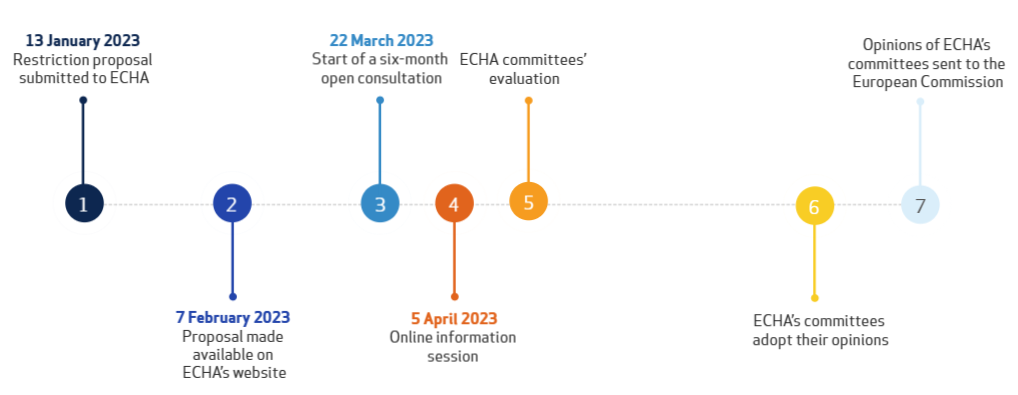
Picture from ECHA
More Contents Related to Food Contact Material
The restriction proposal on PFAS is the broadest restriction proposal in EU’s history, covering roughly 10,000 PFASs and food contact material (FCM) sector. According to the restriction report, food contact materials and packaging are one of the six categories whose PFAS volume used is over 10,000 tonnes/year. (Please note the Annex is pre-publication and the data is only for reference.)
Regarding the application in FCMs, PFASs are mostly used in food contact packaging, consumer cookware and industrial food equipment for their grease repellent properties. PFASs used in FCMs can be found in Table A.80 of Annex A. Table 8 of Annex XV summarizes the alternatives for PFAS manufacturers and the corresponding cost impact under the aforementioned Restriction Option 1—a full ban for PFASs. For example, the alternatives of plastic packaging are mentioned: Sufficiently strong evidence proves there are existing alternatives that can replace the polymeric PFASs used as processing aids in the production of plastic film, to improve the flow behaviour, speed up the production rates, and also enable the production of thinner films. Several alternatives (e.g. boron nitride, polyethylene waxes) are available on the market.
“Once fully effective, the use of PFAS in consumer products will be completely banned. This includes uses in paper or plastics, including as a processing aid in plastics, for packaging or otherwise contacting food, and in consumer articles intended for use in cooking and preparing foods (e.g., non-stick pots and pans),” reported by Packaginglaw.com.
 We provide full-scale global food market entry services (including product registration, ingredient review, regulatory consultation, customized training, market research, branding strategy). Please contact us to discuss how we can help you by