Request a Demo
On Sep 3, during the 11th Chemical Regulatory Annual Conference (CRAC)[1] hosted by REACH24H Consulting Group in Xi’an (capital city of Shaanxi Province) , Akira Nakashima from the food marketing department of New Japan Accreditation Association (Shin Nihon Kentai Kyokai) delivered a speech explaining the supervision of food contact materials in Japan.
Current Regs of FCM in Japan
At present, Japan’s government does not supervise the raw materials and additives of food utensils, containers and packaging, but finished food contact products are subject to material test and dissolution test. Test items vary with materials (refer to tables below).
1. Synthetic resin
| Categories | Material Test | Dissolution Test |
| General specifications of synthetic resins (all synthetic resins) | Cadmium, Lead | Heavy metals, KMnO4 Consumption |
| Phenolic resin PF, Melamine resin MF, Urea resin UF | / | Phenol, Formaldehyde, Evaporation residue |
| Polyoxymethylene POM | / | Formaldehyde Evaporation residue |
| Polyvinyl chloride PVC | Dibutyltin (DBT) compound, Tricresyl phosphate (TCP), Vinyl chloride | Evaporation residue |
| Polyethylene PE, Polypropylene PP | / | Evaporation residue |
| Polystyrene PS | Volatile substances | Evaporation residue |
| Polyvinylidene chloride PVDC | Barium, Vinylidene chloride | Evaporation residue |
| PET | / | Antimony, Germanium, Evaporation residue |
| PMMA | / | Methyl methacrylate, Evaporation residue |
| PA | / | Caprolactam, Evaporation residue |
| PMP | / | Evaporation residue |
| PC | Bisphenol A, Diphenyl carbonate, Amines | Bisphenol A, Evaporation residue |
| PVA | / | Evaporation residue |
| PLA | / | Total lactic acid, Evaporation residue |
| PEN | / | Germanium, Evaporation residue |
2. Rubber
| Categories | Material Test | Dissolution Test |
| Rubber containers and packagings | Cadmium, Lead, 2-mercaptoimidazole | Phenol, Formaldehyde, Zinc, Heavy metals, Evaporation residue |
3. Glass/Ceramics/Enamel
| Categories | Material Test | Dissolution Test |
| Glass | / | Cadmium, Lead |
| Ceramics | / | Cadmium, Lead |
| Enamel | / | Cadmium, Lead |
Revised Food Sanitation Act Introduced Positive List System
The amendment to Food Sanitation Act was published on June 13, 2018 and was the first major revision in 15 years.[2] It has not entered into effect yet. According to Mr. Nakashima, it will be implemented before June 22, 2020 (the implementation date designated by cabinet office). The New Food Sanitation Act will not change the above specification standards but will introduce additional requirements including:
Positive list system
Hygiene management in the manufacturing process (Good manufacturing practice)
Declaration of Compliance
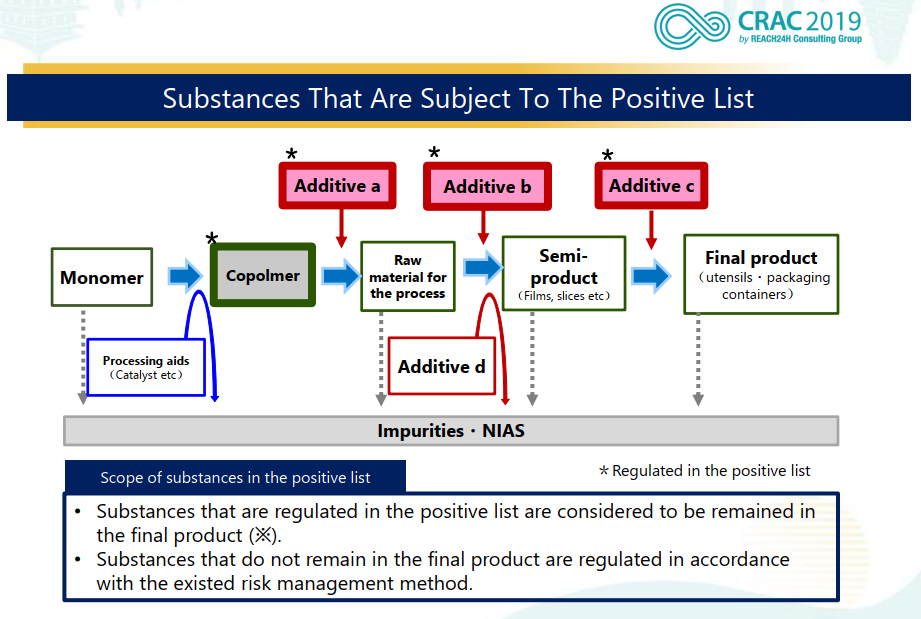 The positive lists of food contact materials were opened to public feedback in August and that will end on September 7 (refer to previous news Japan Solicits Public Feedback on Food Contact Materials Positive Lists).[3] These positive lists of polymers and additives only apply to food contact plastics (synthetic resin). Other materials like paper, paperboard, ceramic, glass will still only require compliance with current standards.
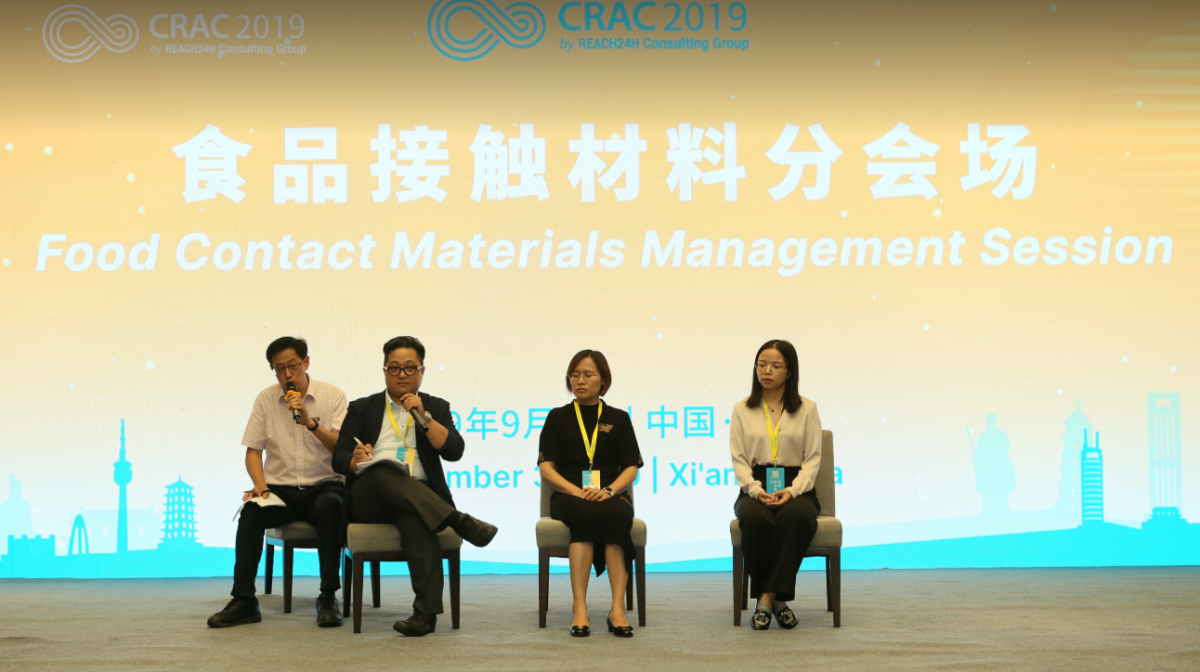 In a side session on food contact materials management, some companies asked questions about the inclusion of a mechanism which would allow both public and industry to influence the expansion of positive lists. In response Mr. Nakashima stated that the Ministry of Health, Labor and Welfare (MHLW) are currently deliberating this issue but as yet no official mechanism or procedures have been proposed.
 We provide full-scale global food market entry services (including product registration, ingredient review, regulatory consultation, customized training, market research, branding strategy). Please contact us to discuss how we can help you by