Request a Demo
As of Nov. 30, 2018, four official files about the new CBEC policy have been released by MOFCOM and MOF after the State Council meeting last week.
According to the file released by MOFCOM, CBEC retail importing refers to a consumption behavior that Chinese consumers purchase overseas commodities from CBEC third-party platforms by bonded mode or direct mail mode. The third-party e-commerce trading platforms shall connect their platforms to GAC network to facilitate the management of transaction sheet, payment sheet and logistics sheet.
The imported CBEC retail commodities (except products from endemic regions or related to severe quality safety risk) shall be supervised as products for personal use, exempt from customs import license and not subject to registration/filing.
Requirements ensured
It’s not allowed to purchase products online for subsequent pickup offline.
Consumers shall not resell the products purchased through CBEC.
Transaction limit of CBEC retail products eligible for preferential tax policy will be raised from 2000 RMB to 5000 RMB per transaction and from 20,000 RMB to 26,000 RMB per person per year.
Main responsibilities regulated for CBEC enterprises
Bear the main responsibility of quality safety.
Entrust an enterprise in China to complete the business registration in GAC.
Implement the notification obligation to consumers with a risk notice, including information of technical standards of safety, hygiene, etc.
It’s not required to have Chinese labels on product packages but enterprises shall post e-labels on the website for consumers to check the information.
Set up a quality safety risk control system and product traceability system.
Declare the transaction list to the GAC.
* For those enterprises that cannot meet supervision demands timely, they will be officially supervised on April 1st, 2019.
Policy for cities and commodity list
The supervision of import products will be supervised according to the positive list of CBEC, which was appended to include 63 types of new commodities in great demand, such as sparkling wine, malt beer and fitness equipment. Currently, 1321 commodities are listed in this list.
This list will come into force on Jan. 1st, 2019, and is applicable to 37 pilot cities/areas. They are Beijing, Tianjin, Shanghai, Tangshan, Hohhot, Shenyang, Dalian, Changchun, Ha’erbin, Nanjing, Suzhou, Wuxi, Hangzhou, Ningbo, Yiwu, Hefei, Fuzhou, Xiamen, Nanchang, Qingdao, Weihai, Zhengzhou, Wuhan, Changsha, Guangzhou, Shenzhen, Zhuhai, Dongguan, Nanning, Haikou, Chongqing, Chengdu, Guiyang, Kunming, Xi’an, Lanzhou and Pingtan.
For other cities, CBEC products are supervised under the direct mail system or the bonded mode (customs supervision area). But products like infant formula, health food and FSMP need registration/filing under the boned mode (customs supervision area) among the non-pilot cities.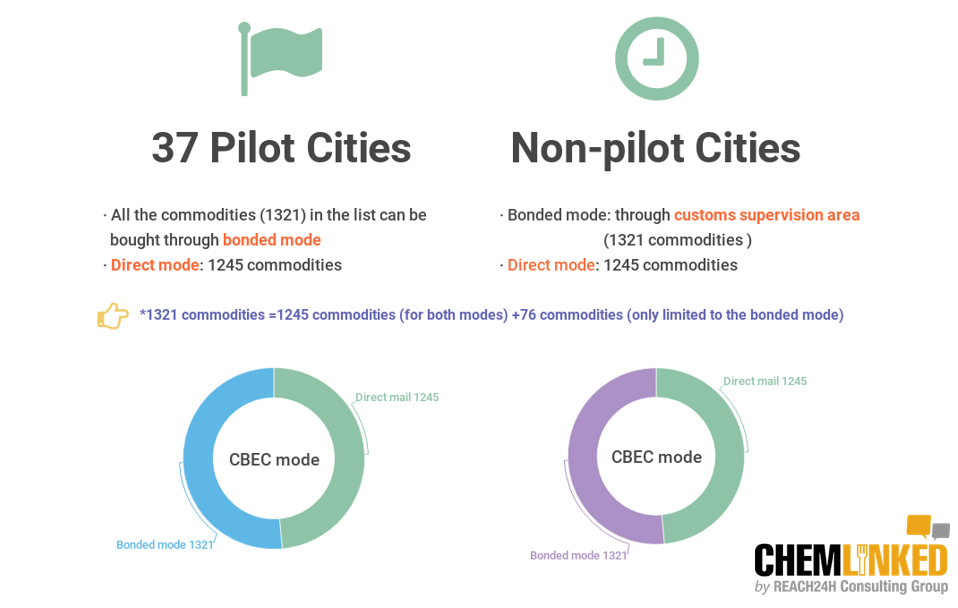
 We provide full-scale global food market entry services (including product registration, ingredient review, regulatory consultation, customized training, market research, branding strategy). Please contact us to discuss how we can help you by