Request a Demo
On April 21, 2025, South Korea Ministry of Food and Drug Safety (MFDS) announced amendments to the Food Labeling Standard. Most provisions will come into effect on January 1, 2026, except for the revisions concerning updated terms and definitions and Korean labeling on exported foods, which take immediate effect.
Key amendments are summarized below:
Expansion of foods subject to nutrition labeling
Within certain food categories, the scope of labeling calorie based on weight and displaying nutritional information has been expanded to cover more food types. Details are as follows:
Food category | Scope of food types subject to nutrition labeling |
Confectionery, bread, or rice cakes | The weight and calories based on the weight and nutritional information should be labeled, except for chewing gum |
Ice cream | The weight and calories based on the weight and nutritional information should be labeled, except for ice. |
Sugar | All food types under sugar should be labeled with the calorie content based on weight and the nutritional information. |
Edible oils and fats | All food types under edible oil and fats should be labeled with the calorie content based on weight and the nutritional information. |
Beverage | The weight and calories based on the weight and nutritional information should be labeled, except for the infused tea, roasted coffee, instant coffee, and coffee beans with only flavoring agents added. |
Sauce | The weight and calories based on the weight and nutritional information should be labeled, except for Korean meju and Korean soybean paste. |
Seasoning | The weight and calories based on the weight and nutritional information should be labeled, except for diluted acetic acid among vinegars, natural spices among processed spices, and salt |
Pickles or stewed foods | The weight and calories based on the weight and nutritional information should be labeled, except for kimchi that are not produced from cabbage |
Processed agricultural products | All food types under processed agricultural products should be labeled with the calorie content based on weight and the nutritional information. |
Processed meat product | The weight and calories based on the weight and nutritional information should be labeled, except for packaged meat (no additive of chemical compound or other food is added, as meat refrigerated or frozen as packaged, cut meat for the purpose of sale) |
Processed egg products | All food types under processed egg products should be labeled with the calorie content based on weight and the nutritional information. |
Dairy products | All food types under dairy products should be labeled with the calorie content based on weight and the nutritional information. |
Processed fishery products | All food types under processed fishery products should be labeled with the calorie content based on weight and the nutritional information. |
Processed animal products: | The weight and calories based on the weight and nutritional information should be labeled, except for other meat and eggs. |
Honey and processed pollen products | All food types under honey and processed pollen products should be labeled with the calorie content based on weight and the nutritional information. |
Ready-to-eat foods | All food types under ready-to-eat foods should be labeled with the calorie content based on weight and the nutritional information. |
Other foods
| All food types (yeast food and other processed products) under other foods should be labeled with the calorie content based on weight and the nutritional information. |
Introduction of nutrition labeling formats for foods composed of natural and processed foods
With the rapid growth of the home convenience food market, the need for nutrition labeling for meal kit products has increased to ensure consumer access to nutritional information. In response to the trend, the MFDS introduces the nutritional labeling formats for products, like meal kits, that combine uncooked and trimmed natural foods with processed foods. Notably, the nutritional values for the natural foods may be based on the values provided in the MFDS food nutrition database.
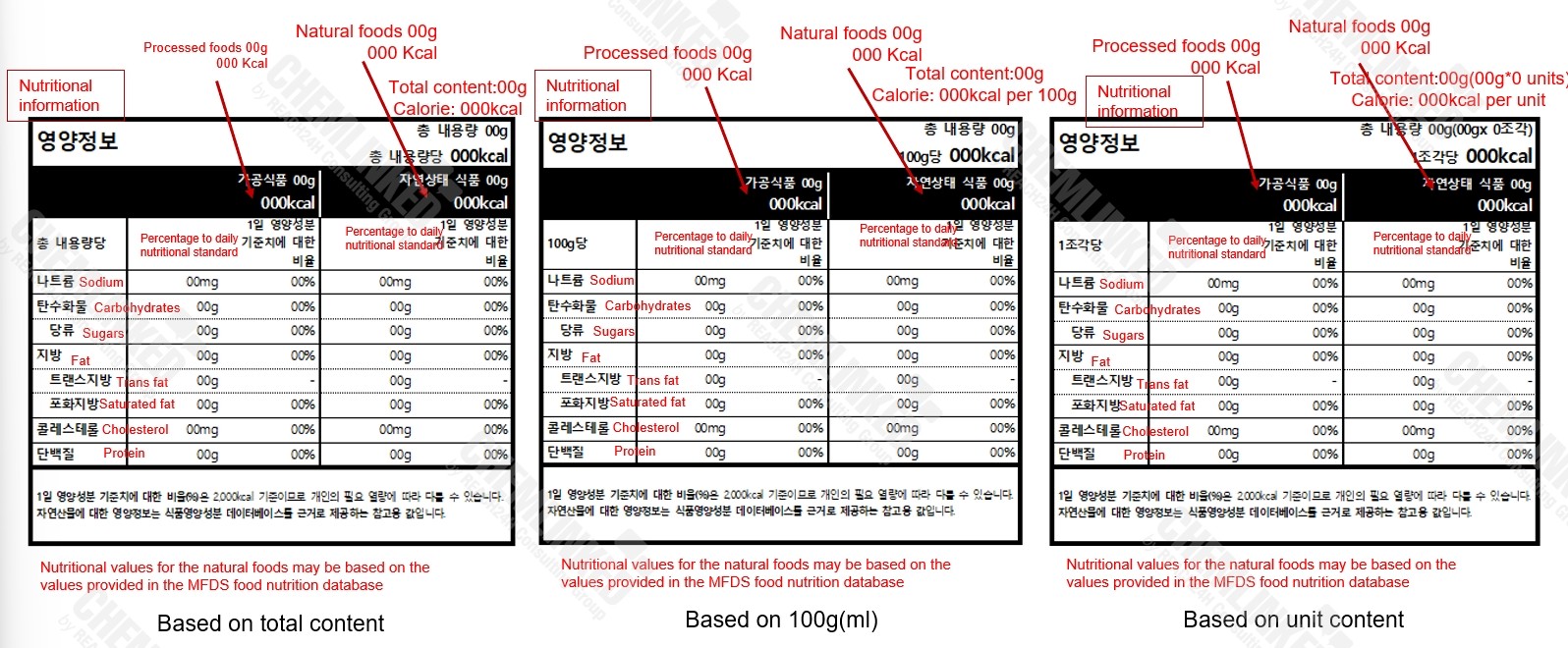
Nutrition labeling formats for foods composed of natural and processed foods
Revisions to certain terms and definitions
Certain terms and definitions are revised to align with partial revisions to the Food Code and the Food Additive Code.
Permission to relabel exported foods with Korean labels
Previously, Korean food exports labeled solely in a foreign language could not be relabeled in Korean language when export issues unrelated to food safety, such as contract cancellations, occurred. This restriction caused business losses and resource waste.
The amendment now allows for the use of adhesive stickers or other methods to affix Korean labels to such food products, provided the foods will be donated locally, used at events (e.g., fairs, international events, local government events), supplied for manufacturing, processing, or cooking purposes, or included in group meal menus as finished products. This measure aims to reduce waste and minimize losses for local business operators.
 We provide full-scale global food market entry services (including product registration, ingredient review, regulatory consultation, customized training, market research, branding strategy). Please contact us to discuss how we can help you by