Request a Demo
As revealed by a notification issued by Thai Food and Drug Administration (FDA) on May 23, 2024, in order to make up for the supervision vacancy of alternative protein products, Thai FDA issued a draft named “Proposal for Developing Regulations and Regulatory Measures Governing the Supervision of Alternative Protein Products”, involving the products’ technical requirements, labeling and contaminant levels. The consultation period will end on June 7, 2024.
“Alternative protein products” mentioned in the draft refers to products whose main ingredients are derived from plants, certain edible microorganisms or seaweeds, and are processed through separation and extraction methods. It includes plant-based meat, plant-based beverage as well as plant-based substitutes.
The plant used as raw materials for alternative protein products should align with Good Agricultural Practices (GAP) and its processing should follow the principle of Good Manufacturing Practices (GMP). The use of food additives should be based on MOPH Notification No. 444 B.E.2023 Re: Prescribing the Principle, Conditions, Methods, and Proportion of Food Additives (No.3), With food classification as the key for compliance, the draft lists some examples for product types and their corresponding food categories.
Product type | Product examples | Food category |
Plant-based meat products or plant-based protein products | Protein products (not soy protein) used as meat and fish substitutes, such as plant-based nuggets, plant-based bologna, and plant-based patties | 12.10 Other protein products that are not soy protein |
Agricultural proteins made from soy protein | 06.8.8 Other products with soy protein as a major ingredient | |
Plant-based milk beverages | 100% unsweetened almond milk drinks | 14.1.5 Coffee, coffee substitutes, tea, herbal infusions, and cereal beverages, excluding cocoa, flavored cereal drinks |
Soy milk drinks (unsweetened/sweetened) (fermented/unfermented) | 06.8.1 Soy milk drinks | |
Sweetened pistachio milk drink | 14.1.4.2 Non-carbonated flavored drinks | |
Plant-based dairy alternative products | Plant-based dairy alternative products | 06.5 Confectionery products with cereal and starch as main ingredients |
Coconut-based yogurt alternative (spoonable) | 04.1.2.9 Sweetened fruit-based desserts | |
Coconut-based ice cream | 02.4 Desserts with fat as a main ingredient | |
Soy-based butter alternative | 01.6.5 Butter analogues |
Basically, the labeling of alternative protein products should comply with MOPH Notification No. 367 Re: Labeling of Prepackaged Foods. In addition, the draft details the naming and claiming criteria for plant-based meat, plant-based milk beverage and dairy alternative products. The following lists some key items of the labeling requirements.
Plant-based meat
Plant-based meat can have names consistent with the physical characteristics of the products (e.g., "nuggets"). Meanwhile, the plant or the main ingredient should be indicated in the name. such as “plant-based nuggets or soy nuggets”. However, terms like “meat”, “meat product”, “clean meat”, etc. cannot be used, as they are quite confusing. When it comes to the claims, plant-based meat is allowed to have the statements indicating the use of flavoring agents for mimicking normal products, such as "Plant-based meatball flavored to resemble pork". Plant-based meat is also permitted to display the image of the source plant of the ingredients, but animal images are prohibited. Moreover, on the package plant-based meat products can have standard logo certified by reputable domestic and international agencies, such as those certified by the National Sanitation Foundation (NSF) or SCS standard.
Plant-based milk drink and dairy alternative products
The plant source can be included in their product names, such as “cereal milk drink” and “almond milk drink”. If more than two plant ingredients are used, the plant names can be listed based on facts. For example, for products containing soybeans, almonds, and cashew nuts, it can be named as “Soy milk mixed with nuts”. However, plant-based milk’s name should not involve terms that are inaccurate, ambiguous, or may cause misunderstanding that it is milk or a dairy product derived from animals, such as "dairy-free milk. Moreover, phonetic spellings like "mylk” and terms related to production process like “semi-skimmed” are not allowed either. Similar with plant-based meat, plant-based milk drink and dairy alternative products can display the image of plants which are the source of the ingredients but animal images are not allowed. In addition, logo certified by reputable domestic and international agencies can be labeled.
Moreover, the competent authority drafts the maximum level of contaminants, pesticide residue and microorganism for the raw materials of alternative protein products in Appendix 1 of the draft. Please click here for more details.
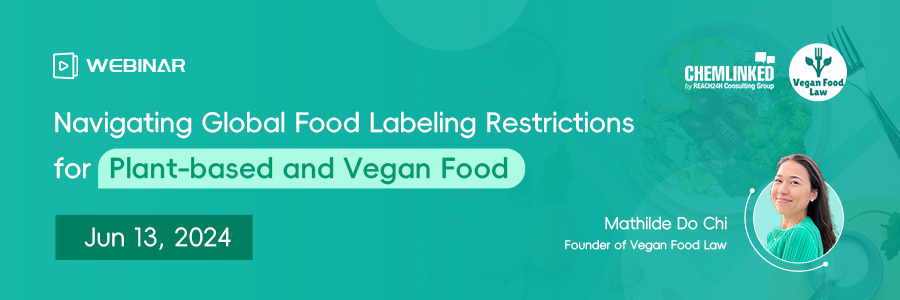
On June 13, 2024, ChemLinked will hold the webinar regarding global Food labeling restrictions for plant-based and vegan Food. Click the picture below to join us for free!
 We provide full-scale global food market entry services (including product registration, ingredient review, regulatory consultation, customized training, market research, branding strategy). Please contact us to discuss how we can help you by