Request a Demo
On May. 6, 2021, China issued a statement to indefinitely suspend all activities under China-Australia Strategic Economic Dialogue, which exacerbated the bilateral ties to hit a new low.1
According to Wei Jianguo, the former Vice Minister of Commerce, China-Australia Strategic Economic Dialogue played a critical role in the exchanges between the two countries. Wei pointed out that China-Australia bilateral economic and trade activities and investments, including cultural, scientific and technological exchanges, may all be halted due to the suspension.2 The Dialogue was regarded as the "premier bilateral economic meetings with China" as Canberra previously described.3
The suspension has aroused widespread concern in Australian business community. "Business and consumers in China take their cues from Beijing and there is no disguising the parlous state of the political relationship with Australia. This will have an impact over time as business and consumers look elsewhere." Australia China Business Council expressed grave concern.4
As the tension keeps increasing, China has raised trade barriers over Australian goods from beef, barley to wine. Will Australian dairy products become the next victim in China-Australia trade friction?
1. Australia in China's Imported Dairy Market
As the largest import market of dairy products in the world, millions of tonnes of dairy products are exported to China every year. Australia is one of the most significant exporters of dairy products for China. From 2019 to 2020, Australia exported close to 198,000 tonnes of dairy products to China, worth US$566 million. Australia ranks the fourth in the share of China's import volume, with a growth of 36.6% over the past five years.
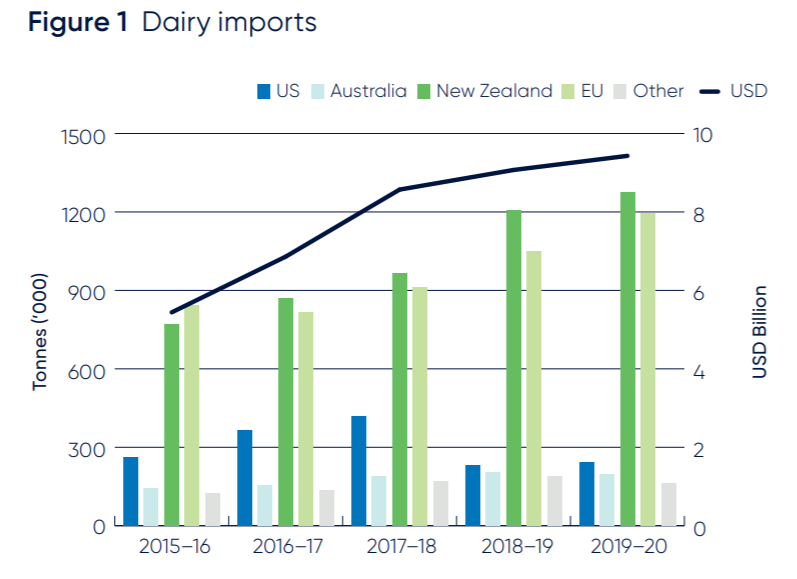 *Source: Market Brief - China from Dairy Australia
2. China-Australia Free Trade Agreement Helps a Lot
Benefited from the Free Trade Agreement (FTA) between China and Australia, which was officially signed on Jun. 17, 2015 and with effect from Dec. 20, 2015, a lot of Australian goods are allowed to enter the Chinese market at low tariffs and prices. The FTA sets a transition period of 5, 10 and 12 years respectively for dairy products. After full liberalization, the average import customs duties of dairy products will be reduced from 12.3% to 0%. Among them, the 10% tariff on milk powder will be reduced to 0% in 12 years after the agreement comes into force.
Now almost six years have passed since the signing of the FTA, Australia remains the fourth largest dairy products exporter to China. Will the FTA continue to play a significant role? or even get an upgrade? or maybe lose its shine gradually. According to the report from South China Morning Post on Dec. 9, 2020, neither China nor Australia has shown the enthusiasm or willingness to further upgrade their bilateral trade relations, given their worsening trade dispute.6 Affected by the relations between China and Australia, it seems the way ahead China-Australia FTA is becoming more unpredictable. By contrast, New Zealand has successfully upgraded its FTA with China earlier this year. Notably, New Zealand has already dominated China's imported dairy market as the largest dairy products exporter for years. Rely on existing advantages and favorable policies, New Zealand might leave its neighbor more behind in terms of the performance on the Chinese market.
3. Possible Obstacles for Australian Dairy Products on Market Entry
With the rising trade barriers as well as the escalating tension between China and Australia, all goods from Australia may encounter different degrees of obstacles when entering the Chinese market, including the delay of customs clearance, the slowdown of the approval process, or even different degrees of restrictions and prohibitions, etc. The obstacles can be fiercer in the context of China's increasingly strict stipulation and implementation of laws and regulations.
For instance, in November 2020, China released "Special Food Registration On-site Inspection Requirements (Interim)", which also applies to imported special food (special food refers to health food, infant formula and food for special medical purposes). According to the Requirements, overseas manufacturers are required to prepare for on-site inspection to complete the registration. In addition, with the release of new GB standards for infant formula milk powder, both domestic and overseas enterprises are prompted to update their formula for the compliance with the new standard, which requires extra registration processes. Given the changes in regulations, geographic boundaries and the uncertainty of bilateral relations, Australian applicants may find it tougher to complete the registration, thus affecting the market entry of Australian dairy products.
4. ChemLinked's Insight
Based on the status quo and the factors mentioned above, ChemLinked believes that the suspension of China-Australia Strategic Economic Dialogue may affect the approval process for Australian dairy products which by no means amounts to an overall ban at present. Undeniably, Australian goods including dairy products are still beloved, which can be proved by their performances in Chinese market over the years. Besides, it is a truism that all relations have their ups and downs, and bilateral ties are bound to exert an influence on trade cooperation. Once the relations begin to thaw, trade cooperation between the two countries is likely to win its prosperity back. From the view of Wei Jianguo, the suspension mainly symbolizes a severe warning for Australia. As China Ministry of Commerce's stance on the trade issue with Australia, China hopes that Australia will do more to strengthen mutual trust and cooperation, boosting the healthy and stable development of bilateral economic and trade relations.7
 We provide full-scale global food market entry services (including product registration, ingredient review, regulatory consultation, customized training, market research, branding strategy). Please contact us to discuss how we can help you by