Request a Demo
Brief background
China is the largest market for online trade around the world. Benefiting from Chinese government’s policies, online trade value is increasing dramatically year by year and may reach 10 trillion USD by the end of 2016. Previously, foods exported to China had to go through a long-winded and complete custom clearance process with many restrictions in foreign exchange management. The new trade model of cross-border e-commerce (CBEC) has changed the situation greatly.
The B2C type of CBEC, which enables consumers to purchase overseas products directly through CBEC platforms, is the mainstream model in China. Compared to general trade, CBEC B2C model enjoys a better tariff policy and accelerated customs clearance. Moreover, customs clearance procedures are simplified as goods are exempt from providing an import permit certificate and Chinese label. There are two models of B2C CBEC, namely bonded import and direct import. Bonded import is based on bulk shipments to China’s bonded areas and it takes a few days to distribute the products from the bonded area to consumers, while direct import is normally through small parcel or bulk shipmen from the country of origin, and takes a much longer time than bonded import model. Current CBEC data shows that the bonded import model dominates the market and accounts for more than 85% of the total trade.
Starting in 2012, CBEC platforms were firstly introduced in 7 pilot cities. A series of implementation rules were issued by the authorities to optimize CBEC B2C model gradually in 2014 and 2015 enabling CBEC to expand quickly in China. The import value via CBEC boomed in 2015 increasing 37.4 fold compared to the value in 2014.
Regulatory landscape in 2016
2016 witnessed a huge reform in the CBEC industry. Key regulatory issues are listed as followed.
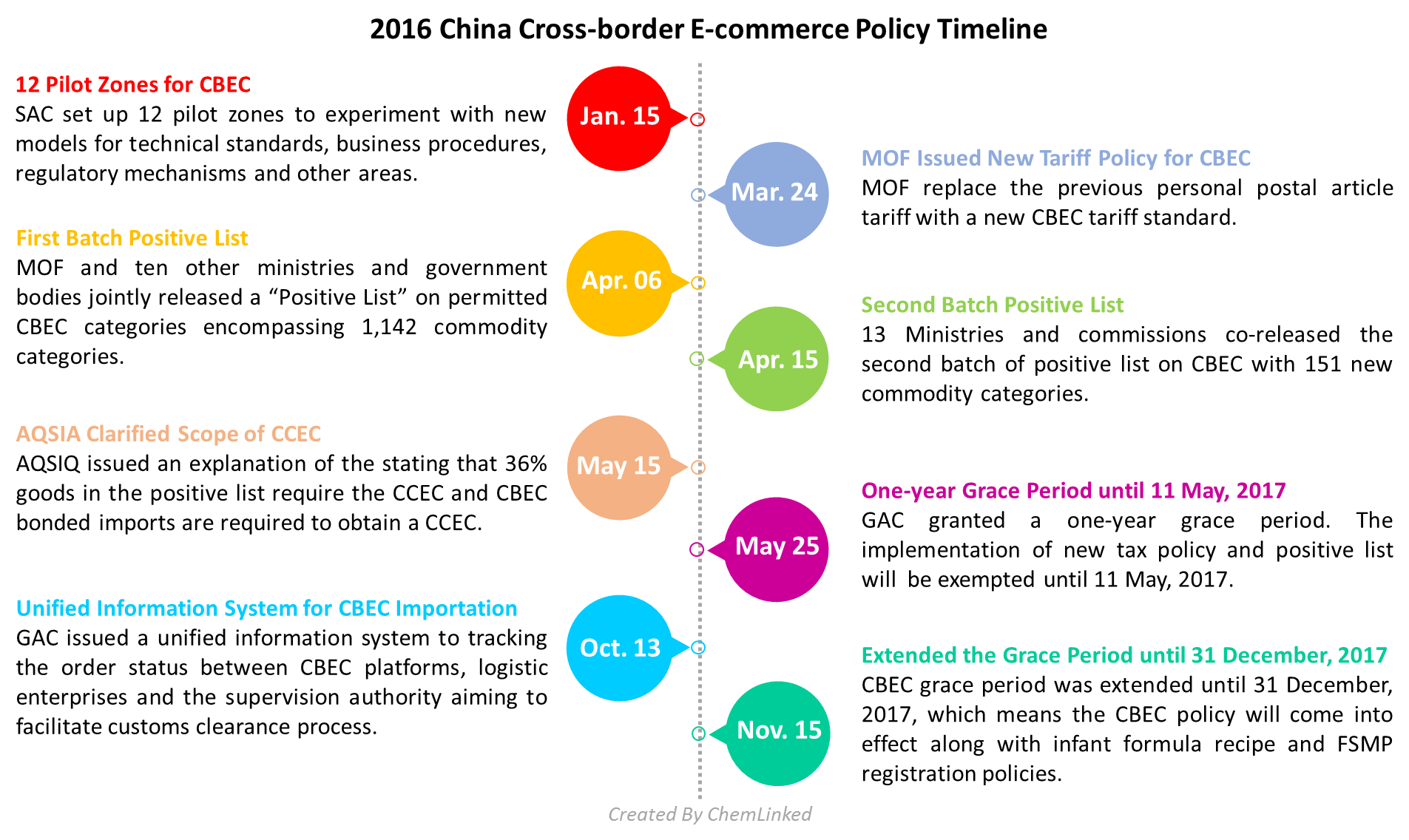
A series of supporting policies were issued in 2015 which boosted the development of CBEC. In 2016 the government began tightening up CBEC supervision. In March and April, a new tariff policy and two batches of permitted commodity category lists (Positive List) were released by relevant authorities for CBEC B2C trade which has changed the current landscape of CBEC in China.
New tariff policy
Previously, CBEC adopted the postal article tax of 10%, and the tax on baggage and articles was free if the amount was less than RMB 50. The new tariff replaces the postal article tax with a combination of an import tariff, VAT and consumption tax at 70% of the total value. i.e. (tariff + VAT + Consumption tax) * 70%. Most food and beverage products are now subject to a tax rate of 11.9%. The new policy also stipulates that the amount of a single order will be limited to 2, 000 RMB and the annual individual consumption of CBEC products would be restricted to 20, 000 RMB. The policy came into effect since the 8th of April.
Positive list
Only permitted commodity categories can be sold on CBEC platforms. The first and second batch of positive list contains 1,293 commodity categories. Among the list, there are 77 commodity categories are not allowed to be imported through the direct shipping model. Special food categories included in the positive list should obtain pre-market clearance from CFDA. To understand more about the tax reform and positive list of CBEC, please refer to our report of “A Comprehensive Guide to China Cross Border E-Commerce Regulatory Reforms”.
In May, AQSIQ confirmed that CBEC commodities need to obtain the customs clearance of entry commodity (CCEC) but only 36% of goods in the positive list are included in the catalogue which requires the CCEC. In addition, only CBEC bonded imports are required to obtain a CCEC (see CL news on 18th May, 2016). To obtain a CCEC, importers or its agent should apply for inspection to CIQ by submitting a dossier including packing lists, invoice, bill of landing, country of origin, sanitary certificate, test report, certificate of free sale, Chinese label, and CFDA certificate for particular food categories etc. Due to the uncertainties in procedures and supervision of inspection and quarantine, the authority granted a grace period and the positive list and CCEC policy will be effective after January 1st of 2018. During the grace period, pilot cities are encouraged to develop proper implementation measures.
Influence on the market
Highlights:
New tax policy reduces the competitive price advantage of CBEC;
Positive list may force traders to adjust import commodity categories, and some niche and customized products will no longer be traded through CBEC market;
Implementation of the positive list will establish higher market access requirements for bonded import model;
The customs clearance requirement for bonded import places imposes regulatory restrictions similar to that of standard trade
Special food traders may withdraw from the bonded import model, or should prepare for registration and filing as soon as possible;
Direct import model is exempt from CCEC, which should foster development in this sector
Implementation requirements in different pilot cities are different.
The development of China’s CBEC has gone through significant reform after the new tax policy and positive list policy, however, CBEC in China is still growing rapidly. According to data from the GAC, the CBEC import value over the past 3 seasons is 17.31 billion RMB, while the annual CBEC import value of 2015 is 18.16 billion RMB.
The bonded import model underwent a significant dip in performance after the new policy, but has rebounded quickly. On the other hand, the regulation provides a much needed stimulus for companies to pursue the direct import model and many Chinse CBEC platforms are setting up overseas warehouses to develop this area along with numerous multinationals planning to enter the Chinese market.
According to the current policy, after the grace period, the requirements for bonded import will be similar to general trade. Customs clearance requirements (mainly CCEC) for bonded import may force some food traders to withdraw from CBEC, especially for special food categories (including infant formula, health food and food for special medical purposes). Under the new policy, special food products sold via CBEC should obtain a pre-market clearance from CFDA. It can be expected that importers may stockpile products in the second half year of 2017 to meet the potential product shortage in early 2018. In addition, according to a speech by Mr. Ye Zhiping, a former government official involved in CBEC regulation, CBEC traded commodities may not be exempted from overseas manufacturer registration obligations (see CL news on 28 Sep. 2016).
CBEC is still in its infancy and as a pilot project new regulations and rules are released from time to time which is a difficult situation for traders. There are still numerous regulatory gaps such as the fact that the Product Quality Law, and Consumer Protection Act currently do not apply to CBEC and we can expect these gaps to be filled by new regulations in the near future. In the meantime, municipal CIQs or CBEC platforms are required to establish traceability systems and internal norms to protect consumer’s right. The authority is also drafting an electronic commerce law, which will be a more detailed regulation to supervise CBEC activity. The draft of the electronic commerce law is expected to be released in 2017.
 We provide full-scale global food market entry services (including product registration, ingredient review, regulatory consultation, customized training, market research, branding strategy). Please contact us to discuss how we can help you by