Request a Demo
Part I Text Analysis
Basic introduction
The National Health and Family Planning Commission of the People’s Republic of China released National Food Safety Standard GB 7101-2015 Beverages on 13th November 2015 which will come into effect on 13th November 2016.
1) GB 7101-2015 is a revised combination of the following national standard:
GB 2759.2-2003 Hygienic Standard for Carbonated Drinks
GB 7101-2003 Hygienic Standard for Solid Drink
GB 11673-2003 Hygienic Standard for Milk Beverage
GB 16321-3003 Hygienic Standard for Lactobacillus Beverage
GB 16322-2003 Hygienic Standard for Vegetable Protein Beverage
GB 19296-2003 Hygienic Standard for Tea Drinks
GB 19297-2003 Hygienic Standard for Fruit and Vegetable Juice
GB 19642-2005 Hygienic Standard for Cocoa powder Based Solid Drink
All the standards listed above will be replaced by GB 7101-2015 and become invalid on 13th November 2016.
2) GB 7101-2015 is not applicable to packaged water for drinking, which is regulated by GB19298-2014. GB 7101-2015 serves as a fundamental and leading food standard for beverages circulating in China. Attention to the key defining criteria of certain beverages like sports beverages, which are regulated by GB15266-2009.
Main stipulations
1) Physicochemical index
Table 1
Item | Index | Measurement method |
The total amount of zinc, iron and copper(mg/L)a ≤ | 20 | GB5009.13 Method for determination of copper in food GB5009.14 Determination of zinc in food GB5009.90 Determination of iron, magnesium and manganese in food
|
Cyanide(HCN)/(mg/L) b ≤ | 0.05 | GB/T 5009.48 Method for analysis of hygienic standard of distilled wines and mixed wines |
Urease test c | Negative | Vegetable protein beverage should be measured by the standard of GB/T 5009.183 Qualitative analysis of urease in vegetable protein drinking |
Note: Solid beverage and concentrated beverage dissolved according to the proportion in the labeling should in compliance with this standard. | ||
a is only applicable to metal canned fruit and vegetable juice drink. b is only applicable to beverages of which almond is the ingredient. c is only applicable to beverages of which soy bean is the ingredient. | ||
2) Contaminants and fungimycin limits
The contaminants limits shall be in compliance with GB2762 Maximum levels of contaminants in food.
The fungimycin limits shall be in compliance with GB2761 Maximum levels of mycotoxins in food.
3) Maximum residue limits for pesticides
The maximum residue limits for pesticides shall be in compliance with GB 2763 Maximum residue limits for pesticides in food.
4) Microorganism limits
4.1) The limits of pathogenic bacteria shall be in compliance with GB29921 Maximum levels of pathogenic bacteria in food.
4.2) The products manufactured by commercial sterilization shall be examined in accordance with GB4789.26 Microbiological examination of food- Examination of commercial sterilization.
4.3) The products that do not go through the process of commercial sterilization shall be in accordance with Table 2.
Table 2
Item | Sampling scheme a and limits | Measurement method | |||
n | c | m | M |
| |
Aerobic plate count b/(CFU/g or CFU/mL) | 5 | 2 | 102(103) | 104(5×10⁴) | GB4789.2 |
Coli form/(CFU/g or CFU/mL) | 5 | 2 | 1(10) | 10(102) | GB4789.3 Plate counting method |
Molds /(CFU/g or CFU/mL) ≤ | 20(50) | GB4789.15 | |||
Yeasts c/(CFU/g or CFU/mL) ≤ | 20 | GB4789.15 | |||
Note: The limits in the brackets are only applicable to solid drinks and the m of aerobic plate count of milk tea, soybean milk powder and cocoa solid drinks equals to 104 CFU/g. | |||||
a The analysis and processing of samples shall be in accordance with GB4789.1 and GB/T4789.21. b is not applicable to lactobacillus beverage with live unsterilized lactobacillus. c is not applicable to solid drinks. | |||||
5) Food additives and nutritional fortification substances
5.1) The food additives in beverages shall be in compliance with GB2760 National Food Safety Standard- Standard for Uses of Food Additives.
5.2) The nutritional fortification substances shall be in compliance with GB14480 National Food Safety Standard- Standard for Uses of Nutritional Fortification Substances.
6) Miscellaneous
6.1) Live lactobacillus Form (Unsterilized) or Non-Viable lactobacillus Form (Sterilized) should be indicated clearly on the labeling of lactobacillus beverages. The total amount of lactic acid bacteria of the Live lactobacillus Form (Unsterilized) should be no less than 106 CFU/g(mL).
6.2) The storage and transportation conditions should be indicated clearly on the labeling of Live lactobacillus Form (Unsterilized) that needs to be stored and transported in refrigeration.
Part II Case Illustration
According to the statistics released by The General Administration of Quality Supervision, Inspection and Quarantine of PRC (data source: http://jckspaqj.aqsiq.gov.cn/), 2,804 food import failures were detected by 21 Chinese provinces or cities due violations of Chinese national standards. Shanghai, Xiamen and Shenzhen were the top three cities in terms of reported food import breaches.
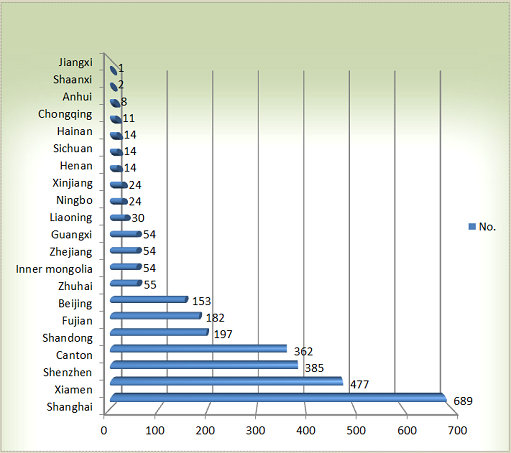
According to the China Imported Food Quality and Safety in the first half of 2015 Whitepaper released by AQSIQ, beverages surpassed all other foods in the list of imported food failing compliance check at port in the first half of 2015.
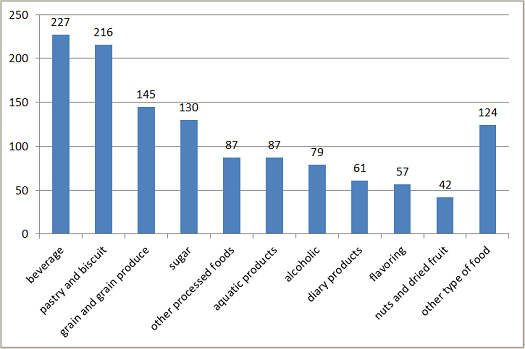
(Data source: The General Administration of Quality Supervision, Inspection and Quarantine of PRC)
Statistics show us that The General Administration of Quality Supervision, Inspection and Quarantine of PRC listed nearly 250 different causes that brought about the 2,804 cases of failed food import. After scrutinizing the monthly report from January to December 2015 concerning the failed food and cosmetics, we found over 34 causes that directly resulted in beverage noncompliance during import. The causes mainly fall into the following categories.
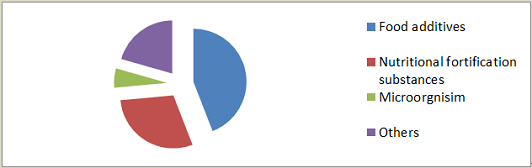
Failures resulting from breaches to standards regulating food additives and nutritional fortification substances are the two most notable noncompliance factors. Exceeding microorganism limits was the third highest cause of beverage noncompliance during import. Furthermore, labelling defects, genetically modified ingredients and other reasons also prevented foreign beverage manufactures from entering Chinese food markets. Table 3 and table 4 will give a detailed illustration of the compliance failures as referenced with the stipulations in GB2760-2014 and GB 14880-2012 respectively.
Table 3 Failures caused by food additives
Causes | Product examples | The right way |
Excess use of benzoic acid | Lemonade | The maximum limit of benzoic acid in carbonated drinks is 0.2 g/kg. |
Excess use of sulphur dioxide | Fruit and vegetable juice | The maximum limit of sulphur dioxide in fruit and vegetable juice drinks is 0.05 g/kg. |
Excess use of tartrazine | Mango drink | The maximum limit of tartrazine in beverage is 0.1 g/kg. |
Excess use of sunset yellow | Carbonated drinks | The maximum limit of sunset yellow in beverage is 0.1 g/kg. |
Wrong use of erythrosine | Taro-flavoured solid drinks
| According to GB2760-2014, erythrosine shall not be put into solid beverage as a food additive. |
Wrong use of sodium saccharin
| Lemonade or fruit juice | According to GB2760-2014, sodium saccharin shall not be put into lemonade or fruit juice drinks as a food additive. |
Wrong use of caffeine | Solid drinks | According to GB2760-2014, caffeine can only be put into cola-type carbonated drinks as a food additive. |
Wrong use of gardenia yellow | Carbonated drinks | According to GB2760-2014, gardenia yellow can only be put into fruit and vegetable juice drinks, solid drinks and fruit-flavoured drinks as a food additive. |
Wrong use of carmoisine
| Carbonated drinks | According to GB2760-2014, carmoisine shall not be put into carbonated drinks as a food additive. |
Wrong use of caramel colour | Carbonated drinks | According to GB2760-2014, caramel colour shall not be put into carbonated drinks as a food additive. |
Table 4 Failures caused by nutritional fortification substances
Causes | Product examples | The right way |
Excess use of calcium
| Fruit drinks | According to GB 14880-2012, the use of calcium in fruit drinks shall be between 1000mg/kg and 1800 mg/kg. |
Excess use of magnesium
| Solid drinks | According to GB 14880-2012, the use of magnesium in solid drinks shall be between 1300mg/kg and 2100 mg/kg. |
Excess use of Vitamin C
| Solid drinks | According to GB 14880-2012, the use of Vitamin C in solid drinks shall be between 1000mg/kg and 2250 mg/kg. |
The content of Vitamin B1 is not in compliance with national standard. | Solid drinks | According to GB 14880-2012, the use of Vitamin B1 in solid drinks shall be between 9mg/kg and 22 mg/kg. |
The content of Vitamin B2 is not in compliance with national standard. | Milk beverage | According to GB 14880-2012, the use of Vitamin B2 in milk beverage shall be between 1mg/kg and 2 mg/kg. |
The content of L-carnitine is not in compliance with national standard. | Flavoured drinks | According to GB 14880-2012, the use of L-carnitine in flavored drinks shall be between 600mg/kg and 3000 mg/kg. |
Wrong use of folic acid
| Energy drinks | According to GB 14880-2012, folic acid can only be added into fruit and vegetable juice drinks and solid drinks. |
Wrong use of Vitamin A
| Fruit juice drinks | According to GB14880-2012, Vitamin A shall not be added into fruit juice drinks. |
Wrong use of biotin | Solid drinks | According to GB14880-2012, biotin shall not be added into solid drinks. |
The Chinese beverage market is extremely competitive. The growth in key areas such as probiotic drinks and fortified drinks provide telling evidence on the potential of the market. Increased financial inputs into R&D are also yielding innovative added-value products and further increasing the competiveness and offering increasingly demanding consumers more purchasing options. In line with the growth in the market and trends towards innovation the Chinese government is increasing the stringency of its regulations and the frequency of its inspections. Knowledge of regulations is crucial in designing a cost effective and efficient market access strategy.
 We provide full-scale global food market entry services (including product registration, ingredient review, regulatory consultation, customized training, market research, branding strategy). Please contact us to discuss how we can help you by