Request a Demo
On April 13 2021, General Administration of Customs of China (GACC) issued the latest version of "Administrative Measures on Safety of Import and Export Food" (hereafter as the "Measures"), which will take effect on January 1, 2022. Later on November 5, 2021, GACC released a follow-up document as the interpretation for the Measures. Among many critical changes brought by the Measures, new labeling requirements are of top priority for stakeholders to keep an eye on. As it is only one step away from 2022, ChemLinked sums up the upcoming new labeling requirements for three categories of imported food to China.
1. Imported Health Food & Food for Special Dietary Uses
According to the Measures, the Chinese labels of imported health food and special dietary food must be printed on instead of affixed to the smallest sales package. Hence, food importers and overseas manufacturers need to make sure the Chinese labels are ready before import, otherwise the imported foods will be rejected due to unqualified labeling.
 An imported health food with Chinese label affixed, which will be impermissible soon
2. Imported Fresh and Frozen Meat Product
The Measures specify that for an imported cold fresh meat product, its inner and outer packaging shall both bear a secure, clear, and legible written identification in Chinese and English, or in Chinese and the language of the export country (region). The following information shall be indicated:
country or region of origin;
name of the product;
registration number of the production enterprise, and production lot number.
Besides, the outer packaging shall bear the specifications, place of origin (specific to state, province, or city), place of destination, production date, shelf life, storage temperature, and other necessary information in Chinese, and carry the official inspection and quarantine mark of the export country (region). The People's Republic of China, as the place of destination, shall be clearly indicated on the outer packaging.
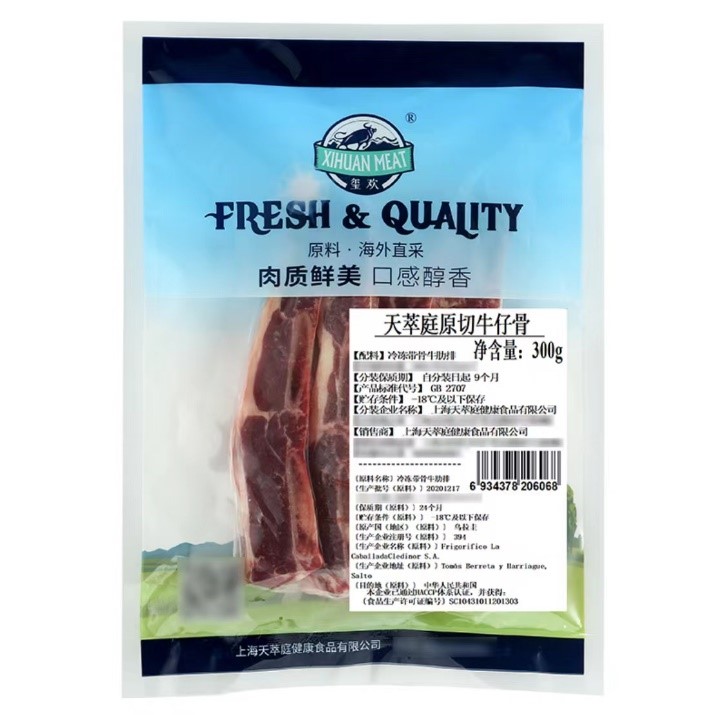 Current label example of imported meat product
3. Imported Aquatic Product
For imported aquatic product, the requirements are similar. Its inner and outer packaging shall both bear a secure, clear, and legible written identification in Chinese and English, or in Chinese and the language of the export country (region). The following information shall be indicated:
name of the goods and scientific name;
specifications;
production date;
lot number;
shelf life, and storage conditions;
production method (seawater fishing, freshwater fishing, or aquaculture);
production area (sea area in the case of ocean fishing, country (region) in the case of freshwater fishing, or country (region) where the aquaculture product originates);
the name, registration number, and address (specific to state, province, or city) of each production and processing enterprise involved (including fishing vessel, processing vessel, transport vessel, orindependent cold store);
the place of destination—People's Republic of China (shall be clearly indicated).
In addition, if imported aquatic products directly enter China's consumer market, they must be indicated all above items. If imported aquatic products do not directly enter China's consumption market (e.g., being used as raw materials for processing and re-export), all the labeling information should be marked on pallets, containers or shipping cabins, which are recognized as independent packaging units.
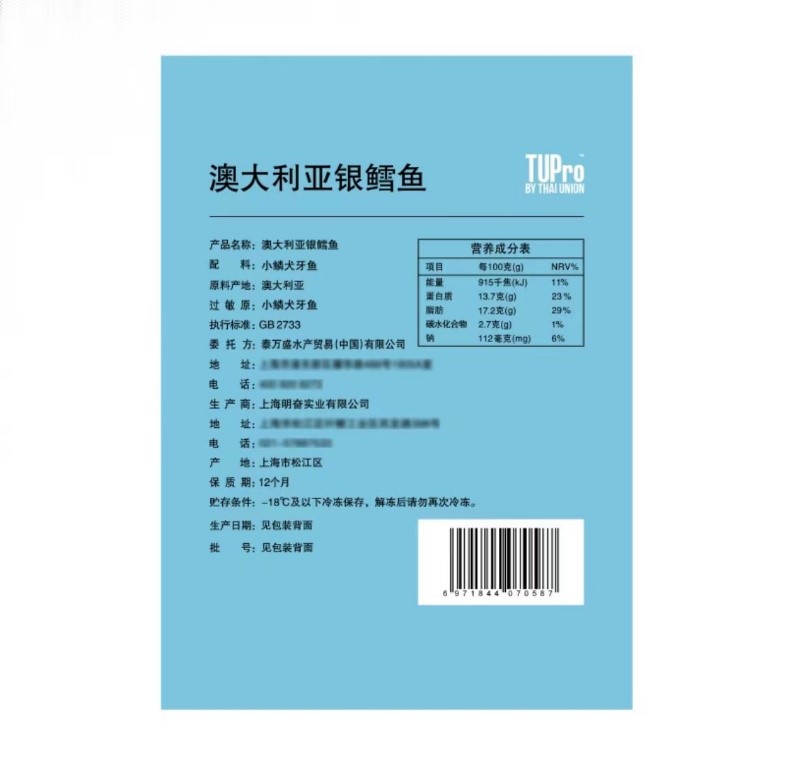 Current label example of imported aquatic product
Notes 1: According to the new version of "Administrative Provisions on Registration of Overseas Manufacturers of Imported Foods", a registered manufacturer shall mark the Chinese registration number or the registration number approved by the competent authority of the country/region on both the inner and outer packaging of the foods exported to China. Inner and outer packaging refers to the transport packaging and sales unit. Therefore, the Chinese registration number will be a mandatory labeling item for all kinds of foods.
Notes 2: All labeling requirements mentioned above only apply to imported food via general trade. Foods that are carried or mailed into China, or sold on CBEC platforms are exempted.
 We provide full-scale global food market entry services (including product registration, ingredient review, regulatory consultation, customized training, market research, branding strategy). Please contact us to discuss how we can help you by