Request a Demo
To help ensure global food safety and also address animal and plant health concerns, WTO adopts the Agreement on the application of Sanitary and Phytosanitary Measures (SPS) and Agreement on Technical Barrier to Trade (TBT). Together the 2 documents form a basic reference to allow WTO members to develop equitable legislative frameworks, foster safe trade of commodities and products and helps prevent countries from developing anti-competitive and protectionist technical barriers to trade.
Member countries are required to notify other countries of any new or revised regulations which affect trade and to set up offices (official enquiry points) to answer requests for more information on new or existing measures at the WTO level. In regards to pesticide, TBT includes pesticide/chemical registration regulations and measures concerning food safety, production, environmental and labeling, etc., while SPS relates more to MRL establishment/amendment/exemption/cancellation, crop grouping and other agricultural or technical practice related to pesticide uses etc.
China participated in the WTO TBT/SPS notification activities as early as 2003 and already developed a mature response system to support international trade of agricultural products, protect its domestic agricultural production and consumers. Through the introduction of official comment on MRL notification and studies of recent cases, this article aims to demystify how these WTO MRL notifications impact China’s national pesticide MRL establishment.
Workflow of Official Comments
In the last 2 years, China has made very few WTO notifications on new enactment or amendment of pesticide regulations and the majority of these notifications involved establishment, amendment or cancellation of pesticide MRLs. An official inquiry point was established at the National Quality Standardization Center of Agricultural Product under the MoARA (Ministry of Agricultural and Rural Affair), which receives notifications from 19 countries/regions including the US, EU, Brazil, Canada and New Zealand etc. Each notification will be sent to relevant government body/institutions covering pesticide management, trade, economic and administration, etc. and expert opinions will be collected and concluded at CCPR Secretariat (a branch office of ICAMA) and then submitted to the national inquiry point.
The collection and conclusion of expert opinions are very vital but technically complicated. Major processes are summarized as follows:
Summarize: Read through the notified document and summarize the affected pesticides and crops/agricultural commodities;
Data query: the registration and use status of relevant active ingredient in China, availability of national MRL, international standard/CAC standard (Codex alimentarius commission)
Comparison: values in national standard, CAC standard and MRL proposed by notifying counties, usage of the pesticide and trade value and volume of the commodity in China and notifying country;
Conclusion and Suggestion: necessity of warning domestic producer and growers or requesting additional scientific information from notifying countries, as well as legislative agenda of developing or amending national MRL regulations;
Typical Cases
China may take different internal (national) and external (international) measures depending on the registration status of the affected active ingredient/pesticide, existence of national or international MRL and impact on trade flow. Below are typical examples which illustrate China's unique system and response to WTO notifications by other countries:
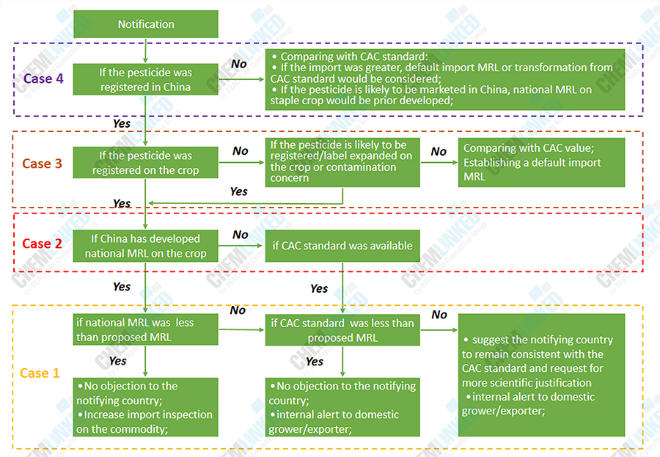
1. Notified pesticide was registered on the crop/commodity in China and established with corresponding national MRL.
On 18 May 2015, Canada proposed a new MRL of deltamethrin in tea of 7.0 mg/kg. Deltamethrin was registered in China on tea and various crops such as peanuts, maize, apple, pear and citrus, etc. and a national MRL in tea of 10 mg/kg was established, which is greater than international MRL of 5 mg/kg and the proposed MRL in Canada. The national MRL was transformed from GB 2763-2005, at a time when China had not gathered sufficient scientific data. China’s tea importation from Canada was around 60,000 USD in 2015 but the exportation to Canada reached 1.26 million USD. Experts therefore issued a trade alert highlighting potential disruption to domestic tea exporters and requirements to make future amendment to national MRL.
If China’s export to the notifying country was greater than the import from the country and the national MRL was greater than the proposed MRL, comparative analysis on CAC standard will proceed. On an international level, China will suggest the notifying country to remain consistent with the CAC standard and request for more scientific justification. Nationally, domestic tea growers and exporters will be alerted to increase quality inspection and national MRL would be amended or renewed if China's national MRL sets a more stringent maximum concentration limitation than the proposed MRL or CAC standard. For example, the national MRL of deltamethrin in apples and pears was 0.1 mg/kg, which is lower than the CAC standard (0.2mg/kg in apple) and EU standard (0.2 mg/kg in apple and 0.1 mg/kg in pear). If the notifying country proposes a higher MRL, import & export management department will be prompted to increase import inspection on the commodities from the country.
2. The notified pesticide was registered on the crop/commodity in China but not yet established with national MRL
In 2015, Canada filed the notification G/SPS/N/CAN/943 to propose a fomesafen MRL in potato of 0.025mg/kg. In China, fomesafen was registered on various crop including soybean, red bean, mung bean, peanuts, strawberry, tomato and potato, etc., but only part of these crops/commodities have been established with national MRLs. The herbicide is allowed to be used on potato but has not yet had a national MRL established. In trade balance term, the value of potato import was modest and export was also negligible. China raised objection to the notification because the impact of the Canadian MRL on potato trade was negligible compared to the impact on Chinese trade of other commodities. If the trade flow of the commodity was considerable, a default MRL for all imported commodities not yet established with national MRL would be considered.
3. The notified pesticide was not registered on the crop/commodity in China but established with national MRL
In 2015, Taiwan region filed the notification G/SPS/N/TPKM/368, proposing a benzamide MRL in grape of 0.02mg/kg. In China, the fungicide was registered only on cucumber but a national MRL in grape of 5 mg/kg was established. No registration of the fungicide on grapes in China essentially signifies that use of the fungicide on the crop was illegal in China. Pesticide registration authority would be required to investigate the actual use status and whether any pending registration application exists. If the fungicide was actually used in China, domestic grower and exporters will be alerted. If not, cancellation of the national MRL will be suggested and default for imported commodities not yet established with MRL would also be considered.
4. The notified pesticide was neither registered on the crop/commodity in China nor established with national MRL
In 2015, notification G/SPS/N/CAN/933 was filed by Canada, proposing a sedaxane MRL in mustard seed of 0.01mg/kg. China’s response team investigated that sedaxane was only registered on maize and wheat but none of these commodities have been established with a national MRL. Since there is no uses of the fungicide on mustard, China raised no objection on this notification. But lawmakers are urged to accelerate MRL development on registered staple crop/commodity.
5. Proactive notification
In 2015, the US notified to establish prohexadione calcium MRLs in strawberry and watercress. The notification seemed to have no bearing on China because this pesticide was neither registered nor established with any national MRL. As a novel plant growth regulator, prohexadione has excellent environmental profiles, which is indeed very likely to replace all existing triazole family in the global agrochemical market. It becomes very necessary for China to prepare enough supporting data in advance.
Balance between Food Safety and Impact on Trade
The economic and political motivations behind MRL development still need to be understood. We can consider EU’s pyrethroid MRLs in tea and Japan’s Positive List System as key examples of politically motivated MRL development.
In China, MRLs are biennially updated under GB 2763 series, while most of overseas MRLs are separately notified in each pesticide/crop by each country/region. This requires China to frequently scrutinize the registration status, crop grouping and trade balance with each of its trade partners. As 5000 more national MRLs still need to be developed by 2020, most of them would be affected by WTO TBT/SPS in these ways:
Pesticide not yet established with national MRL frequently notified by other countries is likely to be established with MRL in most frequently notified crop/commodity. The higher the import surplus China has, the lower the MRL is likely to be. If China has trade deficit on all applicable crop/commodity, a default import MRL would be established;
Unregistered pesticide established with national MRL frequently notified by other countries would have the national MRL cancelled and established with a default import MRL
Unregistered pesticide not yet established with national MRL frequently notified by other countries would be prioritized with national MRL on staple crop if the pesticide is likely to be marketed in China
To support national MRL development and China’s own notification, China almost doubled the number of residue trials for pesticide registration in its new pesticide regulation. Previous registrants are temporarily forbidden from offering residue data use to other applicants until they have complemented all data requirements during the renewal of existing registration.
 We provide full-scale global food market entry services (including product registration, ingredient review, regulatory consultation, customized training, market research, branding strategy). Please contact us to discuss how we can help you by