Request a Demo
Labeling food allergen information is crucial in ensuring consumer safety, and it varies significantly from country to country. In Malaysia, the labeling of allergens is mandatory, guided by the Food Act 1983 and Food Regulations 1985.
1. Mandatory labeling items
Regulation 11(1) of Food Regulations 1985 mandates the mandatory labeling of ingredients known to cause hypersensitivity (hereinafter allergens):
“Every package containing food for sale shall, unless otherwise provided in these Regulations, bear on it a label containing the following particulars, namely … (ea) where the food contains ingredients known to cause hypersensitivity, the ingredients shall be declared on the label …”.
As per a Guideline issued by Malaysia’s Ministry of Health (MOH), “hypersensitivity” refers to uncomfortable conditions such as itching, swelling, vomiting, asthma, chest pain and fainting, which can sometimes lead to death, caused by the body's immune system response.
The specific allergens that must be declared on food labels include:
Cereal containing gluten including wheat, rye, barley and oat;
Nut and nut product including peanut and soybean;
Fish and fish product*;
Milk and milk product (including lactose); and
Egg and egg product.
Notes: Fish includes any marine, brackish water or freshwater fish, crustacean, mollusc and other aquatic life that is edible by human being. It also includes fish roe.
2. Labeling methods
The method of allergen labelling can be divided into the following situations based on different ingredient types.
Principle food ingredients
All allergens must be shown in the list of food ingredients using terminology depicting the source as shown below.
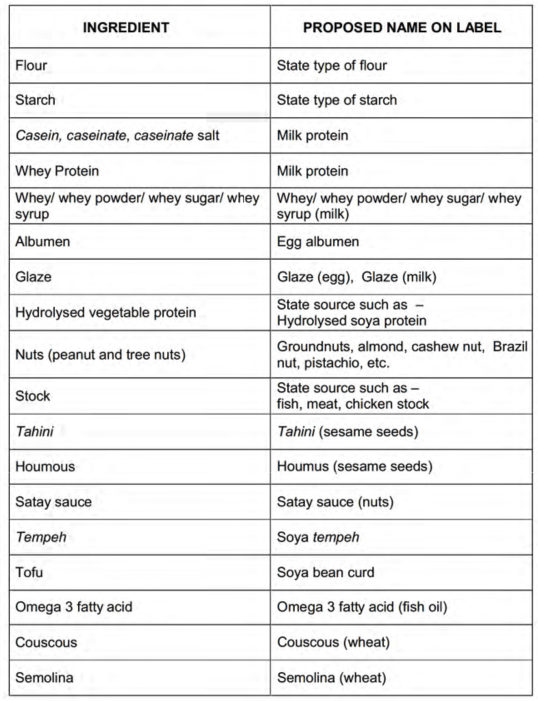
When labeling such ingredients, enterprises can label by referencing the following examples:
Ingredients: - Example 1: Malt extract (barley), XXX, XXX … - Example 2: Butter (with milk), XXX, XXX … - Example 3: Milk, XXX, XXX … |
Compound ingredients
For those included in the compound ingredients, enterprises must state the presence of such allergen ingredients in the formula.
Ingredients: - Example 1: XXX, XXX, belacan (with shrimps), XXX, XXX … - Example 2: XXX, XXX, creamer [with natrium caseinate (milk protein)], XXX, XXX … - Example 3: XXX, XXX, mayonnaise (with egg), XXX, XXX … |
Food additives and added nutrients
The source of food additives and added nutrients known to cause hypersensitivity must be stated, including any carried-over additives. The labelling examples are given below.
Ingredients: - Example 1: XXX, XXX, permitted flavouring substance (prawn based), XXX, XXX … - Example 2: XXX, XXX, Omega 3 fatty acids (fish based). Contains permitted colouring substance (egg based). |
Contamination by other food particles
If there is a possibility of contamination by allergens from other food particles, a statement for such situation should be labelled.
Ingredients: - Example: XXX, XXX, XXX, XXX, and XXX. May contain milk residues. |
3. Special Labeling for GMO Products
Regulation 11(6) of the Food Regulations 1985 requires that
“The origin of food and food ingredients obtained through modern biotechnology shall be stated as follows: “gene derived from (origin)”.
As per the MOH, where foods contain, consist of or are produced from genetically modified organism (GMO), if the gene is derived from animal or substance that may cause hypersensitivity, relevant information shall be labelled without exemption.
The labelling method for genetically modified food (GMF), whose gene is derived from substance that may cause hypersensitivity should follow Regulation 11(6) and (7) by referencing the following examples.
Single ingredient product
Example: Corn (genetically modified) (gene derived from nut) |
Multi ingredient product
Example: Biscuit Contains genetically modified ingredient
Ingredient: Corn flour (genetically modified corn) (gene derived from fish), peanut, milk powder, XXX |
For more detailed labeling requirements for various food products in Malaysia, please refer to ChemLinked’s FoodCheck tool.
 We provide full-scale global food market entry services (including product registration, ingredient review, regulatory consultation, customized training, market research, branding strategy). Please contact us to discuss how we can help you by