Request a Demo
China has implemented infant formula/milk powder recipe registration since Oct 1, 2016 in accordance with stipulations articulated within the New Food Safety Law and Administrative Measures for Registration of Infant and Young Children Milk Powder Formula Recipes. These key pieces of legislation and regulation aim to overhaul the current chaotic market environment by establishing criteria for application, limiting the number of IF brands/recipes as well as further regulating product labeling.
The status quo of infant formula registration in China
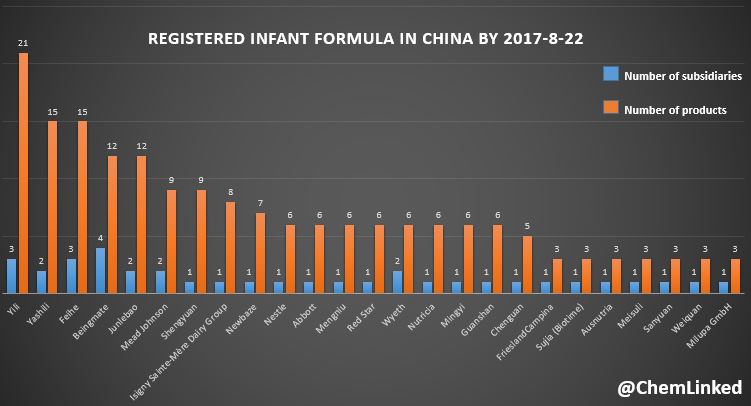
From Aug 3 to 22, CFDA released 6 batches of registered infant formula (ChemLinked News), including 182 products from 36 enterprises. The list includes 23 dairy group companies and around 66 brands, including market leaders such as Aptamil and Friso. Yili, Mengniu (Yashili) and Feihe (Guanshan) are the 3 big winners and have successfully registered 7 product lines totaling 21 products. Junlebao, Beingmate and Nestle (Wyeth) have each registered 12 products.
Table 1: Registered infant formula in China by 2017-8-22
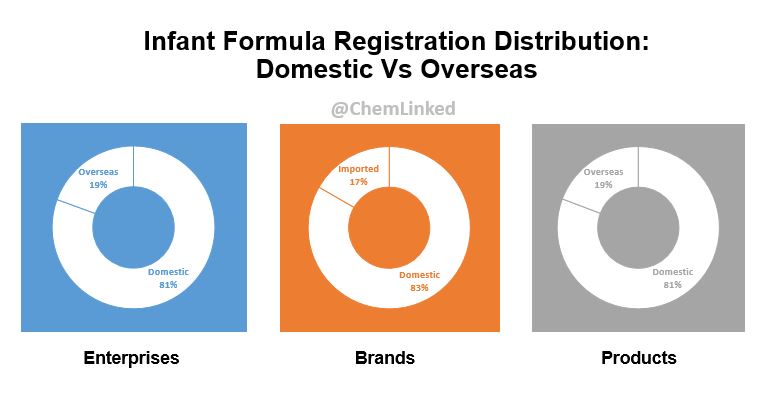
Registrations by domestic enterprise comprise 80% of total approvals. 7 international companies have successfully registered products including Yashili New Zealand (6 products), Wyeth Ireland (3), FrieslandCampina (3), Mead Johnson (6), Nutricia(6), Milupa GmbH(3), Isigny Sainte-Mère Dairy Group (8). Other important international enterprise like A2 and Bellamy have not been approved yet.
Table 2: China infant formula registration distribution: Domestic vs Overseas
According to the Administrative Measures for Registration of Infant and Young Children Milk Powder Formula Recipes, each manufacturer shall not have more than 3 product lines and a total of 9 products. Each enterprise should finish registration before the January 1st 2018 deadline. The number of registered recipes is directly related to the number of products that will circulate in the Chinese market in the future, implying that the greater then number of licensed factories a manufacturer has the more product lines and formulations they can register.
It’s said that over 660 applications have been submitted as of July 31, and considering CFDA’s quick action over the past half month, we can expect the remaining applications (including 130+ overseas applications) to be continuously released until the end of this year (the majority will probably be done by October).
Gap between current registered recipe number and approved manufacturer number
Domestic enterprise infant formula registration status
According to CFDA data, there are 108 approved domestic infant formula enterprises, among which 92 have been officially released in CFDA announcements (original text here and here). If all of them apply for registration and get approved, there should be 324 product lines and 972 products at most. However, up to now, only 29 domestic enterprises have been approved accounting for 54 product lines and 147 products. This means just 28% of the total 108 domestic manufacturers have been approved thus far.
International enterprise infant formula registration status
Many international enterprise initially adopted a wait-and-see approach in response to registration requirements which are still technically in a trial period. It is believed that many were waiting until specific elements of the regulations were clarified and also hoping to learn from the mistakes and successes of early applicants in order to make their own registration process more efficient.
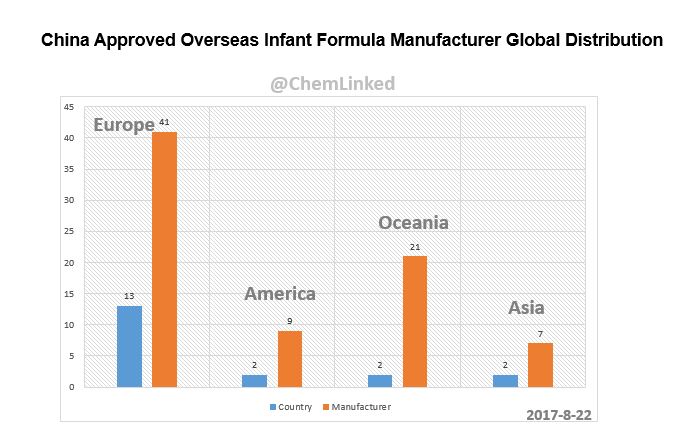
According to CNCA data, there are 78 CNCA approved overseas infant formula manufacturers from 19 countries, among which 2 have been handed down temporary suspensions due to some compliance problems (click here and here to learn more). If all international manufacturers apply for recipe registration, there should be 234 product lines and 702 products at most.
Table 3: China approved overseas infant formula manufactures by 2017-8-22
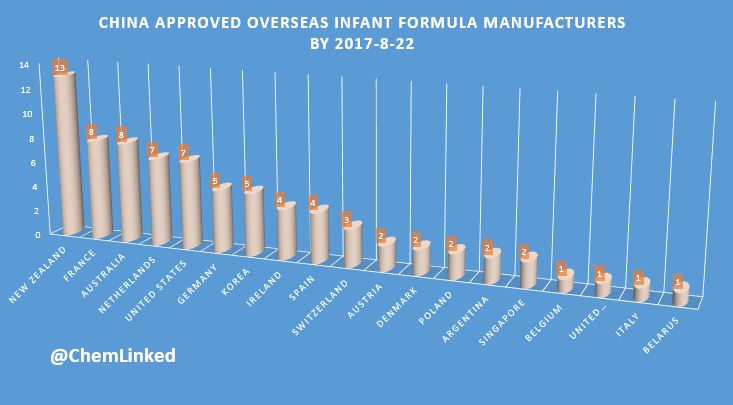
Table 4: China approved overseas infant formula manufactures global distribution by 2017-8-22
Besides, according to AQSIQ’s “imported infant formula milk powder Importers and product information (updated June 13, 2017)” (original text here), there should be a total of 259 importers with around 347 product lines (1,041 products at most). Still up to now, only 7 overseas manufactures accounting for 12 product lines and 35 products have been approved representing just 8% of the total. Experts have suggested that “Only 40% of international enterprise exporting infant formula to China have submitted a registration application by July 31”.
Strict inspection on infant formula safety
The implementation of the recipe registration regulation will eliminate substandard manufacturers and products from the market. According to previous forecasts, of the estimated 2000 brands currently circulating on the market, after the registration regulation has been implemented and the deadline has passed only 500 will remain, which will be an impressive 75% reduction.
Recently, a number of domestic and overseas infant formula manufacturers have been alerted or suspended for quality or production safety. For example, CNCA handed down an infant formula export suspension to Hochdorf Swiss Nutrition on Aug 22 because 3 of its IF products revealed excessive contamination with bacterial pathogens. On August 21, CFDA also put two domestic infant formula enterprises: Heilongjiang Ou Beijia Nutrition Food Co., Ltd., and Gao Pei (Guangzhou) Dairy Co., Ltd. on alert. In the past both Beingmate and Abbott were subject to suspensions.
Will Regulations offer better opportunities for international enterprise or domestic?
Imported infant formula now requires both manufacturer and product registration, and from Jan 1st 2018 only registered formula can be imported to China. In the short term there will undoubtedly be significant impact on infant formula trade balance and overall import volume. It can be expected that larger international manufacturers with approved and registered products will scale up production capacity to fill the market vacuum created as companies are forced from the market. It is difficult to predict if this increase in production will be enough to meet demand or if domestic companies will seize the opportunity to reestablish parity with international competition. One sure thing is Chinese consumers will be able to buy safer products with greater supply chain transparency.
The domestic market will surely be subject to great changes. Many of the “me-too” product lines will be forced from the market. These products use identical formulations as existing products but are packaged and marketed to meet the demands of the varied socioeconomic conditions in China’s 1st, 2nd, 3rd and 4th tier cities. The 3 brand rule and the specific requirements to show clear variations between each registered product will put an end to these industry practices. As mentioned according to the Administrative Measures for Registration of Infant and Young Children Milk Powder Formula Recipes, if one manufacturer applies to register more than 2 product recipes for the same age group, there shall be significant difference among recipes, which shall be confirmed with scientific evidence. Therefore, companies need to pay more attention to product quality and research & development.
Another significant factor that will determine the balance between international and domestic enterprise is the future of infant formula traded through CBEC. There has been massive growth in this trade channel but it almost certain that no special dispensation will be given for infant formula traded through CBEC, a move which is likely to favor domestic manufacturers.
 We provide full-scale global food market entry services (including product registration, ingredient review, regulatory consultation, customized training, market research, branding strategy). Please contact us to discuss how we can help you by