Request a Demo
Applicable scope:
All food products excluding foods for special dietary uses (including FOSHU), FNFC, alcoholic beverages, and food products that may lead to excessive consumption of fat, cholesterol, sugar or sodium are subject to this new system, even including fresh produces.
New regulatory framework of health food sector in Japan:
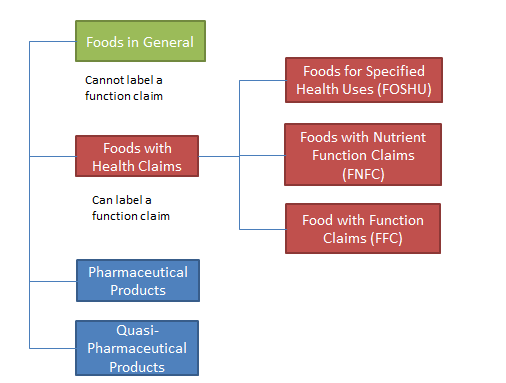
Prior to the implementation of this new system, making functional claims on food labels had only been allowed for Foods for Specified Health Uses (FOSHU) and Foods with Nutrient Function Claims (FNFC) that comply with the specifications and standards designated by the government.
After the FFC system is implemented, the new regulatory framework for health food is described as below:
Extended reading for FOSHU and FNFC on Chemlinked:
FFCs are allowed to label the functions that specific health effects can be achieved based on scientific evidence, which must be obtained from clinical trials or systematic literature review. However, unlike FOSHU, the safety and effectiveness of these food products are not evaluated by the government but it is instead the responsibility of food manufacturers and traders.
Prior to market entry, food enterprises are required to submit relevant product information (including product label bearing health claims, information of the manufacturer, information on production and quality management, as well as the system to gather information on possible adverse health outcomes from the use of the product) to the Consumer Affairs Agency (CCA) for premarket notification.
Implications for the Market:
Compared to the costly and time-consuming (approximately one year) approval process of FOSHU which is generally beyond the means of SMEs, the requirements for FFCs has been greatly lowered and only requires premarket notification 60 days prior to market entry. A lot of Japanese SMEs and other enterprises will have a great opportunity to enter the market under the new regulation and will invigorate Japan’s health food industry.
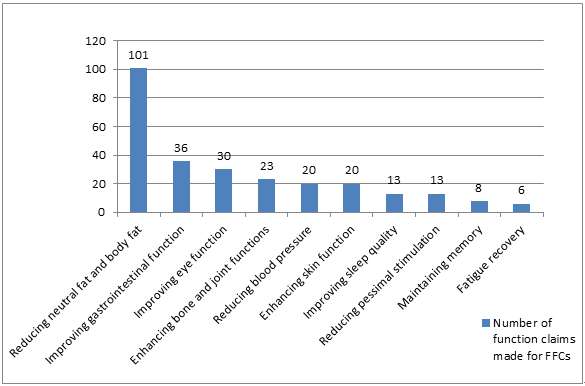
Till this April, there have been 282 types of FFCs received by CCA. Top ten function claims made for FFCs during the past one year are as follows:
Labeling contents required under FFCs:
1. Indication of FFC;
2. Functional components based on scientific basis and the functionality of the said components or foods containing the said components;
3. Adequate daily intake;
4. Amount of nutritional components and calories in an adequate daily intake;
5. Contained amount of a functional component in an adequate daily intake;
6. Acceptance number;
7. Phone number as contact information of the manufacturer;
8. Notice: functionality and safety are not evaluated by CCA;
9. Method of intake;
10. Instruction on intake;
11. Notice: To promote popularity of the idea of a balanced diet;
12. Precaution statement for products which require special attention when cooking or storing;
13. Notice: The product does not intend to diagnose, treat, or prevent disease;
14. Notice: Not to target one suffering from disease, minors, pregnant women (including women planning to become pregnant) and nursing women;
15. Notice: Recommend that one suffering from disease consult with a physician, and that one taking drugs consult a physician or pharmacist;
16. Notice: In case of unusual physical change, recommend stopping eating a product immediately and consult a physician.
Advertisement baseline for FFCs
Recommended advertisement baselines have been formulated by CCA, which can be taken as the basic principle of FFC advertisement.
Functional mechanistic data, statistical data, investigation and research result, etc. may be advertised, however, any information out of the declared scope or cherry picking data that falsely exaggerates functionality will be considered false advertisement.
The following contents are recommended to be included in the advertisement of FFCs:
Clear indication of “foods with function claims”;
The functions declared;
Special attention required for balanced diet of staple food and non-staple food;
It shall be explicitly indicated that “this product has not been verified by the state”, and “this product is not targeted for disease diagnosis, prevention or treatment”.
 We provide full-scale global food market entry services (including product registration, ingredient review, regulatory consultation, customized training, market research, branding strategy). Please contact us to discuss how we can help you by