Request a Demo
On Oct. 17, 2018, a former government official shared his knowledge of CNCA registration with ChemLinked and REACH24H technical team. During the seminar, the expert mainly introduced the regulatory requirements and procedures for overseas enterprise registration. Prior to the seminar, we have prepared several questions that are most commonly asked by our clients:
Q1: What links in the supply chain does CNCA registration assessment include?
A1: It includes all manufacturing, processing and storage enterprise involved in production and all associated enterprise involved in the product/commodity lifecycle.
Q2: CNCA registration mainly includes document review and on-site inspection, so will on-site inspection be carried out on all enterprises?
A2: Meat products, birds' nest and infant formula are subject to pre-approval mechanism, therefore, on-site inspection is mandatory for all enterprise before they are granted CNCA approval.
However, on-site inspection is not mandatory for aquatic products and dairy products (except infant formula) enterprises. Just a small amount of these enterprises will be sampled, and if they pass the inspection, then all enterprises belonging to this category in the country are allowed to export to China. Currently there are a total of 17 thousands enterprises registered. 88% of this 17,000 are aquatic products enterprises.
Q3: What requirements must be followed by enterprises when applying for information modification due to capacity expansion?
A3: To begin with, enterprises need to inform CNCA prior to taking detailed measures. Generally speaking, an application will be accepted however if enterprises attempt to conceal anything then severe punishments will be issued including the possibility of an enterprise having its accreditation suspended.
Another important notice is that enterprises are not allowed to export products to China while expanding capacity. It is suggested that enterprises can make preparations for this in advance and prepare enough inventory.
Q4: During document review what assessment criteria are most important?
A4: Based on practical experience, it is not an easy job for enterprises to fill in the application form correctly. The enterprise should keep it in mind that what you write should be compliant with Chinese standards and regulations. The following 4 items are what enterprises most frequently make mistakes on.
Product name: In China there are only 3 stages for infant formula products (0-6 months, 6-12 months and 12-36 months), but in some European countries the product classification is different and some may even have 4 stages. If enterprises aims to access Chinese market successfully, the product classification shall be aligned with China’s as well.
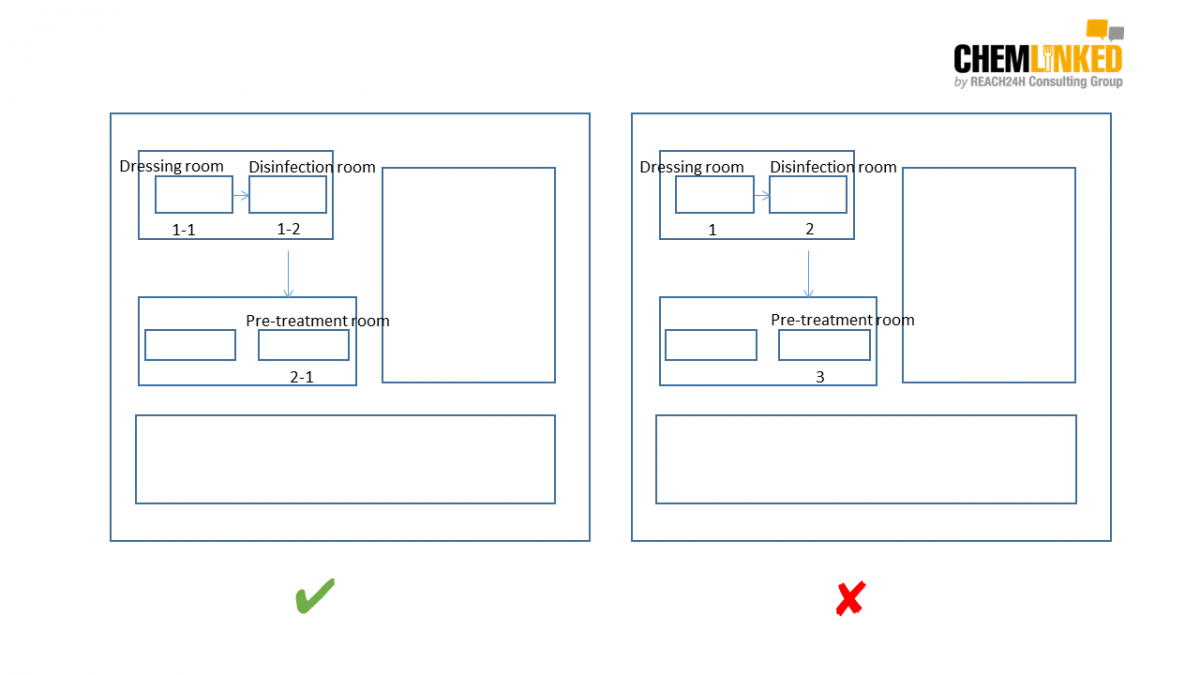
Production flow chart: In order to make it convenience while amending the manufacture procedure, it is suggested to mark the order by section like “1-1, 2-1” rather than serial number like “1, 2, 3, 4….”.
Hygiene and quality management system: the testing for the enterprises’ facility, environment and management system and etc. shall be conducted by China’s standards, but there is no designated testing agency.
Q5: Is there a minimum limit for factory’s capacity?
A5: Currently there is not, but we suggest enterprise could reserve the space for essential equipment such as a blender. In this way, enterprises can directly apply for information modification if the manufacturing capacity is expanded in future.
Q6: How long will it take from document review to on-site inspection?
A6: The duration is not fixed and can be affected by various factors. Due to CNCA budgetary constraints it not feasible to conduct overseas on-site inspection very frequently. However a friendly relation between China and exported country may facilitate CNCA registration.
Q7: Will institutional reform cause any changes to CNCA registration?
A7: Now GAC takes the responsibility of overseas enterprise registration which was undertaken by AQSIQ previously, and those technical experts responsible for on-site inspection currently work for GAC as well. Based on this, the requirements for on-site inspection will not be more stringent as the staff conducting inspection have not changed. However, there may be some changes of detailed administrative procedures in the future.
Q8: Will other product categories require CNCA registration in future?
A8: There are 2 important inclusion categories guiding CNCA’s registration system namely 1) the product/commodity is highly demanded 2) the hygiene conditions of the manufacturing facility have a significant impact on the food safety risk posed by the product.
One product which fits this criteria is honey, and we expect it to require CNCA registration in future. However, we also need to realize that there are still some technical issues to conquer. For example it is difficult to monitor bees as their lifecycle is very short. In addition recent institutional reform may also contribute to the postponing of honey CNCA registration.
ChemLinked will prepare a webinar comprehensively introducing the regulatory requirements of CNCA registration and provide some suggestions to aid companies in extending their registration.
 We provide full-scale global food market entry services (including product registration, ingredient review, regulatory consultation, customized training, market research, branding strategy). Please contact us to discuss how we can help you by