

 Request a Demo
According to the statistics published by Center for Evaluation under China's State Administration for Market Regulation (SAMR), 16 imported health food products have been granted filing certificates in H1 2023, which enables them to enter the Chinese market through common trade channels. In this article, ChemLinked performed an in-depth analysis of the 16 products, scrutinizing the filing status over the years and assessing recent notable regulatory revisions pertaining to health food.
1. Analysis of Imported Health Food Obtained Filing Certificate in H1 2023
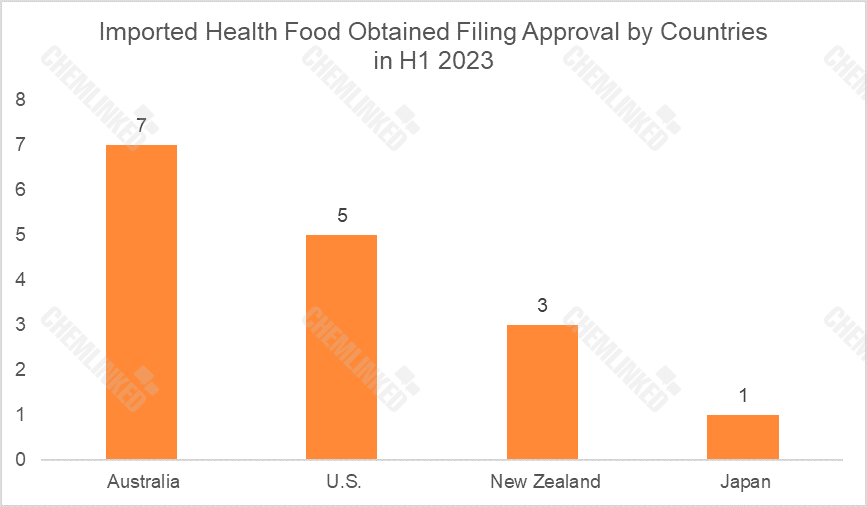
In H1 2023, 16 imported health food from 4 countries were granted filing approvals. in terms of the country of origin, Australia tops the list with 7 filed products, followed by the U.S. (5 filed products), New Zealand (3 filed products), and Japan (1 filed product).
China adopts a positive list of health food raw materials subject to filing. As shown in the chart below, 11 kinds of nutrients were used in the 16 products. Calcium was the most popular nutrient, followed by Vitamin B, C, D, and Magnesium.
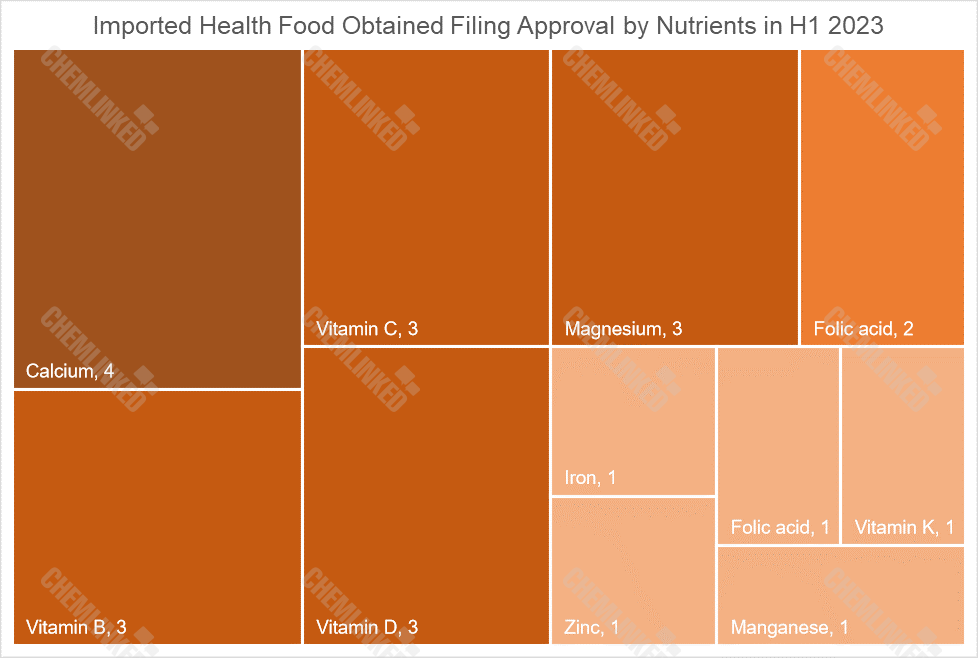
Notes: A health food product is allowed to contain one, two or more nutrients.
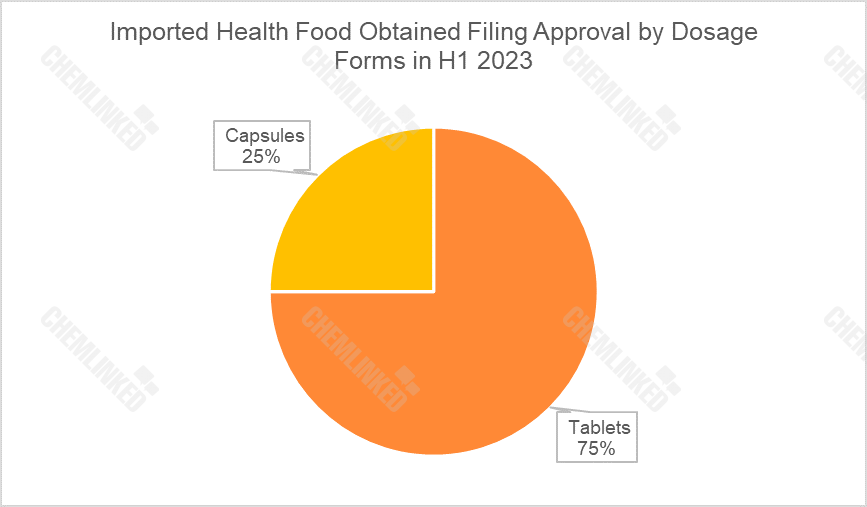
For product forms, 12 out of the 16 products are produced as tablets, mirroring that tablet is still the most common form of imported health food. The rest 4 products are categorized as capsules. In fact, as per Dosage Forms and Technical Requirements for Health Food Filing (2021 Edition), there are more available forms for health food products subject to filing, such as powder, oral solutions and gelatinized confections. However, at present, filed imported health food products are mostly in traditional forms like tablets and capsules.
2. Overview of Product Filing Performance
China adopted a dual track system in 2017 to govern the entry of imported health food into the market. This system offers two options for imported products to gain access: filing or registration with SAMR. However, the registration approval for imported health food encountered significant challenges and stagnated due to transition issue from the old regulation to the new one. As a result, product filing emerged as the sole viable pathway for imported products to enter the Chinese market.
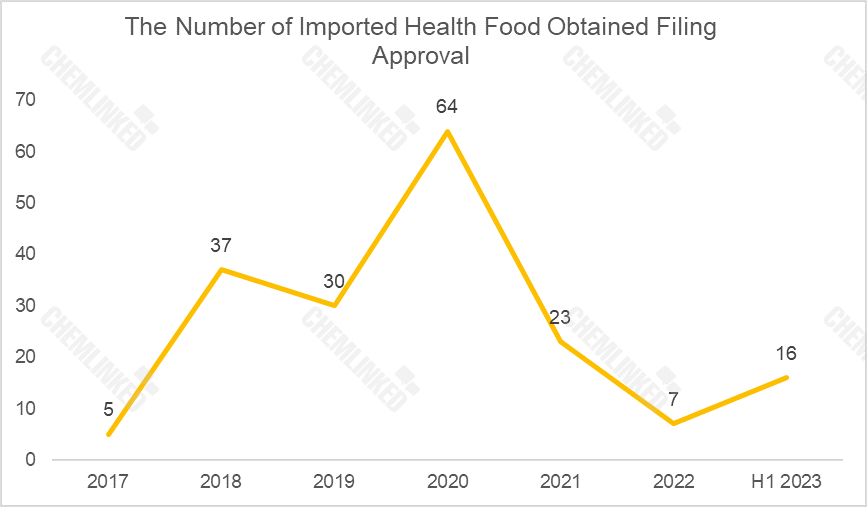
Up to the end of H1 2023, a total of 182 imported health food have obtained filing approvals. The number of filing approvals peaked in 2020, and kept declining after that. Last year, only seven products gained filing certificates. However, it is a good sign that 16 products have already succussed in the first half of this year. It is very likely to see more followers in the next few months.
3. Latest Regulatory Updates on Health Food
Since the beginning of this year, Chinese authorities have released some regulations and notifications pertaining to health food, mainly covering the advertising and use of raw materials.
In January 2023, SAMR released a consultation draft of Administrative Measures on the Review of Health Food, FSMP, Drug and Medical Device Advertisements. This draft revises the Interim Administrative Measures to address issues that have arisen since its implementation. Major revisions include the regulation of Internet live-streaming and advertising for health foods and food for special medical purposes (FSMP). As disclosed by the draft, health food ads shall prominently display the product name and unsuitable group. Besides, the draft reinforces supervision over health food function claims (More details).
In June 2023, SAMR, National Health Commission (NHC) and National Administration of Traditional Chinese Medicine (NATCM) jointly issued a notice announcing four regulations related to raw materials and function claims for health food (nutrient supplement), which will take effect on October 1, 2023. With the release of these four regulations, the directory of raw materials and function claims for nutrient supplements get expanded, giving greater convenience on the production and market access, especially for DHA supplement (More details). In addition, two functional ingredients, namely, soybean protein isolate and whey protein, are added into the health food raw material directory, which will lower the entry barriers for Chinese domestic products added with the two ingredients (More details).
In July 2023, followed by the four regulations, SAMR drafted four corresponding supporting documents and opened them for public consultation. The four drafts mainly interpret the four regulations and further specify the details for their implementations (More details).
For any health food related consultations, please feel free to contact us.
 We provide full-scale global food market entry services (including product registration, ingredient review, regulatory consultation, customized training, market research, branding strategy). Please contact us to discuss how we can help you by








