Request a Demo
Sanitation Standard for Food Utensils, Containers and Packages:
This regulation was revised in Aug. 2013 and includes general provisions, provisions on plastic products, and special provisions on containers and packages for dairy products. It is specially stipulated in this regulation that:
The food utensils and containers specified for child usage under the age of three, shall not contain the following four types of plasticizers, i.e.: di-(2-ethylhexyl) phthalate (DEHP), Di-n-octhl phthalate (DNOP), di-n-butyl phthalate (DBP) and Butylbenzyl phthalate (BBP).
Plastic infant feeding bottles shall not contain of Bisphenol A.
In future amendments, the control scope for plasticizers will be expanded and maximum residue limits provided. Melamine resin will be controlled and relevant melamine migration limit will be set as 2.5ppm.
Labeling requirements
Mandatory labeling information includes material name, thermal resistance temperature, and warning information (e.g. warnings for microwave oven use), which mainly targets:
Disposable paper tableware
Reusable plastic food containers and packages: kettle (cup), feeding bottle, meal box (containing preservation box), dish, bowel, plate, etc.
Disposable plastic food containers and packages
It is stipulated in the “Draft of Labeling for Food Utensils, Containers and Packages” which will be formally implemented from Jul. 1, 2017 that food utensils, food containers or packages manufactured from July 1, 2017 shall be labeled with the phrase “for use in food contact materials” or words with equivalent meanings.
Food utensils, food containers or packages containing plastic materials in the food contact surface require labeling for both disposable and reusable products. Food utensils, food containers or packages containing PVC or PVDC in the food contact surface shall be indicated with warnings “do not contact directly with foods subject to high temperature treatment and/or high fat content” or equivalent sentences.
Mandatory Registration on Food Contact Material Electronic Database Registration
The login system is applicable to utensils, containers and packages containing plastic materials which directly contact with foods. It is targeted at all manufacturers, traders and importers of plastic food utensils, containers and packages, who are required to fill in the information of applicants, raw materials and food contact additives (voluntary for now). This login system is implemented to meet future mandatory traceability requirements.
GHP (good hygiene practice) standard
The GHP standard includes six aspects to strengthen product safety risk control:
Product development and design management
Raw material and finished product storage management
Manufacturing site management
Production process management
Personnel hygiene management
Product hygiene management
Compared to the GMP system, GHP system emphasizes process management and product management rather than organization management and system management.
Source safety verification
Currently Taiwan emphasizes post market supervision for food contact materials. Food contact material manufacturers are often unable to easily obtain safety information of raw materials and food contact additives used during the manufacturing of finished products, and therefore they cannot guarantee the quality of their own products.
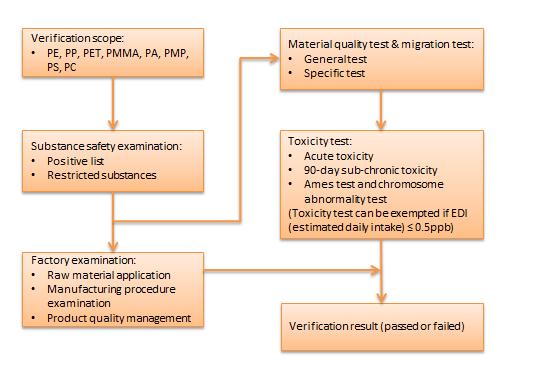
Source-safety verification of food contact plastic materials (FCPM) will be therefore implemented to help transition from post-market management to a combination of pre-market management and post-market management. There have been more than 1,600 food contact additives included into a positive list and negative list. Third party non-profit institutes are in charge of the source-safety verification process which should help guarantee the safety of raw materials and additives. The FCPM verification system flowchart is illustrated below:
Penalties:
The penalties for manufacturing or trading incompliant food contact materials are severe. The maximum fine for safety violations is TWD 200 million. In cases involving the use of misleading labeling or advertising information the maximum fine is TWD 4 million.
 We provide full-scale global food market entry services (including product registration, ingredient review, regulatory consultation, customized training, market research, branding strategy). Please contact us to discuss how we can help you by