Request a Demo
On April 20, 2020, China live-streamed the 7th China Agricultural Outlook Conference [1] in Beijing. Organized by the Chinese Agricultural Information Institute and supported by the Market Early Warning Commission of Agriculture and Rural Affairs, researchers in this conference forecast the market trends of eighteen major agricultural products in China in the following ten years. Here ChemLinked summarized the prediction of three major categories.

Dairy Product: Optimized Consumption Structure with Steady Growth
In 2019, the consumption amount of dairy products in China totaled 49.49 million tons, 4.9% higher than that of 2018. The whole industry is making progress in developing nutritious, individualized, and high-end products. At present, UHT milk (ultra-high temperature processed milk) is still the top category among all the liquid milk products while the consumption of pasteurized fresh milk and yogurt has been expanding fast. In addition, the consumption of cheese was successfully accepted by consumers in 2019, especially cheese designed for children.
So how’s the market performance this year, especially after the outbreak of COVID-19? Although the pandemic resulted in a decline in sales in the first quarter, it also made people attach more importance to health. Hence, it is predicted that increasing health awareness will bring a rise in milk consumption, as milk is believed to be helpful in building the immune system [2]. Under the influence of these factors, the consumption amount in 2020 is estimated to hit 50.9 million tons, a slight increase of 2.8% compared to 2019. It is expected to reach 61.16 million tons in 2025, and 65.96 million tons in 2029, increases precipitated by an average annual growth rate of around 2.9%. It is also predicted that in the future, pasteurized milk will be more competitive with UHT milk products. Chinese citizens are expected to form the habit of consuming butter and cheese products.
Slow Growth Rate of Importation in Following Ten Years
According to the import data from GAC, the import volume of dairy products (including infant formula milk powder) totaled 2.97 million tons in 2019, which is 12.8% higher than the previous year. The value of imported dairy in 2019 was 11.1 billion dollars, 10.8% higher than that in 2018. Among all the products, fresh milk and milk powder used as a raw material enjoyed the fastest growth rate of 32.3% and 26.6%, respectively. While the import volume of yogurt, infant formula milk powder, and cheese were 33.7 thousand tons, 345.4 thousand tons, and 114.9 thousand tons, with a growth rate of 9.3%, 6.9%, and 6.1% respectively.
Dairy Importation in China, 2019
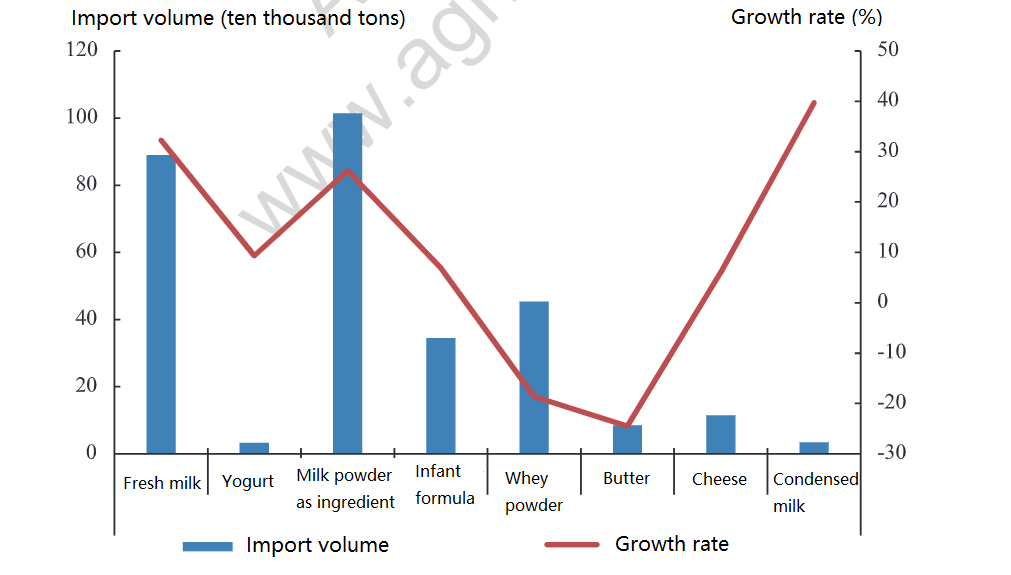
Data from: GAC
With respect to the importation in 2020, the COVID-19 outbreak will restrain the dairy importation. However, due to the strong market demand, the import volume will still increase but at a slower speed. Thus, it is expected the import volume of dairy products in 2020 will reach 17.15 million tons, but at a slow growth rate of 3.3%. And if we look into the future in the following ten years, China will keep opening its market to overseas countries. We expect growth in imports to even out. The dairy import volume is predicted to reach 21.34 million tons in 2025 and 23.15 million tons in 2029, with an average annual growth rate of 3.4% in the following ten years, which will be much lower than the average annual growth rate from 2009 to 2019 (12.3%). Milk powder will still be the major imported product, and products like fresh milk, yogurt, and cheese will maintain a fast growth speed.
Import Volume of Dairy Product in China, 2009-2029
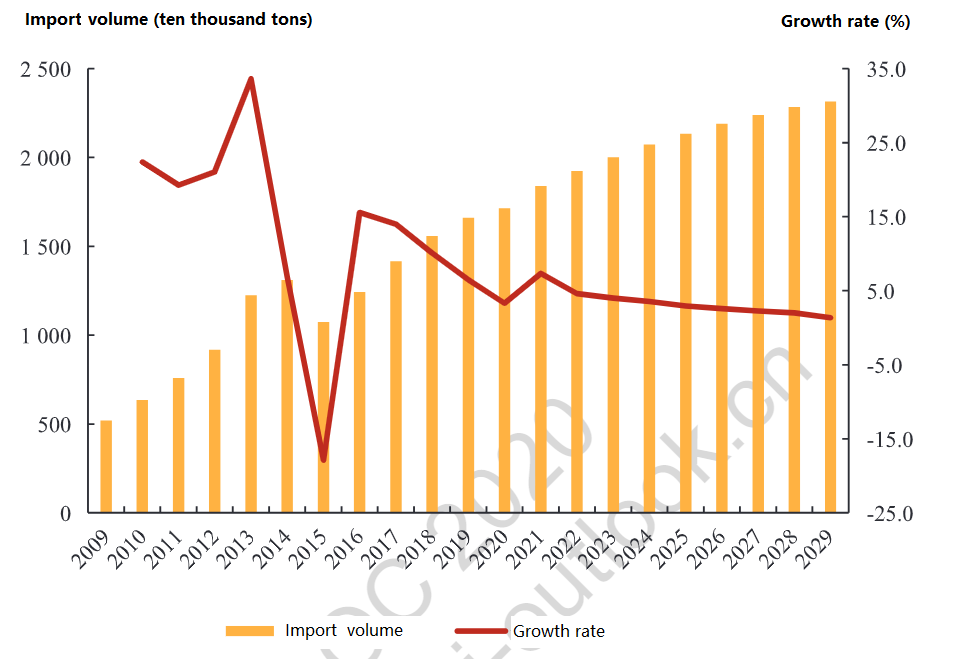
Data from: Chinese Agricultural Information Institute
Diversified Trading Partners
According to the free trade agreement China signed with New Zealand and Australia, as of 2021, fresh milk, butter, and cheese from New Zealand can be exported to China with zero tariffs. And the tariff tax of milk powder will be reduced to zero as well starting from 2023. And yogurt, butter, and cheese from Australia will be subject to zero tariffs from 2024. From 2026, all the dairy products from Australia can enjoy a zero tariff tax. These advantages will allow Austalia and New Zealand to remain China’s most significant trade partners for various food commodities.
What’s more, in 2019, China also signed the phase one trade agreement with the U.S. [3], in the near future, U.S. extended shelf life (ESL) milk, fortified milk, ultrafiltered fluid milk, and dairy permeate powder will enter China’s market. Furthermore, European countries and countries along the “One Belt, One Road” will also increase their dairy exportation to China.
Meat Product
Pork: Imported Pork is Needed to Patch the Domestic Output Gap in the Near Future
Pork is still the essential meat category in China, which accounts for around two-thirds of the meat consumption in China. Impacted by the African Swine Fever, the domestic output of pork dropped significantly in 2019, which caused a surge in the market price and led to restrained pork consumption. Due to this, the consumption of chilled meat and frozen meat climbed quickly in 2019. But from a long term perspective, the consumption amount of pork will increase steadily, which is expected to reach 58.53 million tons in 2025 and 60.77 million tons in 2029.
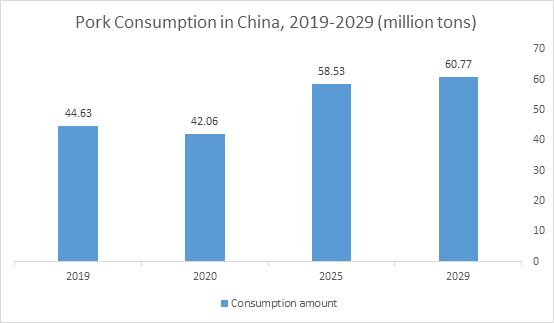
Data from: Chinese Agricultural Information Institute
As for the performance of imports, it is expected that the importation of pork in 2020 will keep increasing and reach 2.8 million tons, with a growth rate of 32.7%, due to the reduced tariff tax, faster GAC registration speed of overseas meat enterprises, etc. However, as production recovers in China, market prices will fall, and profits will narrow, which will slow down the growth of imports and stabilize the market.
Imported Pork Performance in China, 2019-2029
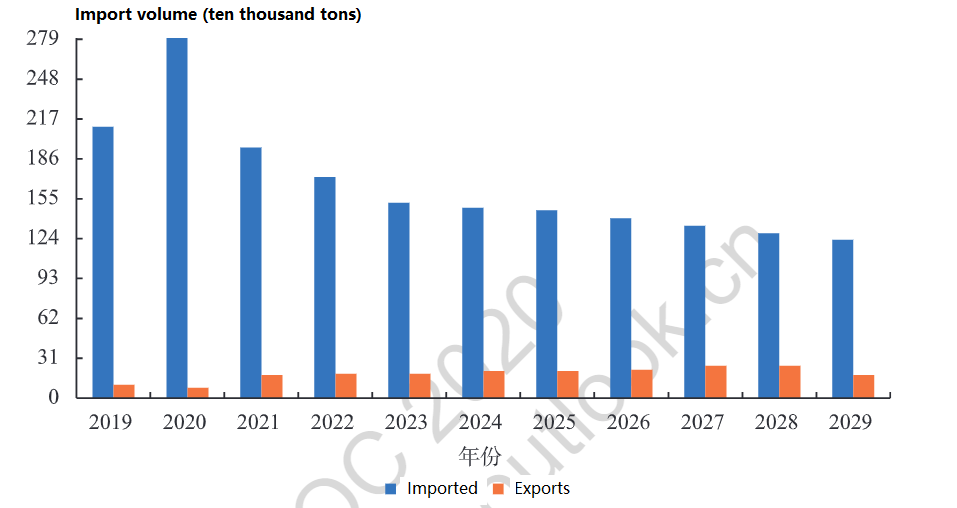
Data from: Chinese Agricultural Information Institute
*Note:
The performance of meat imports will be highly influenced by the COVID-19 outbreak. According to a report from United Morning Paper [4], numerous overseas facilities have had to temporarily close, such as the largest meat processing business Tyson Foods. It closed two plants in Iowa and Indiana in last several weeks, which account for 12% of the pork supply in the U.S. Tyson also closed the largest chicken and beef exporter JBS in Brazil, etc. The world’s largest meat manufacturer, Smithfield Foods also announced the closure of a plant in Illinois. Similar closures have affected businesses in Canada and Brazil. Since these three countries provide 65% of the meat supply worldwide, if the situation worsens, it may lead to a global meat shortage.
Poultry: Substitute for Pork with Steady Consumption Amount in Future
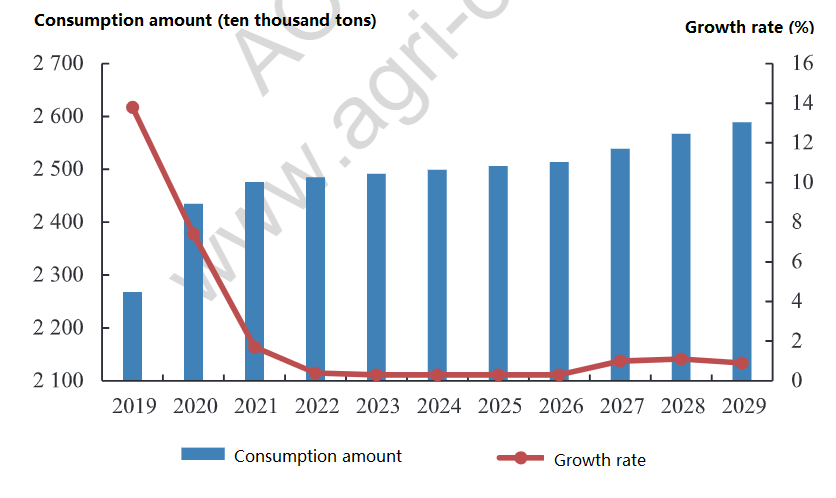
Poultry is the second most-consumed meat category in China. In 2019, due to the high market price and the shortage of pork, poultry naturally became the perfect substitute. The total consumption amount of poultry was 13.9% higher than in 2018. And the consumption amount is expected to keep increasing and reach 24.35 million tons in 2020. However, along with the increasing domestic output of pork and pork products, the growth rate of poultry consumption in the following ten years is predicted to stabilize after several years.
Poultry consumption in China, 2019-2029
Data from: Chinese Agricultural Information Institute
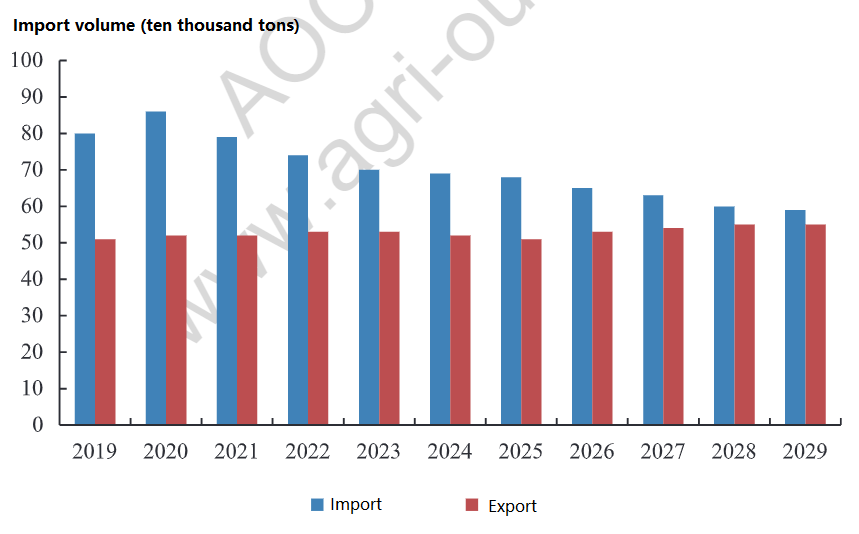
In terms of the importation of poultry products, it reached 797 thousand tons in 2019, increasing by 58% compared to 2018. The import value was 2.058 billion dollars, with a growth rate of 75.8%. Due to the high market demand and China’s further opening-up, importation is predicted to be around 860 thousand tons in 2020, 7.5% higher than in 2019. The import volume of poultry are expected to retract and return to 590 thousand tons in 2029.
Poultry importation performance in China, 2019-2029
 Data from: Chinese Agricultural Information Institute
Beef and mutton: a significant rise in consumption, steady growth potential in the importation
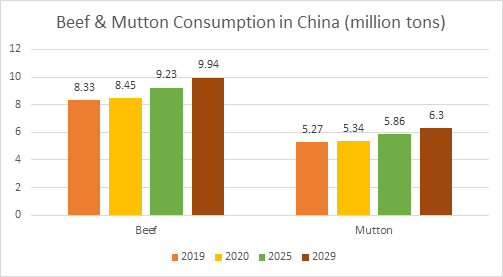
In 2019, the consumption amount of both beef and mutton increased by 11% and 3.9% respectively compared to 2018. Influenced by COVID-19, the consumption amount of beef and mutton is predicted to rise slightly in 2020. The consumption of beef and mutton is expected to keep rising and reach 9.23 million tons and 5.86 million tons, respectively, in 2025.
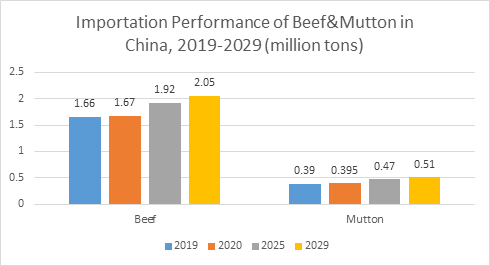
Concerning the importation performance this year, although the import volume of beef from Jan and Feb is 41% higher than last year, due to the pandemic outbreak in South American countries, the total import volume is expected to remain flat compared to 2019 data. But in the long term, both the import volume of beef and mutton will keep increasing with an average annual growth rate of 6.1% and 4.8% respectively in the following ten years.
Fruit: Potential Growth in Processed Fruits, e.g., Freeze-dried Fruit
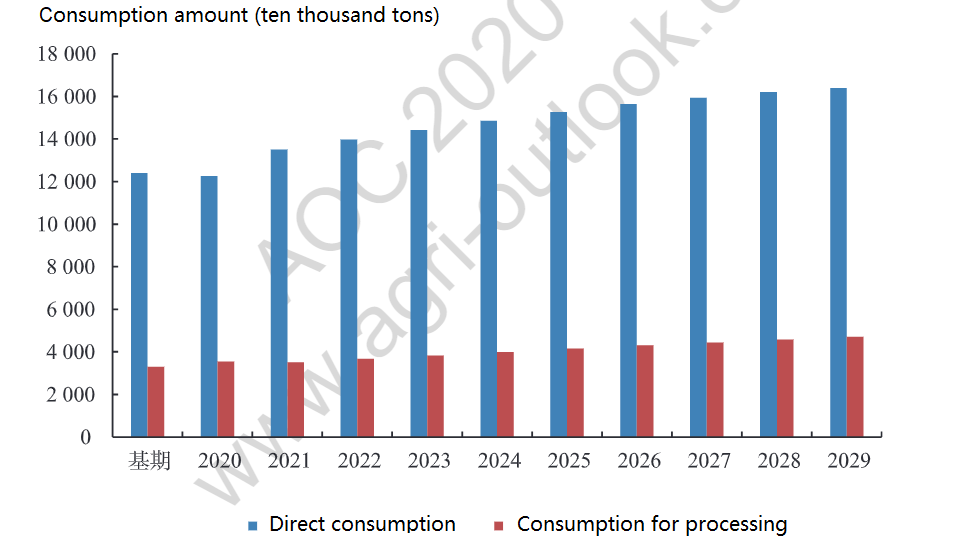
China is the world’s largest fruit consumption market. Due to COVID-19, the fruit consumption amount in 2020 is expected to drop slightly to 263 million tons, 0.67% less than in 2019. The market volume is expected to reach 312 million tons in 2025 and 332 million tons in 2029, with an average annual growth rate of 2.7%.
Fruit consumption can be divided into two parts, consumption for direct eating and for processing. Along with the changing ideas of diet and nutrition, the direct consumption of fruit will be further expanded with the support of the improved logistic infrastructure (e.g., cold chain) and the highly developed e-commerce model. Due to the pandemic outbreak, the direct consumption in 2020 is expected to be 123 million tons, 1.2% less than last year, 153 million tons in 2025, and 164 million tons in 2029.
Although currently, the direct consumption of fruit still plays a dominant role. In the following ten years, we see potential growth in processed fruits, such as the growth in fruit juice, freeze-dried fruit, etc.
Fruit consumption outlook, 2020-2029
Data from: Chinese Agricultural Information Institute
Faster Importation Speed
As for the importation performance, in 2019, although the domestic output in China is increasing, both the imported value and volume of fruit and its product increased by 23.2% (value) and 23.1% (volume) respectively compared to 2018. And fresh durian, cherry, banana, mangosteen, grape, citrus, and kiwi are the most popular categories, occupying 76.6% of the import value of fresh fruits.
Import Performance of Fruit, 2019
Item | Import volume | Imported value | ||
Thousand tons | YOY growth | Billion dollars | YOY growth % | |
Fruit and fruit product | 7293 | 23.1% | 10.36 | 23.2% |
—Fresh fruit | 5870 | 20.6% | 8.6 | 23.6% |
—Fruit juice | 233 | 22.8% | 0.41 | 7.8% |
—Canned fruit | 50 | 37.2% | 0.06 | 33.8% |
Source: GAC data
Due to the outbreak of COVID19, the import volume of fruits from Jan to Feb decreased by 11% YOY. However, from a long term perspective, the import volume in the following ten years will keep growing, driven by the consumption upgrade and higher incomes. The import volume of fruits is expected to reach 14.54 million tons in 2025 and 19.42 million tons in 2029, with an average annual growth rate of 9.4%.
 We provide full-scale global food market entry services (including product registration, ingredient review, regulatory consultation, customized training, market research, branding strategy). Please contact us to discuss how we can help you by