Request a Demo
To cope with the increasingly competitive and saturated infant formula (IF) market in China, most stakeholders saw the product differentiation strategy and the launch of high-end products as the ways out of this hard situation. Under this context, goat IF and organic IF products were introduced into this market.
Market Performance of Organic Infant Formula in China
If we look into the market performance of these two categories, goat IF products are now gaining traction among consumers. Although the market share is still lower than traditional cow milk powder products, it maintains a two-digit growth rate annually. According to Frost & Sullivan, the retail sales of China’s goat IF products grew from 9.3 billion yuan in 2015 to 19.7 billion yuan in 2020, with a compound annual growth rate (CAGR) of 16%. As for the performance of organic IF products, on the one hand, the media kept reporting organic IF news and emphasized its rapid growth rate (with YOY growth rate of 46.8% in 2018 in offline channels, 16.8% in H1 2019, over 20% in H1 2020, Nielsen Data). On the other hand, doubts about the organic IF industry’s prospect are emerging.
Chemlinked analyst Lennie Tao assumes that the gap between the high praise from the media and the industry’s misgivings of the actual situation may be ascribed to the small market size of organic IF products at present. Although the media emphasize the rapid growth rate of organic IF market, they seldom mention its actual sales value. But we can get a clue from the market report disclosed by Mom & Baby Industry Research Center of China Baby Net. According to the report, in 2019, organic IF took over 1.1% of the market share of the total IF markets in offline mom and baby stores, which was expanded to 1.3% in 2020 (Goat IF accounted for 13.0% in 2019 and 13.5% in 2020). Another report from Limu Consultancy Firm shows that from 2016 to 2018, the offline sales value of organic IF was 1.8 billion yuan, 2.67 billion yuan and 5.77 billion yuan, respectively. Due to the low base and the comparison with other categories like goat IF (see data mentioned above), it is easy to make the industry feel the performance of organic IF is overrated. In 2020, senior dairy expert Wang Dingmian gave his projection during an interview that the organic infant formula in China only took 2-3% of the total infant formula market share.
Organic IF Market in Other Countries
What’s the situation in other countries? According to a new research study released by Facts and Factors, the global infant formula market was estimated at USD 57.12 billion in 2019. Another report shows the global organic infant formula milk powder market was valued at USD 2,909.4 million in 2019. From a global perspective, the market share of organic IF was around 5%, which was not high as well. If we compare China with certain western countries, the gap is big. According to the data from Euromonitor in 2015, the penetration rate of organic infant formula in Germany and Australia were 40% and 22%, respectively. What on earth is holding back the organic IF development in China?
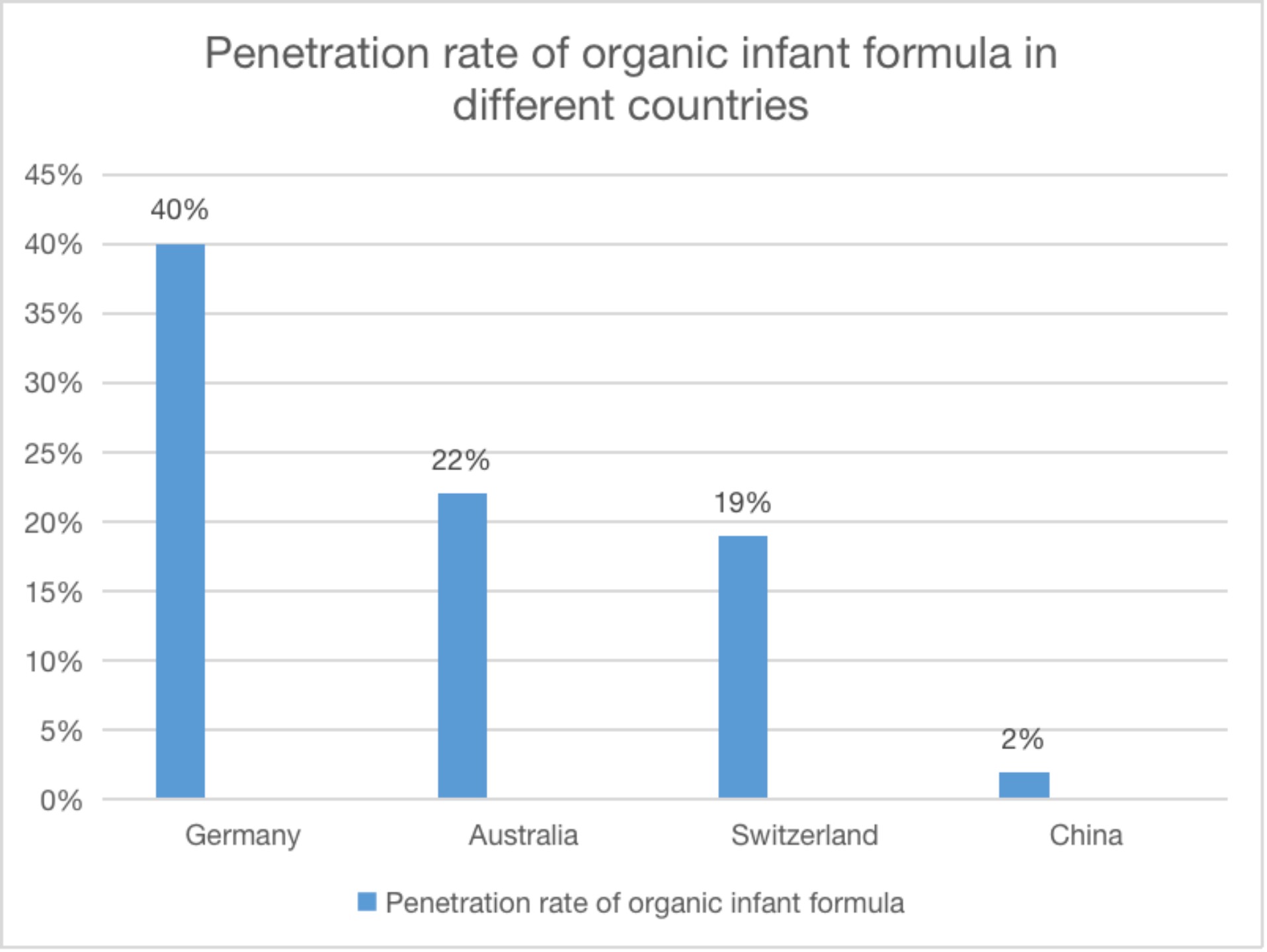
Source: Euromonitor
Three Major Problems Met in China
First, high product safety is the major selling point of organic IF in China. However, this advantage is now dented by the overall enhancement of IF safety and quality in China. According to China’s regulation related to organic products1, the production of organic products should avoid the use of chemically synthesized pesticides, fertilizers, etc. Moreover, the production should follow the natural law and ecological principle as well as maintain the stable and sustainable production system. For processed organic products, the content of organic ingredients should be no less than 95%. Hence, it is true that organic products are with a relatively higher level of product safety. But at the same time, we can see a leap in China’s overall food safety level in past years, especially the safety and quality of infant formula products, which mainly attributes to consumers’ increasing purchasing power, their demands of high quality products, strict regulatory requirements, stringent supervision measures (manufacturer registration, recipe registration, etc.), industrial effort and governmental support like domestic IF promotion action plan2.
As we all know, the melamine scandal in 2008 has greatly influenced people’s consumption preference of IF afterwards. In order to offer safer IF products to their babies, consumers tend to choose imported infant formula instead. Organic IF also had its development opportunity under consumers’ urgent need of safety. But the industry is walking out of the shadow of the scandal bit by bit. Through effective promotion and the enhancement of product quality, domestic dairy and infant formula products now are gradually winning Chinese consumers’ trust back. More and more consumers believe in the safety and quality of domestic IF products. In this context, organic IF’s relatively higher safety becomes less attractive.
Second, when the overall product safety and quality have greatly enhanced, consumers are paying more attention to product nutrition. However, limited numbers of allowed organic ingredients cause the weakness in recipe nutrition, which is the second major problem of organic IF market.
Every coin has two sides. The authentication of organic certificate empowers IF product, but at the same time, it sets the limits of the ingredients that can be used in IF recipes. Specified by the regulation, 95% of the ingredients used in IF products should be organic and also the permitted ingredients listed in the Catalogue of Organic Product Certification in China3. As revealed by the catalogue, permitted nutritional components include DHA, ARA, nucleotide, etc. Due to the limited options, these requirements greatly restrained the formulation of recipes, which also leads to similar IF recipes in the market. In 2018, OPO was added to the organic product certification catalogue. Although more ingredients are expected to be added into the catalogue in the future, it is still far from enough to help organic recipes get closer to breast milk or to catch up with conventional IF recipes. Moreover, mimicking breast milk is always the ultimate goal of infant formula products. Therefore, ChemLinked believes the relatively deficient nutrients in organic IF recipes is the biggest hindrance for potential consumers.
Table: Nutrition facts comparison of cow IF recipe and organic IF recipe, per 100g
Items | Conventional cow IF brand 1 | Conventional cow IF brand 2 | Organic IF |
Product | Xingfeifan from Firmus, stage 3 | Alpha-star from Biostime, stage 3 | Healthy Times from Biostime, stage 3 |
Price (yuan/kg) | 440 | 308 | 535 |
Energy (kJ) | 1956 | 1970 | 1976 |
Protein (g) | 17.0 | 15.0 | 15.0 |
Fat (g) | 20.0 | 19.0 | 19.0 |
Linoleic acid (g) | 1.9 | 2.32 | 2.05 |
Carbohydrate (g) | 53.0 | 59.3 | 59.3 |
Vitamin | |||
Vitamin A (μg RE) | 500 | 453 | 454 |
Vitamin D (μg) | 8.0 | 6.1 | 6.3 |
Vitamin E (mg α-TE) | 4.90 | 3.74 | 3.99 |
Vitamin K1 (μg) | 45.0 | 25.6 | 25.7 |
Vitamin B1 (μg) | 650 | 276 | 338 |
Vitamin B2 (μg) | 723 | 360 | 392 |
Vitamin B6 (μg) | 600 | 415 | 328 |
Vitamin B12 (μg) | 1.30 | 1.16 | 1.01 |
Niacin (μg) | 5000 | 2719 | 2727 |
Folate (μg) | 50 | 50 | 56 |
Pantothenic acid (μg) | 4300 | 2001 | 1764 |
Vitamin C (mg) | 49.0 | 45.3 | 45.4 |
Biotin (μg) | 21.0 | 11.0 | 15.5 |
Minerals | |||
Sodium (mg) | 150 | 170 | 135 |
Potassium (mg) | 510 | 519 | 454 |
Copper (μg) | 315 | 228 | 238 |
Magnesium (mg) | 42 | 36 | 36 |
Iron (mg) | 6.8 | 6.1 | 6.1 |
Zinc (mg) | 4.00 | 2.56 | 2.77 |
Calcium (mg) | 490 | 434 | 415 |
Phosphorus (mg) | 330 | 246 | 270 |
Iodine (μg) | 40.0 | 46.1 | 39.3 |
Chlorine (mg) | 310 | 380 | 375 |
Optional ingredients | |||
Choline (mg) | 80.0 | 62.5 | / |
Manganese (μg) | / | 46 | / |
Inositol (mg) | 40.0 | 25.6 | / |
Taurine (mg) | 38.0 | 22 | / |
L-carnitine (mg) | 11.0 | 7.9 | / |
DHA (%total fat acid) | 0.15 | 0.04 | 0.05 |
ARA (%total fat acid) | 0.30 | 0.04 | 0.05 |
Galactooligosaccharide (g) | 3.0 | 0.50 | 1.20 |
OPO (g) | 4.0 | 2.4 | / |
Lutein (μg) | 210 | / | / |
Ribotide (mg) | 30.0 | / | / |
Casein Phosphopeptides (CPP) (mg) | 40.0 | / | / |
Data: Tmall flag stores of the three products
Third, high price and high-end position determine that organic infant formula is a product for a certain group of people. To have a better understanding of the price difference, ChemLinked collected the market price of conventional IF and organic IF from 10 most popular IF brands as below. As we can see, the price (eliminate any discount influence) of conventional IF products ranges from 217 yuan/kg to 476 yuan/kg. Meanwhile, the price of most organic IF products is over 450 yuan/kg. Some even exceed 500 yuan/kg. Liu Senmiao, vice president of Junlebao Dairy, expressed his opinion to China’s organic IF industry in an interview. He expounded, “We studied the recipe of ten organic IF products. Only three of them used fresh milk as raw material. Only one adds probiotic. Others are just normal recipes. It is quite obvious low quality and high price are the major problems in this sector.” After all, most consumers will consider the price-performance ratio in buying. If the quality gap between products is small, then the price will become an important factor for decision-making.
Table: Price comparison between conventional IF and organic IF of same brands (Data from Tmall and JD flag stores)
No. | Brand* | Conventional IF (stage 3) | Price (yuan/kg) | Organic IF (stage 3) | Price |
1 | Aptamil | Aptamil | 337 | ESSENSIS (CBEC) | 383 |
Profutura | 405 | ||||
2 | Friso | Friso | 253 | Prestige (CBEC) | 556 |
Prestige | 470 | ||||
3 | Firmus | Feifan | 220 | Zhenzhi | 511 |
Xingfeifan | 440 | ||||
4 | A2 | Zhichu | 475 | /(didn’t find an organic brand) | / |
5 | Wyeth | Ultima | 373 | Illuma | 487 |
Illuma | 454 | ||||
6 | Mead Johnson | Qinshu | 422 | / | / |
Enfinitas | 476 | ||||
7 | Biostime | Alpha star | 308 | Healthy Times | 535 |
8 | Abbott | Similac plus | 335 | Eleva Jingzhi | 483 |
Qinhu | 400 | ||||
9 | Junlebao | Lebo | 217 | Youcui | 448 |
Zhizhen | 322 | ||||
10 | Yili | Jinlingguan | 232 | Jinlingguan Sainamu | 460 |
Jinlingguan Zhenhu | 408 |
*Top 10 best-selling cow brands in 618 shopping festival on Tmall4
Summary, Expectation and Suggestion
Although many problems are to be solved, we still see some organic IF brands performing well in the market, such as Eleva Jingzhi from Abbott, Illuma from Wyeth, Healthy Times from H&H Group, Baby&Me from Arla, etc. Disclosed by H&H Group, the growth rate of Healthy Times (H&H Group’s organic IF brand) exceeded that of the overall organic IF sector, whose sales value increased by 33.8% and accounted for 5.6% of the group’s IF income in 2019. Regarding their fast development, most leading products benefited from their long-time brand reputation and their early product layout in China.
Of course, organic IF sector also has its opportunities at present. First, less competition. Up to the end of June 2021, among 1,330 valid IF recipes, 937 of them are conventional cow IF while only 87 recipes (from 17 companies) are organic IF. Second, high margin. According to senior dairy expert Wang Dingmian, the cost of a final organic IF (900g) is around 90 yuan but it can be sold at around 500 yuan. The high margin also attracts the entrance of many giant companies in past years. Third, there’s still a group of people who need organic IF and value safety the most. To this group of people, they look highly on features like safety, nature and purity. Usually, they are with high consumption ability. Fourth, the layout of organic IF goes with the premiumsation5 trend in China. Although the birth rate in China decreased (17 million in 2017 and around 12 million in 2020) and the competition among players intensified, the premiumisation trend is the major factor that drives the development of organic IF. As revealed by H&H Group, the sales value of its organic IF increased by 171.8% in 2018 reinforced by effective marketing measures, sales channel investment and especially the high-end positioning.
However, ChemLinked analyst Lennie Tao still remains unconvinced that organic IF will become a hit in China. First, as mentioned above, the selling point is relatively weak compared with that of conventional cow IF and goat IF (at least, the “easy to be digested and absorbed” concept of goat IF is well accepted by Chinese consumers). Second, parents in China become wiser. As many media start to introduce the difference between conventional IF and organic IF, to many middle-class parents, once they find high price doesn’t mean better quality and nutrition, they will take the price–performance ratio into consideration and may turn to other IF categories.
Overall speaking, ChemLinked believes organic IF can be launched as a supplement of IF product categories and another option for consumers. But from a long-term perspective, it is hard for organic IF to break the bottleneck and to predominate the market. Considering the rare milk source amount and the high production cost of organic milk source, Chemlinked does not advise small companies to enter this sector.
 We provide full-scale global food market entry services (including product registration, ingredient review, regulatory consultation, customized training, market research, branding strategy). Please contact us to discuss how we can help you by