Request a Demo
On May 23, 2019, the National Development and Reform Commission of China (hereinafter NDRC) issued the 'The Promotion Action Plan of Domestic Infant Formula Milk Powder', which emphasized standardization, technological innovation, law enforcement supervision and market cultivation. The Plan aims to improve the quality, competitiveness and reputation of domestic infant formula.
Overview: Requirements and Goals
In general, the plan is designed to stimulate an increase in overall production volume of domestic infant formula. A domestic self-sufficiency level of more than 60% is the goal, with a concomitant increase in consumer satisfaction[1]. In terms of industrial structure, the entire industry chain is required to be continuously optimized. Cooperation and competition between domestic and foreign companies is encouraged. The program also proposes measures for brand management and cultivation.
Optimization through Standardization: Regulatory Selective Pressures
In order to continuously strengthen product quality, the government should oversee implementation of the most stringent regulatory system and implement whole process supervision from farm to fork.
To improve raw materials, the government will develop or revise new national standards and industry standards for raw milk, and will promote the disclosure of enterprise standards. The cooperation between the government and enterprises will be strengthened. It is expected that within 3 years, a unified breast milk research database will be established to study the nutritional needs of Chinese babies. According to CBNData[2], some domestic brands (e.g. Yili, Junlebao, etc.) are more suitable for consumption by Chinese babies compared to international brands. This is attributed to the nutritional research and development undertaken by these domestic enterprise. This assertion has been a significant factor in the steady rise in popularity of certain product lines.
In addition, the formula registration management method will be optimized based on breast milk research and market demand. Independent research into milk powder raw materials will be encouraged (e.g. lactoferrin, whey raw materials, etc.).
The plan also pointed out that for infant formula enterprise with a history of compliance issues will be targeted by regulatory authorities. For these enterprise, SAMR and related authorities will increase the intensity of random inspections. Some illegal activities will be severely cracked down on, for instance, illegal addition of non-edible substances, overuse of food additives, tampering with label identification, and labeling of false, exaggerated content, etc.
Industrial Upgrading Measures: Domestic and Foreign Investment and Cooperation Will be supported
NDRC is encouraging international infant formula companies to set up foreign-invested enterprises in China, to promote domestic and foreign brands cooperation and fair competition. NDRC is also encouraging domestic enterprises to acquire milk source bases or set up processing facilities overseas. NDRC is also reminding manufacturers and brands to stay cognizant of market segmentation within the infant formula market and to meet the differentiated demands of various groups in China.
In March, 2019, Nielsen's China market report showed that the market share of domestic infant formula increased from 40.7% in 2017 to 43.7% in 2018[3]. According to data, more than 90% of worldwide high-end infant formula is consumed by Chinese babies, and products such as high-end organic milk powder are expected to become more and more popular (more info can be acquired by the chart below).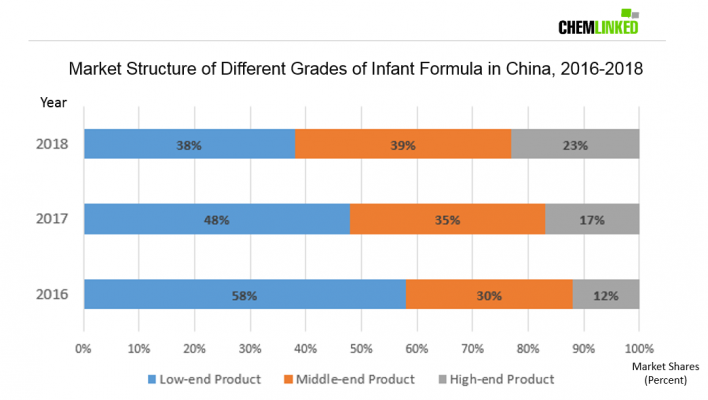
However, at present, the products circulating on the market are suffering from a lack of differentiation. There is excellent data to show that specific segments such as organic and goats milk formula offer serious potential and are currently under exploited.
Based on this, more companies are eager to develop organic milk powder (chart below shows an increase sales of organic infant formula). The market penetration of imported organic products is very high, especially products from Germany, Australia and Switzerland. 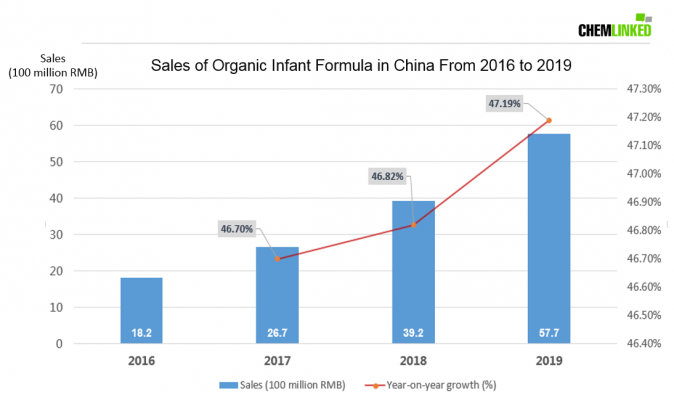
Limitations on Advertising and Importation
Under amended policy requirements it is forbidden to advertise infant formula which is designed for infants aged 0-12 months (Stage 1 and stage 2).
China will also implement a strict management system for overseas milk powder manufacturers and cross-border e-commerce.
The registration management of overseas infant formula manufacturers will be strengthened. It will be forbidden to import pre-blended infant formula powder in bulk into China for subsequent packaging in the mainland into finished sales products. A filing and sales record systems will be implemented for import agents. Imported products that have not obtained formula registration will be considered non-compliant and banned from being imported.
For infant formula imported through cross-border e-commerce, e-commerce platforms should take the main responsibility for product quality and safety for imported infant formula. E-commerce platforms are also required to establish a risk prevention and control mechanism. NDRC also pointed out that a product quality traceability system covering the entire supply chain and product lifecycle should be developed.
 We provide full-scale global food market entry services (including product registration, ingredient review, regulatory consultation, customized training, market research, branding strategy). Please contact us to discuss how we can help you by