Request a Demo


Sales Channels: Online Shopping on the Rise, Conference Marketing on the Decline
Conference marketing, cosmeceuticals shops and long-distance sales (including TV shopping and online shopping) are major sales channels of health-promoting food in Japan. A decade ago, conference marketing was #1 channel and was able to grow by leveraging advertising and promotion which relied on word of mouth and face to face interactions, while at the same time avoid the watchful eye of regulators by ensuring not to indicate any function claims in written form e.g. on labels, advertising material etc. As the number of netizens grew, online shopping gradually took the place of TV shopping and conference marketing. Sales attributed to conference marketing have halved in the last ten years.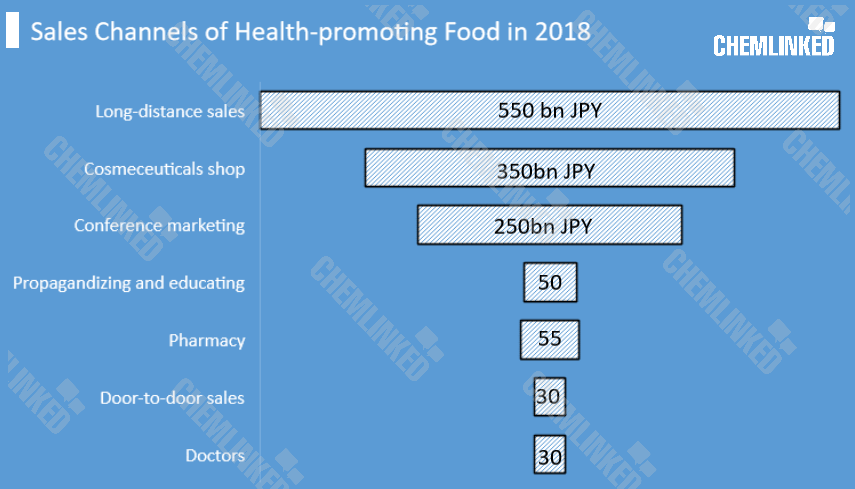 Sales of health-promoting food in cosmeceuticals shops are expanding rapidly. Frustrated by the falling price of pharmaceutical drugs, pharmacies are pooling more efforts to sell health-promoting food. In 2018, sales of health-promoting food accounted for 1% of all sales in pharmacies.
Food for Specified Health Uses is Losing Market
The TOKUHO sector has experienced three decreases in 10 years and dropped from 679.8bn JPY in 2007 to 643.2bn JPY in 2018. The first drop took place after 2007 when Kao Corporation’s TOKUHO edible oil was found to contain high levels of a carcinogen. Consumers’ trust in the government endorsed TOKUHO was at a record low. The second drop in 2014 was a result of an increase in consumption tax from 5% to 8%. Later in 2015, “food with function claims” became another avenue to target Japan’s markets for health-promoting food and offered lower regulatory barriers when compared to the stringent requirements required to launch a TOKUHU. Registration of a TOKUHO product usually takes 300 million JPY and over 3 years because of clinical trial requirements, which is not required by food with function claims. Stakeholders then shifted focus from TOKUHO to food with function claims. The third decrease was seen in 2018.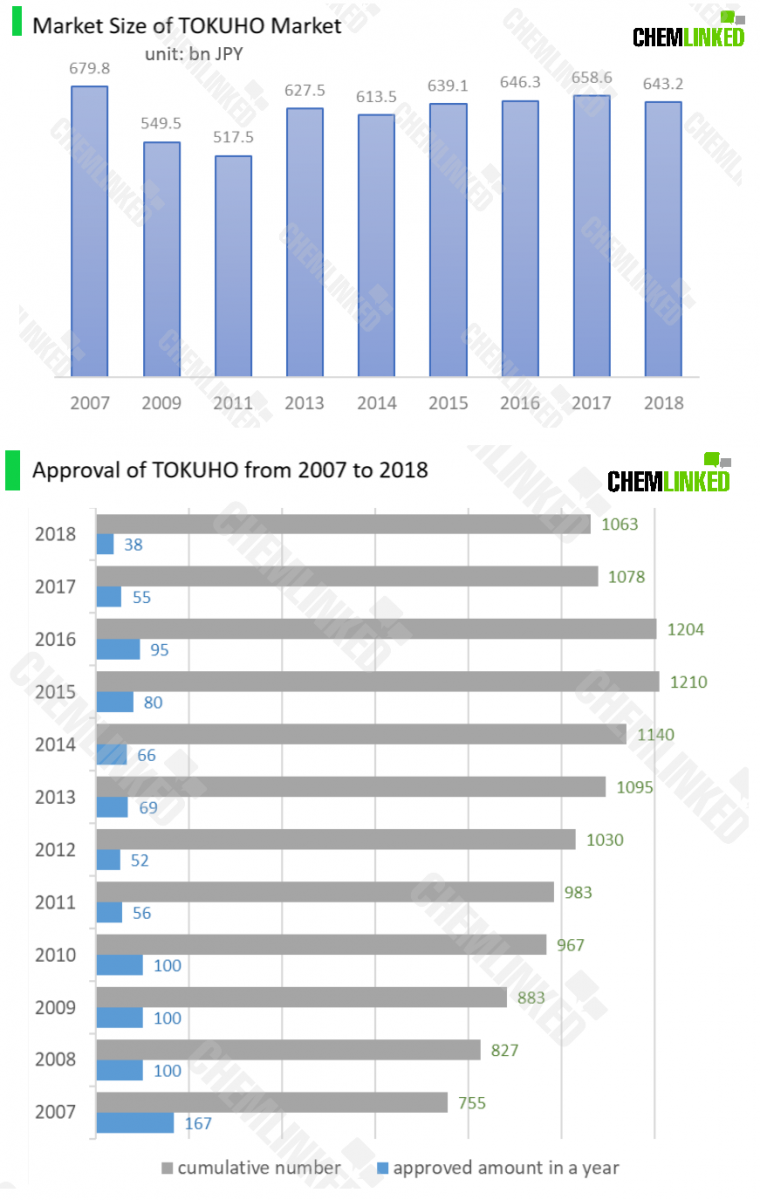 Despite the decline witnessed in the TOKUHO sector, specific segments such as products which regulate intestinal function, lower cholesterol and improve bone density continue to perform well and have recorded steady growth from 2007 to 2018.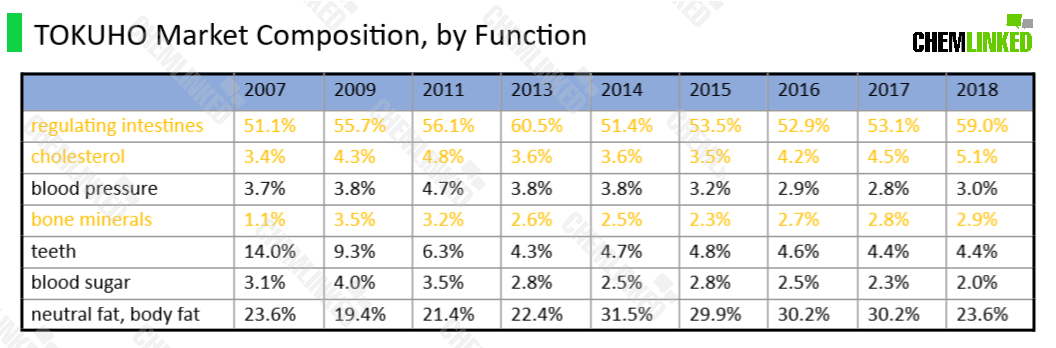
Regulating intestinal function is the most popular TOKUHO function, taking up 59% of the TOKUHO market, up from 51.1% in 2007. In terms of ingredients, over 90% of this growing niche market is driven by lactobacillus, followed by food fiber and oligosaccharide.
Unit: bn JPY
| 2007 | 2018 | |
| lactobacillus | 324.93 | 346.8 |
| food fiber | 15.25 | 20.84 |
| oligosaccharide | 7.18 | 11.84 |
Functions relating to the reduction of metabolic risk factors including triglycerides, cholesterol and body fat ranked #2, making up around 24% of the TOKUHO market. This niche witnessed a decline in recent years and was down from 30.2% in 2016 and 2017 to 23.6% in 2018.
Food with Function Claims Set to Overshadow TOKUHO
Foods with function claims was established as a separate and distinct category of foods by authorities in 2015 to stimulate the health industry and offset the negative influences of deflation and slowing growth. Food with function claims has performed reassuringly over the past 4 years. The leap in market value from 34.4 bn JPY in the first year of its launch to 220 bn JPY has been a revelation and most analysts are predicting the sector to reach 250 bn JPY in 2019.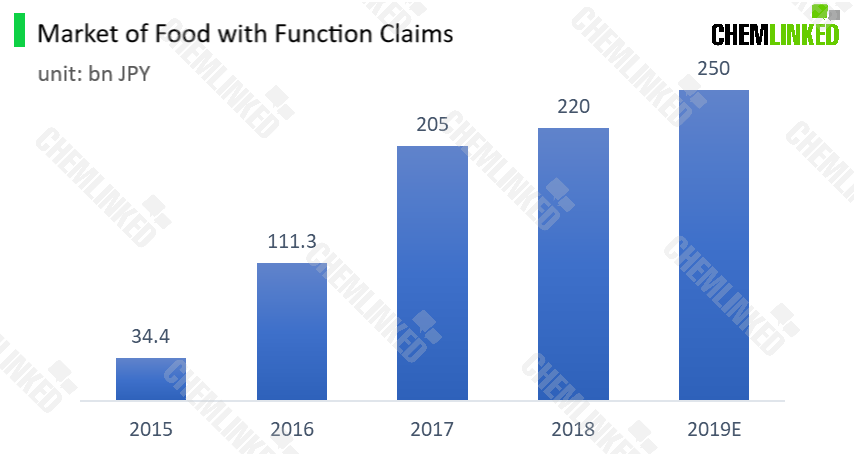 As of June 10, 2019, a total of 2105 foods with functional claims have gained approval, doubling that of TOKUHO. Food with functional claims exists in three forms: 1) supplements in the form of capsule etc.; 2) prepackaged food in the form of beverage, gummy etc.; 3) fresh foods including fruits, vegetables and even fish. The first two types are major categories.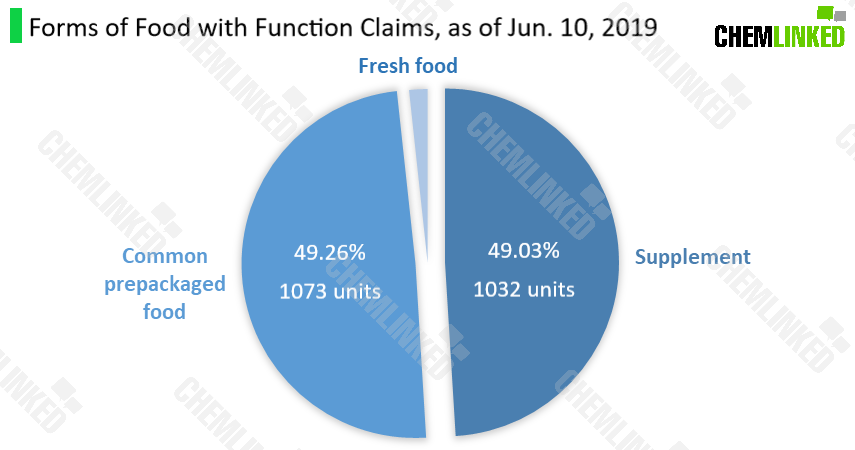
Notification of food with function claims
The approval of food with function claims is based on scientific evidence supporting the safety and effectiveness of the product. Evidence is usually taken from scientific research papers instead of clinical tests. Among all the applications submitted to Consumer Affairs Agency, 93.04% are based on scientific literature collected by applicants. 6.91% are based on results of clinical tests and the report written after the trial, and 0.05% (only 1 product) is supported by a research on this product.| Scientific literature | 93.04% |
| Clinical trials | 6.91% |
| Research on final product | 0.05% |
Of all the applications, top 1 most frequently used raw material is resistant dextrin and the top 1 functional claim is combating the absorption of fat.
| Efficacy ingredient | Application amount | |
| 1 | Resistant dextrin | 258 |
| 2 | GABA | 239 |
| 3 | DHA·EPA | 150 |
| 4 | Bifidobacteria | 100 |
| 5 | Lutein | 99 |
| 6 | Ginkgo biloba | 89 |
| 7 | Hyaluronic acid | 72 |
| 8 | L-Theanine | 71 |
| 9 | Rose flower isoflavone | 69 |
| 9 | Glucosamine (hydrochloride) | 69 |
n Most commonly claimed functions in food with function claims
| Function claim | Application amount | |
| 1 | Combat the absorption of fat | 417 |
| 2 | Combat blood lipid | 324 |
| 3 | Combat the absorption of sugar/control blood sugar | 286 |
| 4 | Prevent/ alleviate high blood pressure | 184 |
| 5 | Improve memory | 174 |
| 6 | Moisturize skin | 160 |
| 7 | Reduce emotional stress | 159 |
| 8 | Relieve eye fatigue | 158 |
| 8 | Reduce body fatigue | 158 |
| 10 | Improve sleep quality | 113 |
Best seller list: Fancl sweeps the board
| No. | Product | Form | Manufacturer |
| 1 | 大人のカロリミット 30日分 120粒 | tablet/capsule | Fancl |
| 2 | 内脂サポート 30日分 120粒 | tablet/capsule | Fancl |
| 3 | カロリミット 徳用3袋 120粒×3 | tablet/capsule | Fancl |
| 4 | カロリミット 30回分 120粒 | tablet/capsule | Fancl |
| 5 | えんきん 30日分 60粒 | tablet/capsule | Fancl |
| 6 | 内脂サポート 15日分 60粒 | tablet/capsule | Fancl |
| 7 | カゴメトマトジュース 食塩無添加 スマートPET720ml | juice | Kagome |
| 8 | ヘルスエイド ビフィーナスーパー 30日分 | tablet/capsule | 森下仁丹 |
| 9 | ピルボックス onaka60粒 | tablet/capsule | Bill box japan |
| 10 | Bifixヨーグルト ほんのり甘い加糖 375g | Yogurt | 江崎Greer |
| 11 | DHA 60日分 240粒 | tablet/capsule | DHC |
| 12 | ロートV5粒 30粒 | tablet/capsule | Rohto製薬 |
| 13 | くるんパックソーセージ 75g×4 | Sausage | maruhanichiro |
| 14 | メタバリア 葛の花イソフラボン 60粒 | tablet/capsule | fujifilm |
| 15 | 大人のカロリミット 15日分 60粒 | tablet/capsule | Fancl |
Japanese Consumer Demand for Health-Promoting Food
The top 15 demand for specific functionality in health promoting foods (which include TOKUHO, food with function claims and food with nutrient function claims) are:| Demand | Consumer market (bn JPY) | |
| 1 | Intestinal environment | 495 |
| 2 | General wellbeing | 310 |
| 3 | Anti- obesity/lose weight | 146 |
| 4 | Beauty | 131 |
| 5 | Arthritis | 75 |
| 6 | Eye care | 56 |
| 7 | Blood circulation | 55 |
| 8 | Vigor | 50 |
| 9 | Immunity | 48 |
| 10 | Control blood sugar | 45 |
| 11 | Sports and fitness | 45 |
| 12 | Liver function | 39 |
| 13 | Tooth decay/oral care | 23 |
| 14 | Brain | 21 |
| 15 | Blood pressure | 17 |
n Top 20 popular ingredients among Japanese consumers
| Ingredient | Consumer market (bn JPY) | Ingredient | Consumer market (bn JPY) | ||
| 1 | lactobacillus | 510 | 11 | Plant enzyme extract | 42 |
| 2 | amino acid | 218 | 12 | DHA | 39 |
| 3 | Resistant dextrin | 63 | 13 | Sesame | 38 |
| 4 | Prunes | 57 | 14 | Blueberry | 34 |
| 5 | Tender barley grass | 55 | 15 | Nucleic acid | 33 |
| 6 | Collagen | 53 | 16 | Hyaluronic acid | 31 |
| 7 | Glucosamine | 45 | 17 | Kale | 28 |
| 8 | Bifidobacterium | 45 | 18 | Ginger | 28 |
| 9 | Royal jelly | 44 | 19 | Lutein | 25 |
| 10 | Black vinegar | 43 | 20 | Propolis | 25 |
 We provide full-scale global food market entry services (including product registration, ingredient review, regulatory consultation, customized training, market research, branding strategy). Please contact us to discuss how we can help you by