Request a Demo
On August 28, 2023, the State Administration for Market Regulation (SAMR) published Detailed Rules on the Implementation of Technical Evaluation on New Functions and Health Food with New Functions (Trial), with immediate effect.
As an essential effort to reform China's management of health food function claims, the Rules expatiate on six aspects, including "General Provisions", "New Function Research", "Material Acceptance", "Technical Evaluation", "Post-Market Evaluation", and "Supplementary Provisions". In addition, the Rules attach "Material Requirements and Technical Evaluation Points for New Function Applications" to further guide the industry in applying for new functions. Details are as follows:
Application Procedures of New Function for Health Food
Any individual or unit can individually or jointly put forward suggestions on the new functions of health food to the food evaluation institution of SAMR.

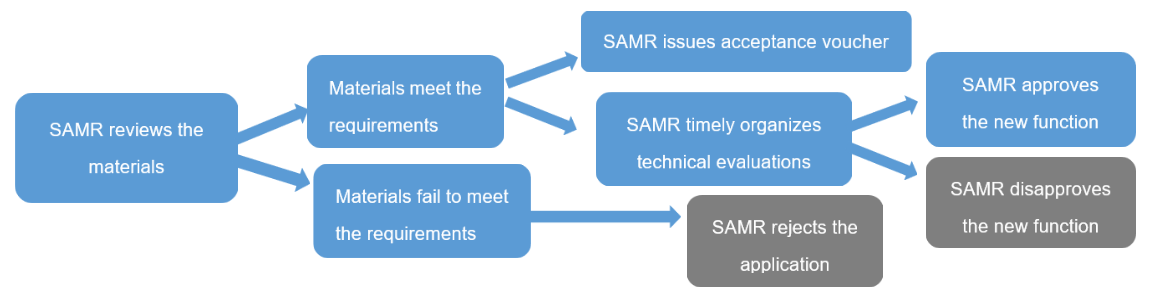
SAMR will review the application materials and timely organize technical evaluations for those meeting requirements.
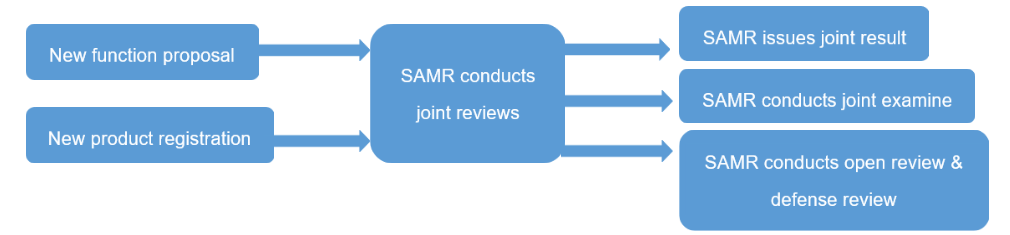
Besides, applicants can apply for the new function and the registration of related health food product simultaneously. In this case, SAMR will accept the applications simultaneously and conduct a joint evaluation.
If the materials meet the requirements, SAMR will conduct on-site verifications and invite the proposers for technical exchange on the new function research as needed.
Regulatory Innovations of Health Food in China
Overall, the Rules bring three new regulatory innovations to China's health food supervision model, aiming to encourage industries to engage in functional innovation as well as product research and development, further promoting the high-quality development of China's health food industry.
Firstly, it combines the pre-market assessment and post-market evaluation for products with new functions, with human taste trials generally required for new function evaluations. The Rules further specify that evaluation indicators and criteria should be scientific, clear, feasible, and validated. Additionally, before proposing new function claims, validation evaluations should be conducted by at least one qualified food testing institution or clinical trial institution. For new functional health food registrations submitted simultaneously, during the post-market evaluation period, validation evaluations should be conducted by at least two qualified food testing institutions or clinical trial institutions.
Another innovation is the establishment of the joint evaluation and approval mechanism for new functional claims and corresponding health food registrations. The Rules state that any entity or individual proposing new function claims and corresponding health food registration applications simultaneously should undergo joint review and examination in the stages of data collection, evaluation, and approval. This institutional innovation aims to stimulate the intrinsic motivation for industrial innovation, and facilitate the rapid transformation of scientific research achievements into marketable products.
The third innovation mainly lies in the exploration of a dynamic management approach for functional claims of new functional health food, with the implementation of classification evaluation and graded labeling based on health functions. As per the Rules, new functions shall be classified into three categories, namely, supplementing dietary nutrients, maintaining or improving body health, and reducing disease risk factors. Besides, for products with approved new functions, based on the sufficiency of scientific evidence, they will be graded with the labeling of "scientific evidence (non-conclusive evidence)", "supportive research evidence (non-conclusive evidence)", or "limited research evidence (non-conclusive evidence) indicates that the product has the function of XXX". It is worth-noting that once the expiration date of the registration certificate has passed, the graded-labeling can be dynamically adjusted as long as meeting corresponding criteria.
ChemLinked's Comments
Compared to the past, Chinese health food enterprises now possess adequate awareness of legal compliance and responsibility. As a result, the government can relax regulations on matters that businesses can handle and markets can regulate, while strengthening supervision on areas that require government intervention.
The release of the Rules is an important step towards these reforms. The optimized health food registration mechanism will better incentivize and guide companies in technological innovation. This includes research on new active ingredients, functional effects, evaluation methods, formulation, and manufacturing processes. In addition, the mechanism can stimulate industry vitality and facilitate market access for new products.
ChemLinked equipped with a professional technician team to provide a one-stop registration service with expertise and efficiency. Our services include:
Feasibility assessment (formula check, data gap analysis, test analysis, budget evaluation, etc.)
Health food registration (product research, dossier preparation & submission, test monitoring, communication with SAMR)
Health food filing (product research, dossier preparation & submission, test monitoring, communication with SAMR)
Please feel free to contact us via [email protected] if you need any help.
 We provide full-scale global food market entry services (including product registration, ingredient review, regulatory consultation, customized training, market research, branding strategy). Please contact us to discuss how we can help you by