Request a Demo
On Mar. 31, 2021, China NHC opened 12 national food safety standards for public feedback, and any comments should be sent back prior to Apr. 30, 2021 via National Food Safety Standards Information System.
GB standards under consultation include:
National Food Safety Standard Standard for Uses of Food Additives
National Food Safety Standard Food Contact Materials and Articles Determination of Solvent Residue
National Food Safety Standard Food Additive Starch Sodium Octenylsuccinate
National Food Safety Standard Food Additive L-Methionylglycine﹒HCl
National Food Safety Standard Food Additive Sweetberry Honeysuckle Red
National Food Safety Standard Food Additive Sodium Methoxide
National Food Safety Standard Food Additive 5-methyl-2-furfurylthiol
 Key amendments to GB 2760 Standard for Uses of Food Additives are listed below:
Food additive
Increase and remove some food additives
The exposure draft incorporates new food additives which were permitted by NHC after the implementation of GB 2760-2014. Those food additives are sourced from 18 announcements.
Some food additives are removed because they are rarely used at present, including basella rubra red, buddleia yellow, jujube pigment, acorn shell brown, 2, 4-dichlorophenoxyacetic acid, and funoran.
Adjust food additives’ functions
With reference to CAC and EU standards, the exposure draft removes the function of stabilizer for potassium sorbate. Besides, the function of chewing gum bases is also deleted for some food additives so as to avoid the repeated regulation in GB 29987-2014 Gum Base and Its Ingredients
Revise the usage standards of some food additives
The maximum amount of sulfur dioxide, sulfite, sulphur used in white granulated sugar and its products (11.01.01) is changed from 0.1 g/kg to 0.03 g/kg (the maximum usage amount is calculated as sulfur dioxide residue).
In GB 2760-2014, the maximum level of some sweeteners used in table sweeteners are expressed by “g/serving”. However, as China lacks the definition of “share”, the authority proposed to change “g/serving” to “use as appropriate” referring to the international rules.
Considering the technical necessity, some additives are no longer used in some food products. For example, because all canned food are pasteurized, the draft cancels the use of food additives whose sole function is preservative in canned food, involving ε-polylysine hydrochloride.
Others include note clarification, items removal/incorporation and etc.
Optimize the search mechanism of Appendix A
In the current GB 2760-2014, table A.2 lists food additives that can be used in various types of food with appropriate dosage and table A.3 lists food categories exempted from the rule that food additives can be used with appropriate dosage. These tables caused much confusion when it comes to food additive query. In this case, the exposure draft mainly makes the following adjustments:
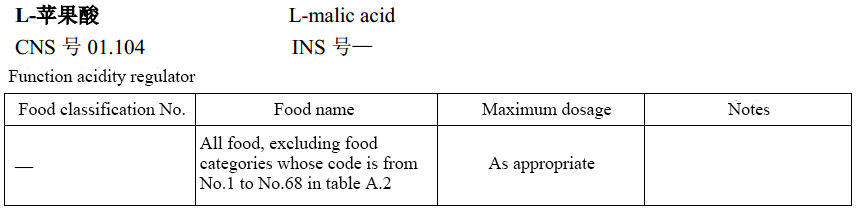
Food additives included in original table A.2 (2014 version) are incorporated into table A.1, and their application scope as well as usage amount are specified. For example, L-malic acid is just listed in table A.2 in GB 2760-2014, but now it has an individual item in table A.1
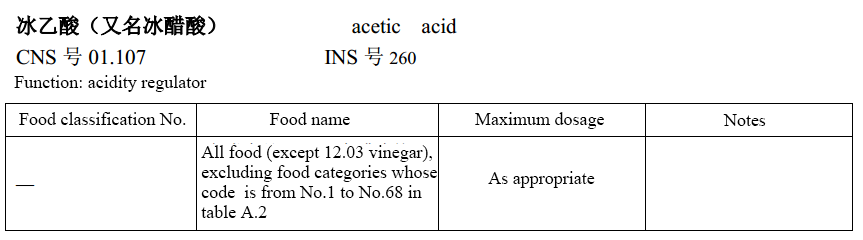
According to the requirements stipulated in table A.3 in GB 2760-2014, those exclusive food categories are now clarified in table A.1 of the exposure draft. For instance, all exclusive food categories are mentioned in the usage standard of acetic acid.
After the revision, all exception rules or notices could be found in table A.1, which would bring more convenience to the users.
Modify the names, INS code and CNS code
For the sake of accuracy and completeness, Chinese name, English name, INS code and CNS code of some food additives are modified/added. Please refer to attachment 1 (change of Chinese name), attachment 2 (change of CNS code), and attachment 3 (change of English name and INS code) for the details.
Food flavoring and fragrance
Add the list of spices that shall be processed into food flavoring before fragrance use
After the industry investigation, the expert panel reached a consensus that spices having multiple food additive functions cannot perform other functions in the name of food flavoring. Therefore, the draft stipulates that some substances must be processed into food flavoring before it is used to improve food flavor and substances involved are listed in table B.2. If those substances propose to serve other functions, they shall comply with corresponding requirements.
Clarify the use of food flavoring in complementary baby food
Complementary baby food is newly included in “Table B.1 List of foods not allowed to be added with flavorings or essences”, that is, food flavoring and fragrance cannot be applied in complementary food, while cereal-based complementary baby food is an exception.
Revise the food flavoring list
6 essences are deleted, and 2 essences are changed from natural to synthetic type. In addition, names and FEMA code of 25 essences are revised. Please refer to attachment 6 for the details.
Processing aids
Revise the use of hydrogen peroxide
The use of hydrogen peroxide is subject to more stringent requirement that now it has specific functions and limited application scopes.
Current version | Exposure draft |
Included in table C.1 can be used during the processing procedure of various foods without residual limits | Included in C.2 Functions: desulfurizer, decolorising agent, iodine-removal agent Application scope: starch sugar processing technique, starch processing technique, oil processing technique, seaweed processing technique |
The current GB 2760-2014 was implemented in May 2015. At the end of 2017, China National Center for Food Safety Risk Assessment consulted on GB 2760, and in Mar. 2021 it was under consultation for the second time.
 We provide full-scale global food market entry services (including product registration, ingredient review, regulatory consultation, customized training, market research, branding strategy). Please contact us to discuss how we can help you by