Request a Demo
Updated on January 2, 2025:
According to the Commission Regulation (EU) 2024/3190 published on December 31, 2024, EU officially prohibits the use of Bisphenol A (BPA) in food contact materials (FCMs).
The Regulation mainly prohibits:
The use of BPA and its salts in the manufacture of food contact materials and articles referred to in Article 1(2) and the placing on the Union market of food contact materials and articles manufactured using BPA; By way of derogation, BPA and its salts may be used in the manufacture of food contact materials and articles for a specific application set out in Annex II, subject to the restrictions laid down therein.
The presence of BPA in food contact materials and articles for which other bisphenols or bisphenol derivatives are used in their manufacture
The use of hazardous bisphenols other than BPA or hazardous bisphenol derivatives
For more details, please refer to the full text.
Updated on December 20, 2024:
As revealed by an official news, the Commission adopted the ban on the use of Bisphenol A (BPA) in food contact materials on December 19, 2024. This ban prohibits BPA in products that come into contact with food or beverages, including coatings on metal cans, reusable plastic drink bottles, water distribution coolers, and various kitchenware. Most products will have an 18-month phase-out period, with very limited exceptions where no alternatives are available, allowing the industry time to adapt and prevent disruptions in the food supply chain. The ban also extends to other bisphenols that are harmful to reproductive and endocrine systems.
Previous report published on February 22, 2024:
Background: At present, BPA can be used in FCMs in the EU under Commission Regulation (EU) No 10/2011 on Plastic FCM. However, it is prohibited to use BPA for the manufacture of polycarbonate drinking cups or bottles which are intended for infants and young children under three years from September 2018 or polycarbonate infant feeding bottles from January 2011. |
On February 9, 2024, the European Union (EU) proposed a ban1 on the use of bisphenol A (BPA) and certain other bisphenols in food contact materials (FCMs). This proposal is important for enterprises involved in FCMs, as BPA is widely used in plastic and resin within these industries. Moreover, the prohibition of BPA represents a significant departure from conventional chemical practices. Feedback can be sent to this website1 prior to March 8, 2024.
Background of the Revision
Early in 2015, resulted from data gap and uncertainties in evidence, the European Food Safety Authority (EFSA) established a temporary tolerable daily intake (t-TDI) for BPA of 4 μg/kg body weight (bw) per day2. Since chemicals such as BPA can migrate from food containers to food, EFSA regularly reviews the safety of such chemicals based on the latest data. In this context, EFSA re-evaluated the safety risk of BPA with latest data and revealed a scientific opinion in April 20233.
As per the updated opinion, EFSA concludes that there is a health concern from dietary BPA exposure for all age groups of the general population. It is found that BPA has multiple adverse effects on various body systems, such as reproductive and developmental system, metabolic system, and immune system. Based on the new evidence, EFSA significantly lowers the TDI to 0.2 ng BPA/kg bw per day, which is 20,000 times lower than that established in 2015.
In addition, in September 2023, the European Environment Agency (EEA) published a briefing4 introducing that the European human biomonitoring project, HBM4EU, which measured chemicals in people’s bodies in Europe and detected BPA in the urine of 92% of adult participants from 11 European countries. The data support EFSA’s new conclusion that there is a health concern for Europeans from exposure to BPA. Moreover, the briefing further stated that the most important exposure route for most people is through diet and the subsequent ingestion, during which even very small amounts of BPA can migrate from FCMs into foods.
Keynotes of the Proposal
Based on EFSA’s opinion of 2023, EU proposed to ban the use of BPA in FCM. As per the proposed draft, not only 4,4'-isopropylidenediphenol (BPA) (CAS No 80-05-7), but also some certain other bisphenols and bisphenol derivatives listed in Annex VI, Part 3 of Regulation (EC) No 1272/2008 are prohibited to be used in FCMs, except for some circumstances. It is because that these bisphenols and their derivatives may also present risks similar to BPA due to the similarities in their chemical structure and activity.
Table 1: Prohibited Usage Scope of BPA and Certain Other Bisphenols as well as the Exemptions
Affected substance | Prohibited usage scope | Exemptions |
BPA | Used at any manufacturing stage of food contact varnishes and coatings, printing inks, adhesives, ion-exchange resins and rubbers and the placing on the market of final food contact articles composed partly or wholly of these materials manufactured using BPA | Used as a precursor in the synthesis of bisphenol-A diglycidyl ether (BADGE) (CAS No 1675-54-3) and its derivatives to be used as monomers for the manufacture and placing on the market of BADGE-based heavy-duty varnishes and coatings (Detailed use restrictions can be found in Paragraph 2 of Article 3) |
Certain other bisphenols and bisphenol derivatives listed in Annex VI, Part 3 of Regulation (EC) No 1272/2008 as category 1A or 1B “mutagenic”, “carcinogenic”, “toxic to reproduction” or category 1 “endocrine disrupting” for human health | Used in the manufacture of food contact varnishes and coatings, printing inks, adhesives, ion-exchange resins and rubbers | May be used in the manufacture of food contact varnishes and coatings, printing inks, adhesives, ion-exchange resins and rubbers after meeting Article 4 |
For enterprises, manufacturers placing the following FCMs on the market shall monitor the presence of BPA and its migration from: a) materials and articles on which BADGE-based heavy-duty varnishes and coatings is applied; b) polysulfone resins for use in filtration membranes; and c) paper and board materials and articles containing recycled material. Business operators shall ensure the involved materials and articles are accompanied by a written declaration at all stages of marketing. The declaration of compliance shall contain the following information:
the identity and address of the business operator issuing the declaration of compliance;
the identity and address of the business operator that manufactures or imports the material or article;
the identity of the intermediate food contact material or the final food contact article;
the date of declaration;
confirmation that the intermediate food contact material or article or the final food contact article complies with the restrictions laid down in this Regulation and the requirements set out in Articles 3, 15 and 17 of Regulation (EC) No 1935/2004.
Moreover, corresponding regulations like Regulation (EU) No 10/2011 and Regulation (EC) No 1895/2005 are to be amended accordingly. Regulation (EU) No 10/2011 is to delete BPA (CAS No 80-05-7) from authorized substances and permit the use of “disodium 4,4'-Isopropylidene diphenolate” (CAS No 2444-90-8) only in the manufacture of polysulfone resins for use in filtration membranes. Regarding the revision of Commission Regulation (EC) No 1895/2005, the Draft revised the current provision “the use and/or presence of BFDGE in the manufacture of materials and articles are prohibited” as below.
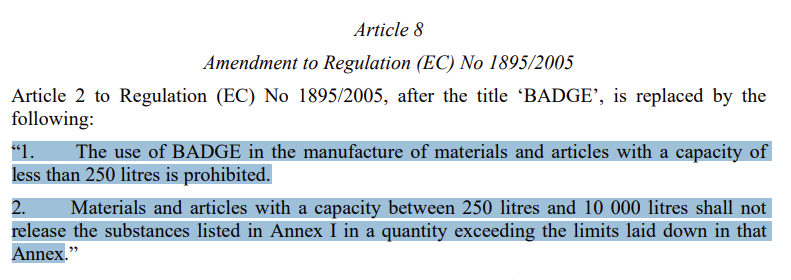 To avoid production disruption, transitional provisions for different situations are expounded in Article 10. For example, single-use final food contact articles intended to be filled with processed fruits, vegetables and fish products have a transitional period of 36 months, while many others are with a grace period of 18 months.
For further consultation service, please email [email protected].
Recommended reading:
ChemLinked Foodpedia: EU Food Contact Materials Regulation
 We provide full-scale global food market entry services (including product registration, ingredient review, regulatory consultation, customized training, market research, branding strategy). Please contact us to discuss how we can help you by