Request a Demo
Update: In a recent interview, Unilever's vice CEO Xiwen Zeng just admitted the fact that Magnum uses different ingredients in its ice cream products on Chinese market and international market, proving the earlier allegation of "double standard" to be true. Different from using condensed milk in the ice cream on the European market, Magnum uses reconstituted milk (milk powder with water) in China due to lack of fresh milk supply. Industry expert Liang Song pointed out that there's a huge cost gap between using condensed milk and reconstituted milk. However, the cost difference wasn't reflected by the price on the different markets, maybe that's the only real mistake Magnum did.
------------------------------------------------------------------------------------------------------------------------------
Since Unilever debuted its famous ice cream brand Magnum in China back in the 90s, Magnum has rapidly become one of the most popular ice cream brands and keeps dominating China's high-end ice cream market even to this day. However, the ice cream maker is accused of "double standard" by Chinese netizens on social media lately.
The Dispute Triggered by Food Label
Recently, a post on Chinese social platform Weibo aroused a plethora of discussions and criticisms towards Magnum's ice cream. The post accused Magnum of using different ingredients in the same product on Chinese market and on international market. To make matters worse, the difference between labels revealed that Magnum uses vegetable oil instead of animal fat in its ice cream with only a small amount of milk, which runs counter to the practice in the international version. Feeling treated differently or even discriminated by Magnum, lots of Chinese netizens expressed their disappointment and indignation.
Magnum posted an explanation via Weibo as a response, trying to quell the storm. In the post, Magnum first acknowledged the use of vegetable oil in place of animal fat, but stressed the choice was made out of the intention of environmental protection and all the products in the Chinese market conform to Chinese regulations. For no apparent reason, the post was deleted from Magnum's Weibo page. Evidently, Magnum's attempt failed to appease the consumers.
Where does Magnum's Mistake Lie?
What's wrong with Magnum? Let's trace it back to the label.
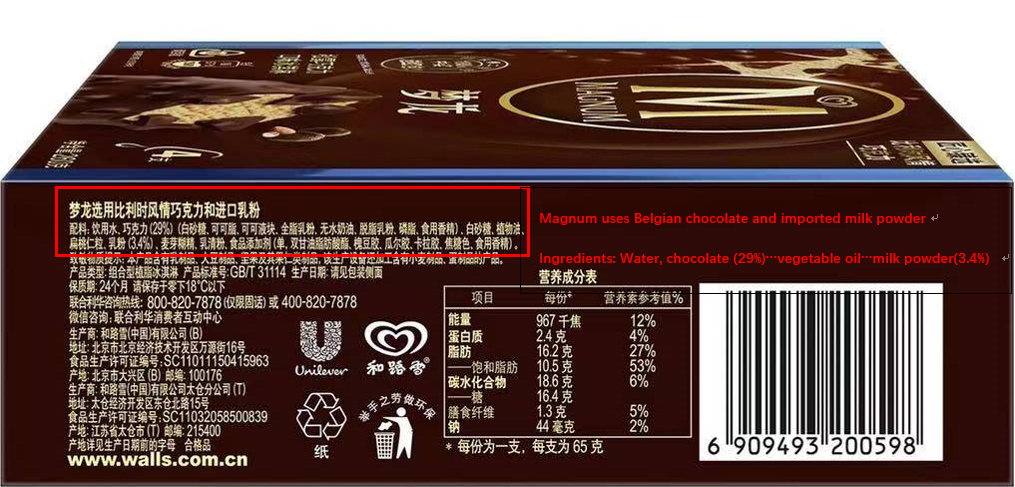 *The image is from Hema Fresh App.
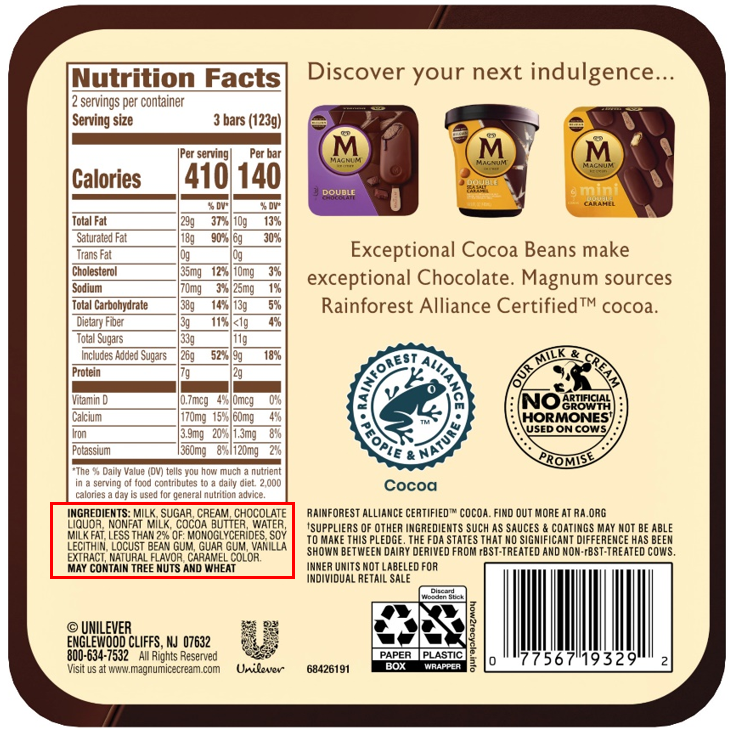 *The image is from Walmart.com.
On the label of Magnum's ice cream for the Chinese market, Magnum prints "Magnum uses Belgian style chocolate and imported milk powder" as a striking claim with larger fonts. Is magnum suspected of false claim? We can figure it out by observing the ingredients. Water ranks the first, followed by chocolate (29%), sugar, vegetable oil, almond, and milk powder (3.4%), etc. According to GB 7718-2011 General Standard for the Labeling of Prepackaged Foods, all ingredients shall be listed in descending order of their weights added in the manufacturing or preparation process of the food, which means in the product for the Chinese market, water is the leading ingredient in the ice cream, and even the amount of vegetable oil is greater than that of milk powder. On the contrary, the same product for the international market has milk as the leading ingredient and doesn't contain vegetable oil. It is distinct enough to accuse Magnum of having a "double standard" between consumers in China and in the rest of the world. Nevertheless, can it be counted as a false claim? Maybe not, since the cream does contain chocolate and milk power despite the origin is not indicated in the ingredient list.
Here comes another question, is it legitimate to use vegetable oil in Magnum's ice cream for the Chinese market under Chinese regulations? According to GB/T 31114-2014 Frozen Drinks - Ice Cream, ice cream products can be divided into nine categories, such as full-milk fat ice cream, half milk-fat ice cream, and vegetable fat ice cream, etc. In Magnum's deleted post, it claims the involved product belongs to "combination vegetable fat ice cream" category, which refers to a product processed with vegetable fat ice cream with the mass fraction of more than 50% as the main part, combined with other kinds of frozen drinks and (or) foods such as chocolate, cake blank, etc.. To name a few, chocolate crispy vegetable fat ice cream and waffle sandwiched vegetable fat ice cream. It is still doubtful whether this product belongs to the "combined vegetable fat ice cream" category claimed by the brand, at least Chinese food regulations allow vegetable oil to be used in ice cream instead of animal fat. Therefore, from the regulatory perspective, it seems Magnum doesn't make mistakes with its products.
 ChemLinked's Suggestions
For overseas brands in the Chinese market, guaranteeing their products meet Chinese supervision requirements is the basis for business operation. Take food labels for example, the storm that got Magnum involved actually mirrors the importance of product labels, for labels carrying many significant information and details. Moreover, as revealed by "Research Report on Chinese Consumers' Awareness and the Use of Food Labels 2020",1 consumers are increasingly concerning about food labels, in which ingredients in particular. Only 8.7% of respondents never check the labels.
Beyond regulatory supervision, many other aspects are worth to be concerned about. For instance, having double standard in different markets is definitely reprehensible. As Song Liang, a Chinese dairy expert expressed,2 "The essence of this matter is that a brand discriminates against the Chinese market. It harvests the Chinese market with low cost and high price". Indeed, Magnum has been doing well in the Chinese market, gaining almost $10 billion sales in 2020.3 Given the tarnished reputation and public backlash, the future performance of Magnum in China seems more unpredictable. Notably, as the parent company of Magnum, Unilever has a record of receiving an administrative penalty for the inconsistency between ingredients on the label and actual ingredients.4 ChemLinked believes that Magnum's case is a critical reminder that enterprises should always hold the spirit of persistent sincerity to consumers regardless of region or market. Meeting regulatory requirements is the bottom line, and the way a brand treats consumers determines how far it can go.
 We provide full-scale global food market entry services (including product registration, ingredient review, regulatory consultation, customized training, market research, branding strategy). Please contact us to discuss how we can help you by