Request a Demo
On June 20, 2025, the Ministry of Health Malaysia (MOH) launched Online Public Consultation No. 2/20251 to seek public feedback on proposed amendments to several regulations under the Food Act 1983. The amendments pertain to the following regulations:
Food Regulations 1985
Food Irradiation Regulations 2011 (limited to food packaging materials)
Food (Food Analysis Fee) Regulations 2016
The public is encouraged to provide feedback via the following link: https://forms.gle/T16Pp1ZjN8g8etXc8 before the deadline on July 29, 2025.
Key Proposed Amendments to Food Regulations 1985
1. Updates to Permitted Probiotic Cultures
The Twelfth A Schedule of the Food Regulations 1985 has listed permitted probiotic cultures in Malaysia.
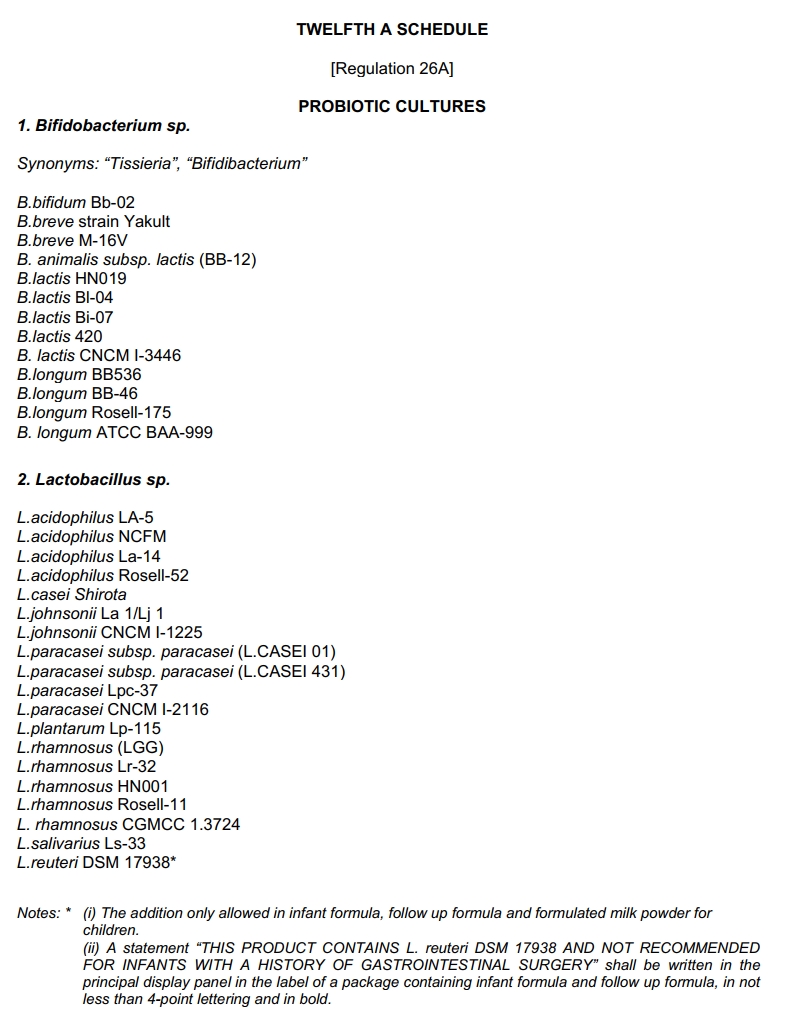
The proposed changes include:
a) Revising the name of the culture Lactobacillus casei Shirota.
b) Adding two new cultures: L. plantarum TCI378 and L. plantarum 299v.
2. Amendments Related to Sweetener Commodities
a) Introduction of three new product regulations:
Regulation 125B: Dry Glucose Syrup
Regulation 128A: Lactose
Regulation 134D: Evaporated Creamer
Example Regulation 128 A Lactose 1) Lactose shall be a natural constituent of milk normally obtained from whey. It may be anhydrous or contain one molecule of water of crystallization or a mixture of both. 2) Lactose shall –
3) The pH of a 10 per cent lactose solution shall be not less than 4.5 and not more than 7. |
b) Removal of preservatives from the following products:
Sugar
Dextrose monohydrates
Glucose
Glucose syrup
Fructose
High fructose glucose syrup
Icing sugar
The Sixth Schedule on Permitted Preservatives is updated accordingly.
c) Revisions to definitions, specifications, permitted additives, and/or labeling requirements for:
Regulation 118: Sugar
Regulation 119: Soft Brown Sugar
Regulation 120: Colored Sugar or Rainbow Sugar
Regulation 125: Glucose Syrup
Regulation 128: Fructose
Regulation 129: High Fructose Glucose Syrup
Regulation 131: Icing Sugar
Regulation 132: Molasses
Regulation 134A: Beverage Whitener
Regulation 134B: Sweetened Creamer
Regulation 134C: Non-Dairy Creamer
3. Amendments to Cocoa Commodities and Products
a) Updates to definitions, specifications, permitted additives, and/or labeling requirements for:
Regulation 274: Cocoa Bean
Regulation 275: Cocoa Nib or Cracked Cocoa
Regulation 276: Cocoa Paste, Cocoa Mass, Cocoa Slab, or Cocoa Liquor
Regulation 277: Cocoa Butter
Regulation 278: Cocoa or Cocoa Powder or Soluble Cocoa
Regulation 279: Chocolate
Due to the revision of the product regulation for chocolate (Regulation 279), the proposal requires chocolates to follow the requirements listed in the table below.
Types of chocolate | %, dry matter basis | ||||||
Cocoa fat | Defatted cocoa solids | Total cocoa solids | Milk fat | Total milk solids | Starch/Flour | Hazelnut | |
Chocolate/ bittersweet chocolate/ semi-sweet chocolate/ dark chocolate | ≥18 | ≥14 | ≥35 | - | - | - | - |
Chocolate a La taza | ≥18 | ≥14 | ≥35 | - | - | <8 | - |
Sweet chocolate | ≥18 | ≥12 | ≥30 | - | - | - | - |
Chocolate familiar a la taza | ≥18 | ≥12 | ≥30 | - | - | <18 | - |
Chocolate Couverture | ≥31 | ≥2.5 | ≥35 | - | - | - | - |
Milk chocolate | - | ≥2.5 | ≥25 | 2.5-3.5 | 12-14 | - | - |
Family milk chocolate | - | ≥2.5 | ≥20 | ≥5 | ≥20 | - | - |
Milk chocolate couverture | - | ≥2.5 | ≥25 | ≥3.5 | ≥14 | - | - |
White chocolate | ≥20 | - | - | 2.5-3.5 | ≥14 | - | - |
Gianduja chocolate | - | ≥8 | ≥32 | - | - | - | 20 - 40 |
Gianduja milk chocolate | - | ≥2.5 | ≥25 | 2.5-3.5 | ≥10 | - | 15 - 40 |
b) Introduction of three new product regulations:
Regulation 276A: Cocoa Cake
Regulation 279A: Chocolate Compound
Regulation 279B: Pre-Mixed Cocoa/Chocolate
Example Regulation 279A Chocolate compound 1) Compound chocolate shall be a cocoa-based product having the same organoleptic characteristics as chocolate. It shall contain not more than 5 per cent edible vegetable fat other than cocoa fat. 2) Compound chocolate may contain-
3) No package of compound chocolate shall be labelled with the word “chocolate” unless that word is combined in the same lettering as the word “compound”. |
c) Repeal of Regulations 280 (White Chocolate) and 281 (Milk Chocolate). Corresponding content will be removed from related schedules as well, including Table II of the Eleventh Schedule.
Table II of the Eleventh Schedule
Food Conditioner That May Be Added to Specified Food
Food | Food conditioner |
Chocolate, white chocolate | Polyglycerol polyricinoleate, beeswax, candelilla wax, shellac or carnauba wax |
Milk chocolate | beeswax, candelilla wax, shellac or carnauba wax |
4. Amendments to Regulation 282: Milkshakes
The proposal removes the allowance for adding "citric acid" or "tartaric acid" to pasteurized, sterilized, or ultra-high temperature milk before sale. Additionally, the provision allowing milkshakes to contain permitted food conditioners is also removed.
5. Amendments to Packaged Drinking Water Regulations
The proposal revises regulations for natural mineral water, packaged drinking water, isotonic electrolyte drinks, and isotonic electrolyte drink bases.
For isotonic electrolyte drinks, the proposal specifies:
"Prescribed electrolyte" includes sodium, potassium, calcium, magnesium, or chloride.
The product must contain 30-100 g/L of total glucose, fructose, sucrose, dextrose, or maltodextrin (previously 20-50 g/L), with fructose not exceeding 50% of total carbohydrates.
For further inquiries, please email [email protected].
 We provide full-scale global food market entry services (including product registration, ingredient review, regulatory consultation, customized training, market research, branding strategy). Please contact us to discuss how we can help you by