Request a Demo
According to China Securities Regulatory Commission (CSRC), EASTROC(东鹏) Beverage (Group) Co., Ltd. (hereinafter referred to as EASTROC) issued the Initial Public Offering Prospectus (Declaration Draft), which is planned to be listed with 1.49 billion yuan fundraising on the Shanghai Stock Exchange. Over half of the fundraising will be used for its production base construction in cities in South and West of China[1].
Development of EASTROC Beverages
EASTROC Beverage Group was founded in 1987 as a state-owned company. EASTROC super drink -its most successful energy drink was launched in 1997, ushering in the nascent development period of China’s fledgling functional beverage sector. In 2003, EASTROC Beverage transitioned from a state-owned company to a privately owned enterprise and was taken over by the current chairman Lin Muqin.
Eastroc’s products include energy drinks, non-energy drinks, and packaged drinking water. From 2017 to 2019, the revenue of EASTROC was 2.84 billion yuan (2017), 3.04 billion yuan (2018), and 4.21 billion yuan (2019). Energy drinks were the biggest contributor to revenue, accounting for 96.19%, 94.99%, and 95.11% of the total revenue from 2017 to 2019[2].
China’s Energy Drinks Market Share
According to Euromonitor International, the annual compound growth rate of retail sales of energy drinks in China reached 15.02% from 2014 to 2019, the fastest among all beverages categories. EASTROC super drink currently ranks second in China’s energy drink market share. In 2019, the top four companies in China’s energy drink market totaled 37.781 billion yuan in sales, with a market share of 88%[3].

What Made EASTROC Stand Out?
Packaging differentiation - different from Red Bull, which is packaged in cans, EASTROC rolled out bottled energy drinks as well. It provides 500mll and 250ml bottles. The 500ml bottle accounted for 54.12% of the sales revenue in 2019.
Price differentiation - compared with Red Bull, EASTROC super drink has a lower price tag. According to Tmall, its retail price is about 2.7yuan/250ml for one can, while Red Bull is 6 yuan for the same sized can.
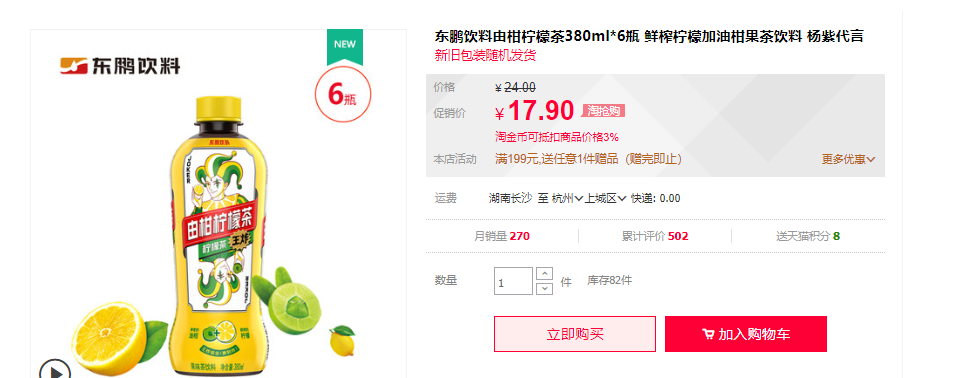
 Focus on marketing to its core consumer base - EASTROC’s sales revenue in Guangdong province accounted for 66.66%, 61.10%, and 60.12% of its total revenue from 2017 to2019. Additionally, it introduced other beverages that cater to local consumers like orange lemon tea and orange peel drinks.
Problems Worry Industry experts
Although most local media have reported EASTROC IPO plans in an optimistic light, experts have remained skeptical for the following reasons:
Its market share accounted for just 15% of China’s energy drinks sector. There is considerable distance between Red Bull and Eastroc, but no daylight between itself and its closest rivals.
It relies too much on its flagship product. Sales of its new products like orange lemon tea, have been poor.
Its business is highly reliant on consumers in the Guangdong region.
 We provide full-scale global food market entry services (including product registration, ingredient review, regulatory consultation, customized training, market research, branding strategy). Please contact us to discuss how we can help you by