Request a Demo
Organic food certification in Malaysia is voluntary unless a product intends to bear an "organic" claim, which mandates compliance with relevant regulations such as Food Regulations 1985. This article outlines Malaysia’s two official certification schemes and key requirements for businesses.
1. Official Organic Certification Schemes in Malaysia
Malaysia operates two organic food certification frameworks: one initiated by the Department of Agriculture (mandated by the previous Ministry of Agriculture and Agro-based Industry) for agricultural products and the other for processed foods, launched by the Ministry of Health (MOH).
1.1 Malaysian Organic Certification Scheme (myOrganic) Developed by the DOA
The Department of Agriculture Malaysia (DOA) has been working towards organic certification since 2002. The first certification guideline and standard, MS1529:2001 The Production, Processing, Labeling & Marketing of Plant Based Organically Produced Food, focused solely on the production, processing, labeling, and marketing of plant-based organically produced food. The certification program began in 2003, covering only agricultural products like fruits and vegetables.
After decades, the myOrganic scheme has expanded systematically since its inception:
Ø 2012: Introduction of MS 2463:2012 - Good Organic Aquaculture, outlining essential components for certifying aquaculture activities.
Ø 2015: Revision of MS 1529:2001 to MS 1529:2015 Plant-based Organically Produced Food - Requirements for Production, Processing, Handling, Labelling and Marketing. It incorporates the information from IFOAM Standards version August 2012, and includes requirements for labeling and marketing to be in line with other labeling requirements in Malaysia.
Ø 2017: Release of MS 2463:2017 - Good Organic Aquaculture Practice First Revision, which updated the aquaculture practices standard to include compliance with the Occupational Safety and Health Act 1994 and animal health care requirements.
Ø End of 2024: Publication of MS 2791:2024 Good Animal Husbandry Practice (GAHP) - Organic Farming, promoting organic livestock practices. This document outlines requirements for organic animal husbandry, including livestock resources, health management, and waste management. It serves as a reference for the myOrganic certification, ensuring that organic livestock farms meet specified conditions and criteria.
Logo of myOrganic certification

1.2 Malaysian Organic Food Certification Developed by the MOH
In 2017, the Ministry of Health established the Malaysian Organic Food Certification for processed food products that are organically produced without synthetic chemicals. All food operators involved in organic food processing can apply for the certification. After obtaining the certification, enterprises can display the organic logo on food labels that have been recognized under this scheme.
Currently certified products include:
Ø Soft drinks (e.g., pomegranate juice)
Ø Dairy products (e.g., probiotic yogurt, pasteurized milk)
Ø Grain products and bread
Ø Beverages (e.g., tea, coffee)
Ø Others (e.g., olive oil, virgin coconut oil)
Logo of MOH's organic food certification
2. Application Requirements and Certification Procedures
2.1 For myOrganic Certification
To assist enterprises with myOrganic certification, relevant guidelines have been issued for plant, livestock, and aquaculture subsectors by corresponding competent authorities:
Ø Guidelines for myOrganic Plant Subsector (by the DOA): Details requirements for applicants, application conditions, and certification procedures, etc. Certificates are valid for one year.
Ø Guidelines for myOrganic Livestock Subsector (by the Department of Veterinary Services): Specifies requirements for applicants, conditions for suspension and cancellation, certification procedure, auditing requirements, etc.; with a certification validity of two years.
Ø Guidelines for myOrganic Aquaculture Subsector (by the Department of Fisheries): Introduces schemes for various aquaculture products, outlining production and certification requirements; valid for two years. Auditing documents for different types of aquaculture products (e.g., seaweed, mollusk, etc.) can be found in this link.
The application and certification procedures can be different for different products. The application & certification procedure for livestock products is summarized below as a reference.
Download the application form and submit it with supporting documents to the Veterinary Regulatory Division within 14 days.
An Appointed Veterinary Auditor (AVD) conducts a document audit.
The AVD reviews the application for compliance with myOrganic standards.
Compliance audits are conducted, including document audits, GAHP and organic criteria as well as field audits.
The results are presented to the Veterinary Certification Technical Committee for review.
Successful applicants receive notification and must comply with specified conditions.
A list of approved premises can be found in the following links: for plant sector, and for livestock sector.
2.2 For Malaysian Organic Food Certification by the MOH
The Ministry of Health has issued Organic Food Certification Guideline for processed food certification, requiring at least 70% organic ingredients. The guidelines cover applicant requirements, labeling, certification procedures, certification validity period (i.e., 3 years), monitoring, etc.
Regarding the application procedure for new cases, enteprises should
Complete the application form (attached in the Guideline) and submit it to the Food Safety and Quality Programmes head office.
Include the submission of supporting documents, such as:
Ø Application Checklist (attached in the Guideline)
Ø Cope of company registration documents (e.g., KKM premises registration, etc.)
Ø Organic Food Process Control Manual
Ø Copy of organic certificate from a certification body accredited under ISO/IEC 17065 or a certification body recognized by the government
Ø Document regarding the certification fee
Ø Product Formulation - raw materials, quantity, percentage and organic recognition status (if any)
Ø Label artwork with organic logo
Auditing activities will commence upon receipt of the completed application form. This includes an adequacy audit, a field audit to assess compliance with organic standards, and a follow-up audit to verify the effectiveness of any corrective actions taken in response to non-compliances identified during the field audit (if required). The premises audit will be conducted by the appointed auditor.
In the event of non-compliance, a Corrective Action Request (CAR) will be issued. The company must implement the corrective actions within the specified timeframe. The audit report will then be reviewed by the appointed approval panel for final approval. Finally, the applicant will be notified of the application approval status.
A list of approved products and enterprises can be found here.
3. Labeling Requirements
Once certified, enterprises are allowed to make organic claims. The labeling requirements include:
3.1 For myOrganic Certification
The labeling requirements for each type of agricultural product are detailed in the corresponding guidelines as given above. Taking organic plants as an example, each package must include the following information as specified in the guideline:
Certification number and logo
Product name and variety
Grade
Size
Net weight (Kg)
Name and address of the producer / supplier / importer / exporter
Country of origin of the producer
Organic Certification Body that certifies the product
Products sold in bulk (e.g., a box containing various types of vegetables) can only be labeled as organic if all items are certified organic. Additionally, please note that organic products cannot be labeled as GMO-free.
3.2 For Malaysian Organic Food Certification
In addition to Food Act 1983 & Food Regulations 1985 requirements, each package must display:
Organic certification number and logo;
Proper name;
Grade (if applicable);
Size (if applicable);
Net weight;
Name and address of manufacturer/packer/manufacturer or agent; and
Name of country of origin (if applicable).
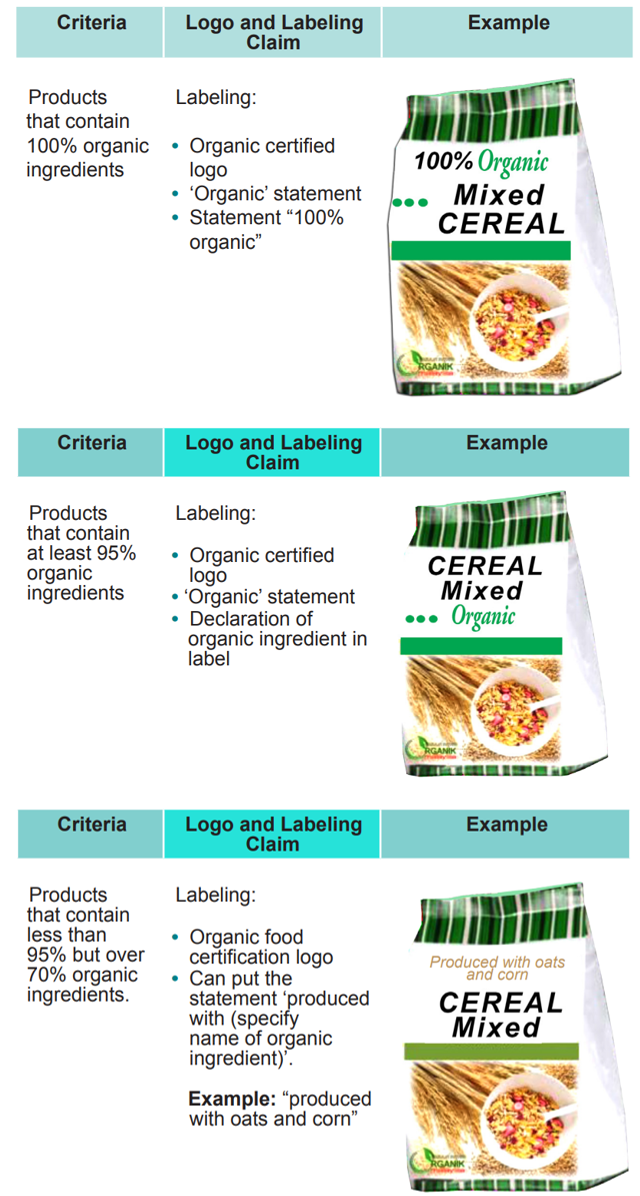
Products with 100% organic ingredients may state “100% organic,” while those with at least 95% can declare the organic ingredient in label. For products with less than 95% but over 70% organic ingredients, the label can state “produced with (name of organic ingredients).” Details and examples can be found as below.
For further consultation or inquiries, please email [email protected].
 We provide full-scale global food market entry services (including product registration, ingredient review, regulatory consultation, customized training, market research, branding strategy). Please contact us to discuss how we can help you by