Request a Demo
Some Background
The current boom in the demand for organic products is the result of steady growth over the last decade. Chinese people care about physical health more than ever. The current trend has obviously lead to considerable interest in the market however the certification and corresponding registration requirements pose considerable market entry barriers.
Significant Growth in Chinese Food Importation
Data from China’s National Bureau of Statistics suggests an annual increase of 15% for imported foods in the last five years a significant proportion of which was organic foods. Major categories of imported organic foodstuff are infant formula, milk, kiwi fruit, olive oil and wines. Many foreign enterprises are determined to conduct organic registration in China despite the high costs due to the large potential investment dividends. For instance, Australian Organic UHT milk products have seen 10% growth in China since obtaining China’s organic certification. In reality, many enterprises with a long history of organic food production are experiencing huge competition in their domestic markets which are often nearing saturation point. Considering China’s huge population (which easily outnumbers that of the whole European Continent), European manufacturers are as anxious as their peers in Oceania or North American to explore Chinese marke
Domestic Certification is a Must
Chinese authorities still reject organic certifications issued by other international organic certification bodies. Only the Chinese CNCA is authorized to conduct domestic organic certification. Domestic registration is a must for Chinese market entry under the current regulatory system .Take Shandong port as an example, in the first eight months of 2014 there were 13.6 ton of imported products which were claimed as organic which failed to present valid domestic organic certificates. CIQs are paying significant attention to the inspection on imported products bearing labeling claims such as “organic” on the packages or promotional materials. Any unqualified products will be issued with a rectification, and only allowed in the Chinese market as ordinary products.
List of CNCA Approved Certification Bodies*
In light of Administrative Measures for Organic Product Certification, organic certificates must be issued by CNCA approved certified organizations.
| No. | Certified No. | Name of Domestic Certifier for Organic Registration |
| 1 | CNCA-R-2002-001 | CQC |
| 2 | CNCA-R-2002-002 | CQM Certification |
| 3 | CNCA-R-2002-007 | GZCC |
| 4 | CNCA-R-2002-013 | Gainshine Assessment |
| 5 | CNCA-R-2002-015 | Wit Assessment |
| 6 | CNCA-R-2002-028 | ZhongAn Authentication Center |
| 7 | CNCA-R-2002-100 | OFCC |
| 8 | CNCA-R-2003-115 | CHTC |
| 9 | CNCA-R-2004-122 | FOFCC |
| 10 | CNCA-R-2004-129 | BJCHC |
| 11 | CNCA-R-2004-131 | Institute of Environmental Protection, Xinjiang Production and Construction Corps |
| 12 | CNCA-R-2004-134 | OFDC |
| 13 | CNCA-R-2007-151 | BEIJING CO-OPS INTEGRITY CERTIFICATION CENTER |
| 14 | CNCA-R-2006-45 | ECOCERT CHINA |
*as of Nov. 2014
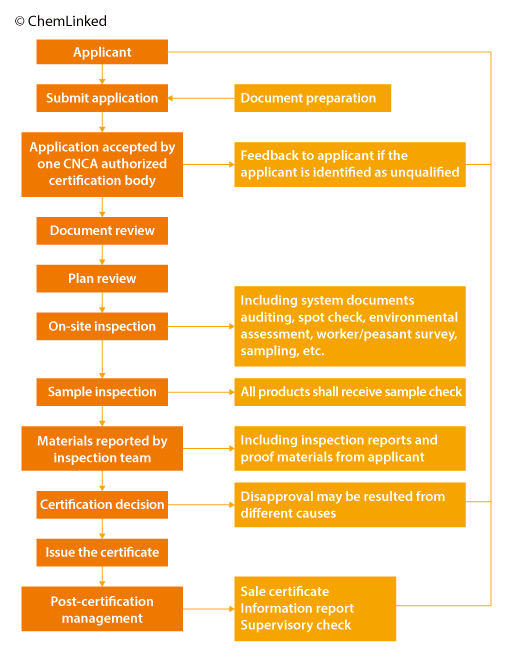
Registration Procedure
REACH24H Food Compliance Service Team
Located in the beautiful city of Hangzhou China, The REACH24H FCS Team is a multidisciplinary and multilingual team composed of food technologists, nutritionists, chemists and regulatory analysts. Years of regulatory compliance experience and close ties with authorities has made the FCS team China’s foremost private agency on China food import regulatory compliance issues. If you are planning to launch a food business in China or encounter any problems during food exportation to China, please feel free to contact us for compliance solutions.
 We provide full-scale global food market entry services (including product registration, ingredient review, regulatory consultation, customized training, market research, branding strategy). Please contact us to discuss how we can help you by