

 Request a Demo
Before exporting halal foods to Malaysia, it is essential to understand the regulations related to specific food categories as well as halal requirements. Notably, halal certification is mandatory for all animal products (excluding pork), while for other product categories, it is highly advisable but not compulsory. This article focuses on the procedures to obtain halal certificates, divided into two sections based on the type of products: a) animal and animal products (excluding pork), and; b) other food categories.
For detailed compliance information regarding specific food categories in Malaysia, please refer to ChemLinked’s Food-pedia. For more information about halal, please refer to the following articles:
Section 1: Halal Certification Procedure for Foods Excluding Animal and Animal Products
Step 1: Ensure applicable halal scope
The Department of Islamic Development Malaysia (JAKIM), the competent authority for halal management in Malaysia, offers five halal certification schemes for international manufacturing, which includes food products:
Food Products
Cosmetics
Pharmaceuticals
Consumer Goods
Medical Devices
Stakeholders must ensure that their products meet the basic halal criteria outlined in the Trade Descriptions (Definition of Halal) Order 2011, which includes:
No parts from forbidden animals for Muslims or non-halal slaughtered animals.
Free from impurities (najis).
Non-intoxicating.
No human-derived components.
Non-toxic or harmful for human consumption.
Equipment must not be contaminated with impurities.
No contact or mixing with or close to forbidden animals or impurities during processing.
Step 2: Identify eligible applicants
The application for Malaysian halal certification is open to companies registered in Malaysia. Eligible applicants for international manufacturing include:
Branches
Subsidiary Companies
Importers
Distributors/Traders
Agents in Malaysia
In addition, as per Malaysian Halal Certification Circular No. 1 of 2014, the Malaysian halal certification application must be handled directly by the applicant without going through a third party. JAKIM emphasizes that it is the responsibility of the companies to understand all conditions, requirements, and procedures for halal certification. However, companies may appoint parties to assist in developing their internal halal management systems.
Step 3: Meeting halal requirements and prepare the application
To meet Malaysian halal requirements, applicants must adhere to the requirements set forth in Malaysian Standard MS 1500:2009 Halal Food - Production, Preparation, Handling and Storage - General Guidelines and MS 1500:2019 Halal Food- General Requirements (Third Revision). Additionally, understanding JAKIM's and other authorities’ halal management requirements, such as the Malaysian Halal Management System (MHMS) 2020, is crucial. Read more at Decoding the Regulatory Framework for Imported Halal Foods in Malaysia.
After fulfilling these requirements, applicants should prepare the application form along with the following documents, as outlined in an official announcement dated December 22, 2023.
No. | Needed documents |
1 | Cover letter of the application, which explains; a) Brief information on the application; and b) Summary of raw materials/ingredients |
2 | Registration of company in Malaysia |
3 | Manufacturing license from the local authority (for international manufacturer) |
4 | Halal Executive certificate and the appointment letter for halal Executive (manufacturer and/or applicant); *Halal Executive must be Muslim |
5 | Copy of identity card and the appointment letter for two Muslim workers (if any) |
6 | Halal Assurance System (HAS) as below (Manufacturer and/or applicant); a) For first-time application and/or new manufacturer: - Halal Assurance System Manual/Procedure b) For renewal and/or existing manufacturer: - Halal Policy - Internal Halal Committee - Summary of Halal Risk Management Plan - HAS amendment (if any) |
7 | Halal certificate or product specification for all raw materials or ingredients; a) Documents should be compiled according to the list of raw materials in the MYeHALAL system; and b) Raw materials must be clearly marked on the halal certificate or related documents |
8 | Halal certificate or product specification for processing aids including water filter/purification used in the factory; |
9 | Manufacturing license from National Pharmaceutical Regulatory Agency (NPRA) (for pharmaceutical and cosmetic products only) (if applicable); |
10 | Establishment license, medical device registration from Medical Device Authority (MDA) and ISO 13485:2017 (for medical device products only) (if applicable); |
11 | Flow chart of product processing; |
12 | Packaging artwork; |
13 | Factory layout plan; |
14 | Factory location map; |
15 | Other documents of manufacturers such as Halal Certificate, HACCP, ISO, GHP, GMP, TQM, etc. (if applicable) |
Step 4: Submit application and obtain halal certificate
All imported foods that want to be marketed in Malaysia as halal food must submit halal application via an online system and
obtain a Halal Certificate issued by JAKIM; or
certified as Halal by the foreign halal certification body recognized by JAKIM (List of recognized foreign halal certification bodies).
Refer to the Manual Procedure for Malaysia Halal Certification for the certification process flow. Note that JAKIM may conduct random audit inspections.
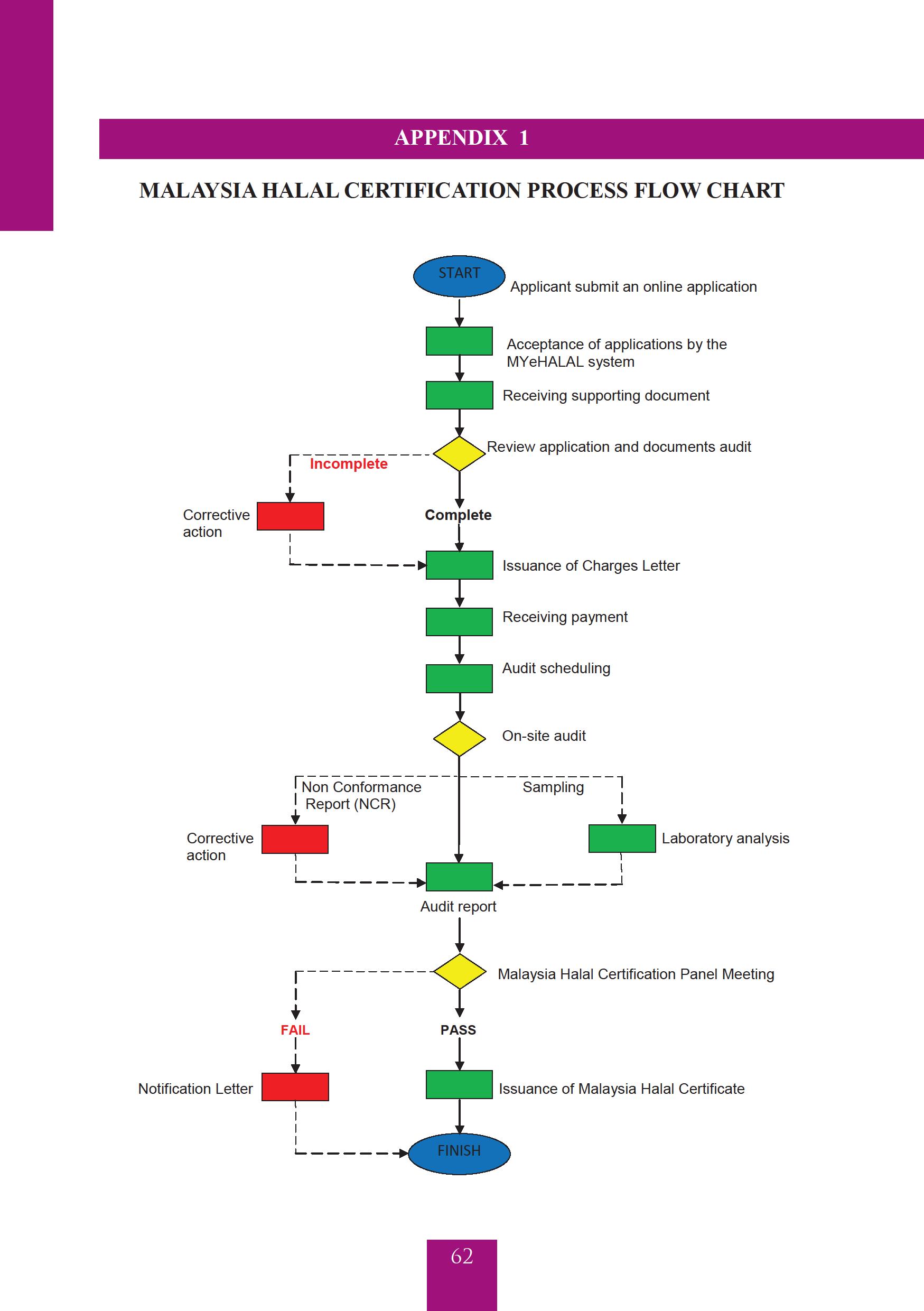
Section 2: Halal Certification Procedure for Animal and Animal Products (Excluding Pork)
Step 1: Ensure applicable halal scope
The Department of Islamic Development Malaysia (JAKIM), the competent authority for halal management in Malaysia, offers five halal certification schemes for international manufacturing, which includes food products:
Food Products
Cosmetics
Pharmaceuticals
Consumer Goods
Medical Devices
Stakeholders must ensure that their products meet the basic halal criteria outlined in the Trade Descriptions (Definition of Halal) Order 2011, which includes:
No parts from forbidden animals for Muslims or non-halal slaughtered animals.
Free from impurities (najis).
Non-intoxicating.
No human-derived components.
Non-toxic or harmful for human consumption.
Equipment must not be contaminated with impurities.
No contact or mixing with or close to forbidden animals or impurities during processing.
Step 2: Identify eligible applicants
Overseas stakeholders must secure approval for their slaughterhouses and processing establishments before exporting animal products to Malaysia. JAKIM has transitioned the application process to an online system known as the JAKIM International Abattoir Application System (JIAAS).
Eligible applicants include
Slaughterhouses for:
- Ruminants
- Poultry
Processing plants for:
- Meat-based products
- Dairy products
- Egg products
In addition, as per Malaysian Halal Certification Circular No. 1 of 2014, the Malaysian halal certification application must be handled directly by the applicant without going through a third party. JAKIM emphasizes that it is the responsibility of the companies to understand all conditions, requirements, and procedures for halal certification. However, companies may appoint parties to assist in developing their internal halal management systems.
Step 3: Ensure halal compliance and obtain halal certificate
To obtain a halal certificate, stakeholders must meet the halal requirements for animal products set by Malaysia, including the Malaysian Protocol for the Halal Meat Production (by JAKIM) and MS 1500:2009 Halal Food - Production, Preparation, Handling and Storage - General Guidelines (by the Department of Standards Malaysia). Understanding the halal requirements imposed by JAKIM (such as halal management circulars, etc.) and other relevant authorities is essential as well. Read more at Decoding the Regulatory Framework for Imported Halal Foods in Malaysia.
Then, stakeholders should appoint a Foreign Halal Certification Body (FHCB) in their own country recognized by JAKIM for halal certification.
The competent authority in the exporting country must recommend establishments that comply with the Protocol for exporting meat and meat products to Malaysia. With the recommendation, stakeholders can start to prepare plant registration applications to DVS and JAKIM as outlined in Step 5. For new exporters, it is essential to ensure that the exporting country has successfully passed the risk analysis outlined in Step 4.
Step 4: Confirm the Exporting Country's Risk Analysis Status (for new exporters)
According to the General Procedure Import Meat, Poultry, Milk and Egg Products to Malaysia, for import from new countries, risk analysis on the exporting country’s risk disease status need to be done by the Department of Veterinary Services (DVS). For the purpose of the risk analysis, the veterinary/competent authority of the exporting country is required to fill up the “Questionnaire on Animal and Public Health Services Information” based on the species.
Once approved, exporting countries are eligible to export corresponding products to Malaysia.
Step 5: Prepare application, undergo audit and register the plants
All animal products exported to Malaysia must be halal-certified. For the purpose of the importation approval, JAKIM and DVS will conduct inspection/audit to the abattoirs and processing plants. Therefore, establishment/abattoir which intends to export meat, poultry, milk and eggs products to Malaysia need to fill up the forms below for adequacy audit (document audit) by DVS and JAKIM.
Application for Export of Meat, Poultry, Milk and Egg Products to Malaysia - (DVS)
HALAL application form for the processing establishment - (JAKIM)
JAKIM will inspect in terms of halal aspect and DVS will inspect in terms of animal health and food safety. Upon approval of both departments, the abattoirs and processing plants will be listed in the Malaysian approved plants list. The halal certificate issued by the recognised certification body will only be valid upon approval from the Malaysian authority.
Once all halal compliance and certification steps are met, products may bear the halal logo in Malaysia.

For further consulting service, please email [email protected].
 We provide full-scale global food market entry services (including product registration, ingredient review, regulatory consultation, customized training, market research, branding strategy). Please contact us to discuss how we can help you by








