Request a Demo
Under Japanese law, products (taken by mouth) are classified into two categories, namely, "pharmaceuticals" and "foods". The Pharmaceutical and Medical Device Act (PMD Act) applies to pharmaceuticals, while the Food Sanitation Act applies to food. Due to regulatory difference between countries, imported health food products may be considered as "unapproved/unpermitted pharmaceutical products*" if they contain ingredients recognized as drugs in Japan. According to the PMD Act, enterprises are prohibited from selling unapproved/unpermitted pharmaceutical products. Otherwise, they will be imprisoned for up to three years or a fine of not more than three million yen (Article 84).
*Unapproved/unpermitted pharmaceutical products
It refers to a product that is not a pharmaceutical product but is marketed with the same efficacy or effect as a pharmaceutical product, or a product that contains medicinal ingredients in the so-called health food (especially products for tonic or slimming effect). These products violate the PMD Act, and their quality, effectiveness, and safety have not been confirmed with high risk of use.
1. The Drug/Non-Drug List
Ingredients used in the product are the essential basis for classifying products as pharmaceuticals or foods. In Japan, the competent authorities supervise the use of relevant ingredients through the Drug List and Non-drug List. Before importing, enterprises can independently confirm whether the product contains pharmaceutical ingredients recognized by Japan through the Drug List and Non-drug List.
Drug list
The Ministry of Health, Labour and Welfare (MHLW) of Japan determines whether or not the raw materials of a pharmaceutical product belong to pharmaceutical ingredients on the basis of the actual usage, toxicity, and drug-like effects. Those identified as pharmaceutical ingredients are included in the “Drug List1 (ingredients exclusively used as drugs)"
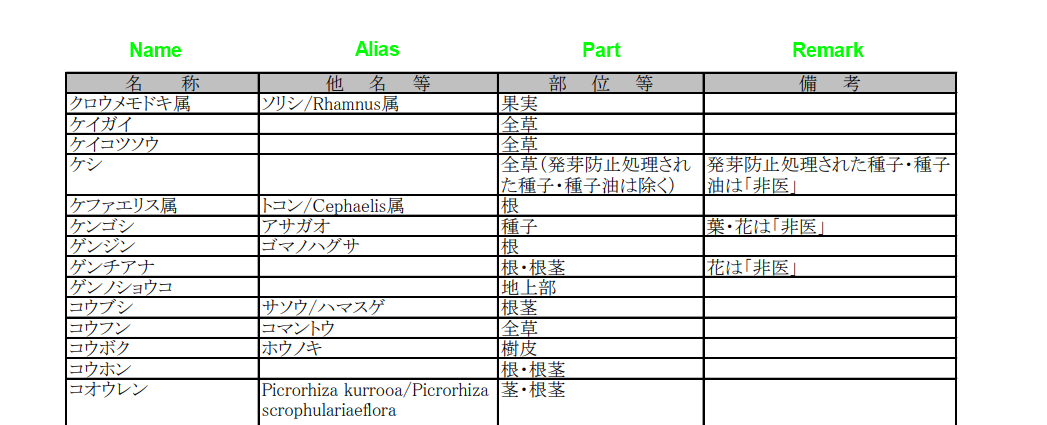 Table 1 Drug List
(Ingredients exclusively used as drugs)
The substances (raw materials) listed on the drug list cannot be used in so-called health foods. However, when the substance is used as a food additive for coloring or fragrance, and the additional amount is not enough to produce a pharmacological effect, it can be exempted from being considered as a pharmaceutical ingredient.
Non-drug list
Those identified as non-drug ingredients are included in the "Non-drug List2 (substances (raw materials) that will not be considered as pharmaceuticals as long as the efficacy and effects of pharmaceuticals are not marked)" . In addition, the substances (raw materials) listed on the non-drug list are not considered as pharmaceuticals product under the PMD Act.
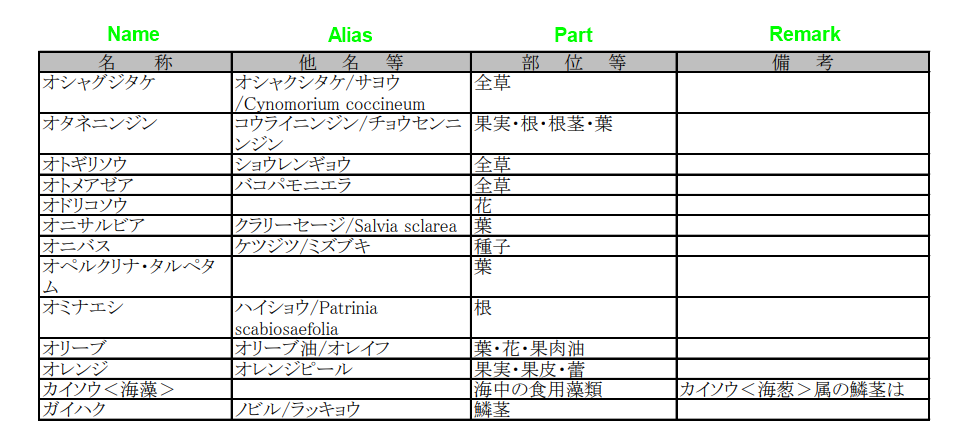
Table 2 Non-drug List
(List of ingredients (raw materials) not deemed drugs unless claiming medicinal efficacy)
Some of the substances on the list cannot be used in food because they are not recognized as food additives in Japan, while some must be used in accordance with the standards for food additives. If it is necessary to use it in food, manufacturers/importers are recommended to confirm with the person at the public health center (for example, Sakyo Healthcare Center, Kyoto City).
2. Noteworthy Points on the Use of Drug/Non-drug List
Health foods that contain ingredients in the non-drug list must:
(1) Not claim efficacy
No matter expressly or implicitly, products with claims to treat and prevent diseases and enhance human tissue's function in instructions, advertising leaflets, or pamphlets, or on the product packaging or the Internet will be considered as pharmaceuticals, even if it's marked in a foreign language.
(2) Be non-pharmaceutical form in terms of dosage form, container, packaging, etc.
Ampoule, spray filled in a nebulizer tube for oral cavity, etc., are considered as pharmaceuticals.
(3) Not advocate medicinal doses
Products marked with detailed usages such as time, interval, and dosage are pharmaceuticals.
Ingredients considered as drugs may also be used as food additives
Generally speaking, raw materials used as food additives can be used in food even if they are considered as pharmaceuticals.
For example:
• γ-Oryzanol (antioxidant)
• Cinchona (bittering agent)
• Gentiana lutea (bittering agent)
• Lithospermum root (colorant)
• Picrasma quassioides (bittering agent)
It is necessary to confirm whether the extracts from the raw materials on the non-drug list are drugs
For raw materials on the non-drug list that are extracted with a solvent other than water or ethanol, it is necessary to check whether the extracted substances belong to pharmaceutical ingredient.
It is noteworthy that even if the raw materials are listed on the non-drug list, their extracts and refined products may be listed on the drug list. For instance, octopus and sardines (non-drug) contain taurine (pharmaceutical ingredient). In such cases, the following conditions must be met to prevent processed foods like octopus and sardines from being regarded as "pharmaceutical products".
1. The product should be indicated as "food";
2. The product should be indicated as "processed";
3. Specific ingredients that may be mistaken for "pharmaceutical products" should not be emphasized;
4. The processing should not make the essence of the original raw material lost;
It may be misunderstood if the claimed used part is not specific enough
For some products containing plants and/or animals, whether they are drugs depends on the part used in the products. For example, the “Senna alexandrina”, its stem is a non-drug ingredient, but the fruit, leaflets, petioles, and leaf shafts are drug ingredients. In this case, even if only the stem is used, when simply displayed as "senna", the products may be misunderstood as pharmaceuticals. Therefore, stakeholders must clearly indicate that the ingredients used are non-drug parts.
It is noted that some non-drug ingredients should be labeled with their plant-based names instead of herbal names, otherwise it may cause misunderstandings.
For example:
Raw material | Herbal name(considered pharmaceuticals) | Plant-based name(considered food) |
Yam | サンヤク(山薬) | ヤマノイモ、ナガイモ |
Ginger | ショウキョウ(生薑) | ショウガ |
Jujube | タイソウ(大棗) | ナツメ |
Oyster shell | ボレイ | カキ殻 |
Pearl barley | ヨクイニン | ハトムギ |
3. Violation Case
As shown in the picture, it is a so-called health food imported from the United States. During a market inspection, the product was found containing "melatonin" which is listed in the drug list.
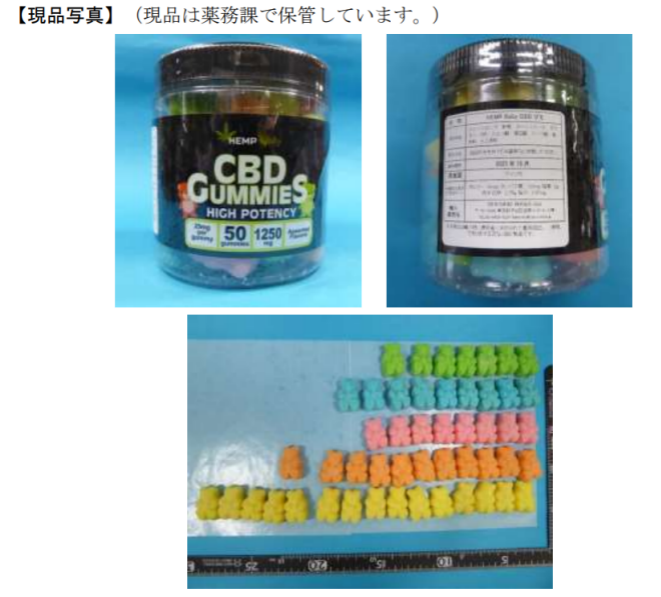 Table 3 Sample of the Product
 Table 4 "Melatonin" in Drug List
"Melatonin" is used as an effective (drug) ingredient for improving sleep quality, and it has been reported to cause side effects such as drowsiness and headache. In Japan, so-called health foods that contain drug ingredients are considered as pharmaceuticals, and the sale of pharmaceuticals is prohibited without MHLW approval and permission. Although the supervision authorities had not received any reports of health hazards as of the inspection date, the importer was still ordered to suspend sales and recall all products.
4. How to Apply for a Non-drug List Raw Material
For ingredients that are hard to judge whether they could be used in foods or not, manufacturers/importers of products containing ingredients not listed in the above two lists can request an assessment from MHLW (via Prefectural agencies). Materials required for the assessment include the scientific name of the raw material, application site, pharmacological or physiological action, toxicity, narcotic/stimulant-like action, the history of being used as a pharmaceutical or food in Japan, etc.In particular, slimming products may be required to test whether they contain Fenfluramine, N-Nitroso-fenfluramine, Sennoside, Triiodothyronine, and Thyroid hormones.
If a company wishes to register a new ingredient in one of the lists, the application sample can be found here3. The required documents are listed below:
• The summary of Ingredient essence (raw material): derived from plants, animals, etc.
• Information on contained ingredients
• Information on the actual use of the ingredient essence as pharmaceuticals
• Information on the actual use of the contained ingredients as pharmaceuticals
• Dietary experience information
• Safety information of ingredient essence
• Safety information on contained ingredients
• Assessment and regulatory information in other countries
If all the raw materials for health foods to be imported are confirmed as foods, they will be subject to a hygienic safety check by the Quarantine Station of the MHLW as per the Food Sanitation Act. Besides, the "Food Import Declaration Form" submitted for import will usually be accompanied by the "Raw Material Composition Table", "Manufacturing Process Table" and "Confirmation of Ingredient (Raw Materials) in Food and Drug Distinction".
5. Latest Updates of Drug/Non-Drug List
Latest modification notice
On February 25, 2022, MHLW issued an amendment4 to move five non-drug list ingredients of plant origin to the drug list for supervision. They are Shinkinsou, Sensoutou, Tinospora cordifolia, Celosia argentea, and Vinca minor. In addition, the designated parts of Sensoutou and Celosia argentea have been expanded to "whole wood".
Revision details:
Name | Alias | Part | Revision |
Shinkinsou | ヒカゲノカズラ | whole grass | Moved from non-drug List to drug list; |
Sensoutou | / | whole grass | • Moved from non-drug list to drug list; • Part changed from "whole grass" to "whole wood" |
Tinospora cordifolia | Tinospora crispa | whole wood | Moved from non-drug list to drug list; |
Celosia argentea | セイショウ | whole grass | • Moved from non-drug list to drug list; • Part changed from "seed" to "whole wood"; |
Vinca minor | Vinca minor L. | whole grass | • Moved from non-drug list to drug list; • The alias added; |
Regulatory trend
On July 7, 2022, MHLW released a notice saying that it would add two new raw materials to the drug list: Crinum latifolium from plants and Buffalo Horn from animals. ChemLinked will continue monitoring regulatory changes regarding the non-drug/drug list to provide the first-hand information.
 We provide full-scale global food market entry services (including product registration, ingredient review, regulatory consultation, customized training, market research, branding strategy). Please contact us to discuss how we can help you by