Request a Demo
In this fast-paced world, where consumers are becoming increasingly health-conscious and mindful of their dietary choices, the importance of clear and informative food labeling cannot be overstated. By presenting key nutritional information in a clear and accessible manner, Front-of-Pack (FOP) labeling has emerged as a vital tool to empower consumers to make informed decisions, thus as a pivotal role in the global effort to combat obesity, chronic diseases, and nutritional deficiencies. This article aims to provide an overview of FOP labeling requirements in several key F&B markets in the Asia Pacific region.
Mainland China
At present, there is no official regulation or scheme for FOP labeling in Mainland China. However, the legislative process in this area is ongoing. The draft version of GB 28050 General Rules for Nutrition Labeling of Prepackaged Foods in 2021 has added requirements for FOP labeling, which allows the use of graphics, text, and other means to provide additional information on the nutritional composition of the food on the front of the packaging. Besides, prepackaged foods are expected to carry the warning statement as "children and adolescents should be cautious in choosing foods high in salt, fat, and sugar". Currently, this standard has not been officially published or implemented.
Furthermore, to promote the implementation of the National Nutrition Plan, the Chinese Nutrition Society issued the group standard T/CNSS 001-2018 Labeling Specification for Healthier Choice in Prepackaged Food, which was implemented on May 1, 2019. The standard specifies the technical requirements for using the "Healthier Choice" label and the corresponding graphical symbols. When the levels of fat, saturated fatty acids, trans fatty acids, sugar, and sodium indicated on prepackaged foods meet the corresponding classification thresholds, these products can display the "Healthier Choice" or "Smart Choice" logo. Specifically, grain and grain products, legumes, dairy products, nuts and seeds, meat products, aquatic products, egg products, and vegetable and fruit products that meet the thresholds requirements should use the "Healthier Choice" logo, while beverages and other foods (puffed snacks, jellies, and pastes) should use the "Smart Choice" logo.
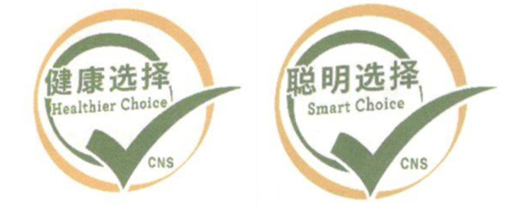 Example: China's Healthier Choice Logo and Smart Choice Logo
Hong Kong, China
The Committee on Reduction of Salt and Sugar in Food, the former Food and Health Bureau, and the Centre for Food Safety of the Food and Environmental Hygiene Department jointly introduced a voluntary "Salt/Sugar" Label Scheme for Prepackaged Food Products in 2017, to help consumers identify low-salt-low-sugar products more easily and make informed choices. It is also expected that the Scheme will serve as a catalyst for trade, to provide more varieties of low-salt-low-sugar products for consumers.
Any prepackaged food falling within the definition of "low salt", "no salt", "low sugar" or "no sugar" can be labeled with the FOP logo after enterprises notifying the Centre for Food Safety. The FOP logo has three language versions and are allowed to be printed in color or black-and-white.
Nutrient | Description of claim | Conditions |
Sodium (Salt) | Low | Food, solid or liquid, containing not more than 0.12g of sodium per 100g/mL of food. |
No | Food, solid or liquid, containing not more than 0.005g of sodium per 100g/mL of food. | |
Sugars | Low | Solid food containing not more than 5g of sugars per 100g of food; |
Liquid food containing not more than 5g of sugars per 100mL of food. | ||
No | Solid food containing not more than 0.5g of sugars per 100g of food; | |
Liquid food containing not more than 0.5g of sugars per 100mL of food. |
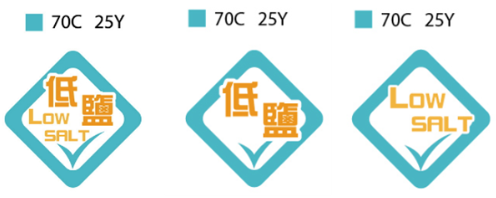 Example: Hong Kong's colored FOP logo in three language versions
Taiwan, China
Taiwan FDA published the Guidance on Front-Of-Packaging (FOP) Nutrition Labeling on Packaged Foods in 2017, to encourage enterprises voluntarily provide clear and simple graphics about food nutrition.
Taiwan's FOP labeling scheme applies to all packaged foods, excluding special nutrition foods. The displayed nutrients on the FOP logo can be: a) energy only; b) energy, saturated fat, sugar and sodium; c) energy, saturated fat, sugar, sodium, and at most two voluntarily claimed nutrients. Other mandatory items of FOP labeling include unit (per serving), nutrient content, and percent daily value (%DV). The FOP logo shall be in two colors, one of which must be white.
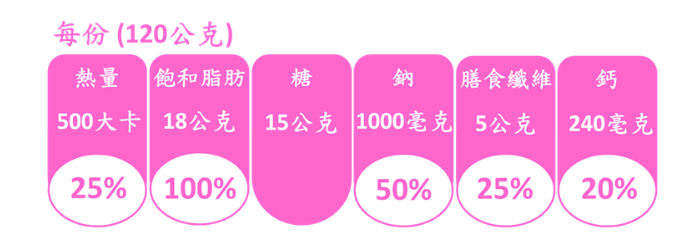 Example: Taiwan's FOP Logo with Six Displayed Nutrients (energy, saturated fat, sugar, sodium, dietary fiber, calcium)
Japan
In Japan, there are currently no specific regulations or guidelines regarding FOP labeling. However, the general labeling regulations do specify that the net weight, solid content, and total net content can be displayed on the main display panel along with the product name.
Furthermore, the Ministry of Health, Labour and Welfare and the Ministry of Agriculture, Forestry and Fisheries of Japan have mentioned on their websites that discussions related to FOP labeling have taken place in recent years during Codex meetings. The absence of specific regulations does not imply the lack of attention to FOP labeling issues in Japan. The adoption and implementation of FOP labeling practices in Japan will depend on the future developments in this area.
South Korea
South Korea adopts a voluntary FOP labeling scheme (Traffic Light Labeling) for children's favorite foods. As per The Special Act on Safety Control of Children's Dietary Life, depending on the contents of sugar, total fat, saturated fat and sodium, children's favorite foods should be classified into three grades. Enterprises are recommended to label these foods as green, amber and red based on grades.
Foods applied to South Korea's FOP labeling scheme are only children's foods, such as confectionary, chocolate, candies, bakery products, dairy products, fish meat sausage, and beverages.
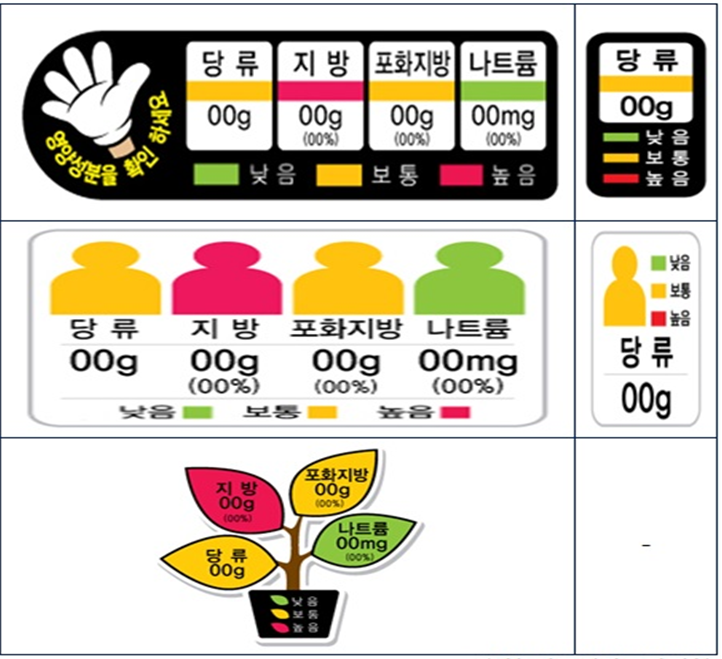 Example: South Korea's three patterns of traffic light labeling logo for children's favorite foods
Singapore
Back in 2001, Singapore introduced the Healthier Choice Symbol (HCS) on packaged food products to indicate that they are healthier options. So far, the HCS can be seen on about 4,000 different food products, spanning across over 100 food categories such as convenience meals, sauces, beverages and breakfast cereals. For details, view the latest list of HCS products here. For food categories and their HCS criteria, please refer to Healthier Choice Symbol Nutrition Guidelines. HCS is optional for labeling, for which applications are done via HCS Online.
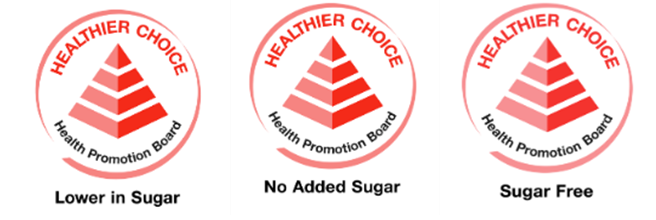 Example: Singapore's HCS (sugar-related)
In 2021, Singapore mandates the Nutri-Grade system for beverages, which requires all beverages sold in Singapore to be classified into four grades (A, B, C, or D) based on the contents of sugar and saturated fat.
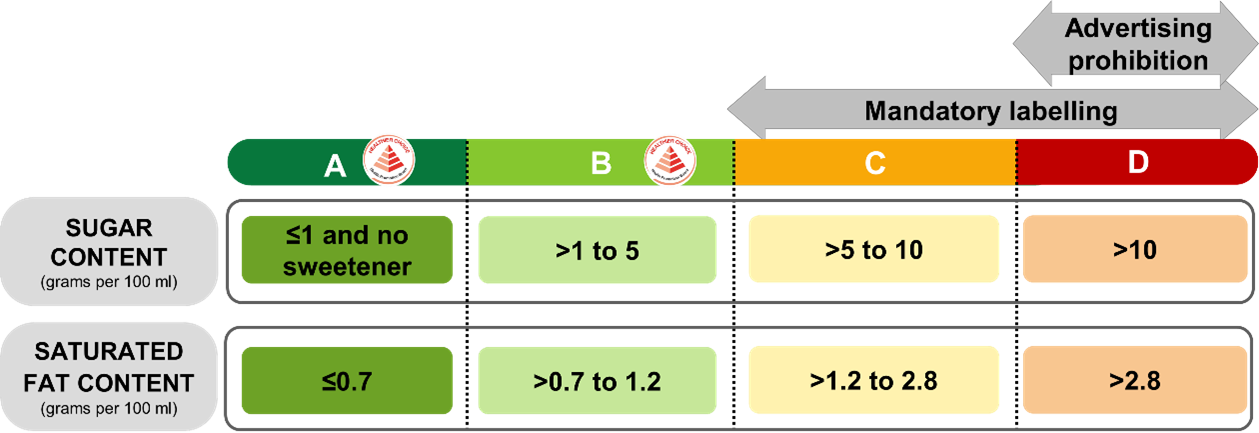
For Grade "A" or "B" beverages, it is voluntary for enterprises to indicate the Nutri-Grade logo. However, beverage whose grade is "C" or "D" must be labelled with the Nutri-Grade logo.
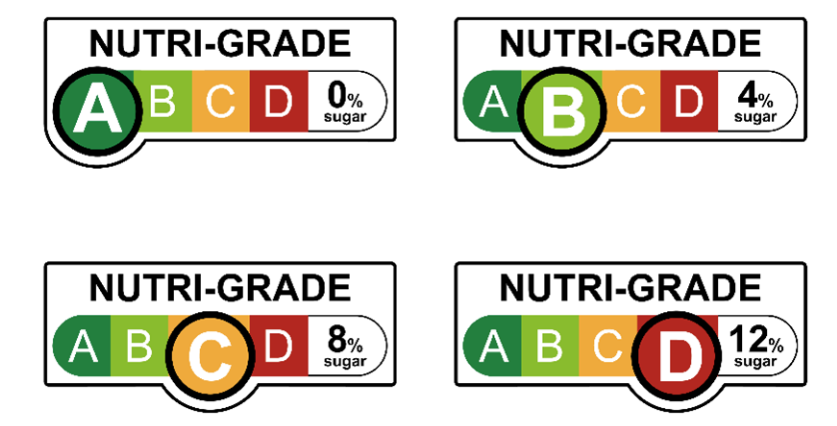 Example: Singapore's Nutri-Grade logo for beverages with four grades
Indonesia
In 2019, the Indonesian government launched an optional Healthier Choice Logo (HCL) to help consumers identify healthier products within two food categories, namely, ready-to-consume drinks, and instant pasta & noodles. The regulation was updated in 2021 to include 20 different food categories, including bakery products, ice cream, ready-to-eat snacks, processed peanut products, and ready-to-eat cereals.
Excerpt of Indonesian HCL requirements for several food categories
Products | HCL requirements |
Ready-to-consume drinks | Sugar ≤ 100mg/6g |
Instant pasta and noodles | Total fat ≤ 20g/100g; Salt (sodium) ≤ 900mg/100g. |
Original milk powders | Sugar ≤ 12.5g/100g; Calcium ≥ 15%ALG/100g. |
Flavored milk powders | Sugar ≤ 30g/100g; Calcium ≥ 15%ALG/100g. |
Cheese | Salt (sodium) ≤ 900mg/100g; Calcium ≥ 15%ALG/100g. |
Ice cream | Total fat ≤ 10g/100g; Sugar ≤ 17g/100g. |
*ALG refers to Nutritional Label Reference

Thailand
In 2011, Thailand FDA implemented the Guideline Daily Amount (GDA) system of labeling, which is mandatory for snack products and certain ready-to-eat foods. The GDA label breaks down nutritional information into the following four components: calories, sugars, fats, and sodium. This requires producers to clearly state the nutrient content and percentage of recommended daily intake of each package.
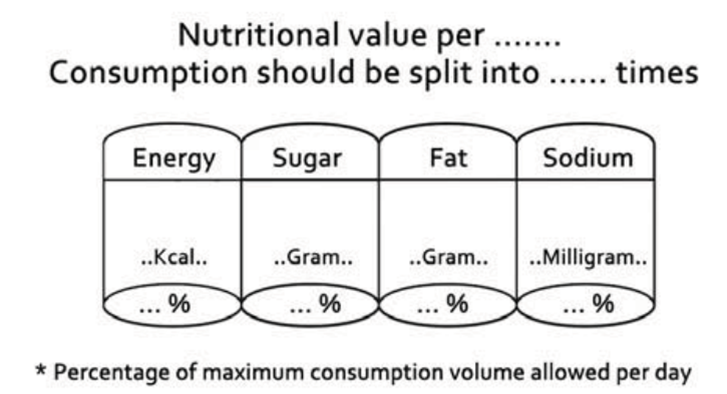 Example: Thailand's GDA label
Later in 2016, Thailand introduced the voluntary "Healthier Choice" nutritional logo for food products. Food producers who wish to use the "Healthier Choice" nutritional logo on their products must have the result of nutrient analysis that meet the nutrition criteria of such food category. Upon meeting the criteria, the producers must submit all necessary documents to the Healthier Choice Nutritional Logo Certifying Unit. Please refer to Guidelines for Applying the "Healthier Choice" Nutritional Logo for more details.
 Example: Thailand's Healthier Choice Nutritional Logo
Malaysia
In 2017, Malaysia Ministry of Health launched the Healthier Choices Logo (HCL), a voluntary criteria-based FOP scheme that is intended to provide point-of-sale information to consumer in making informed food choices.
Applicants that are registered with the Registrar of Companies are eligible to apply for HCL certificate via the HCL online system. Each selected food group has a set of nutritional criteria according to which each product will be evaluated. For the latest HCL criteria, please refer to Nutritional Guidelines on Nutrient Criteria for Healthier Choice Logo Malaysia (As of February 2023).
Malaysia approves two color versions of HCL. The HCL must not touch the brand name on the product to suggest that the product is generic, or cover any essential information on the label.
 Example: Malaysia's HCL
In conclusion, across the Asia Pacific region, most countries and regions have adopted a voluntary FOP labeling scheme to provide consumers with key nutritional information on food products. However, it is worth noting that Thailand stands out as the exception, which implements mandatory FOP labeling for certain food products. For a comprehensive overview of FOP labeling in other significant global food markets, including Europe, North America, Australia, and New Zealand, please refer to Front-of-Pack (FOP) Nutrition Labeling on Food Products in the EU, UK, US, Canada, Australia and New Zealand.
 We provide full-scale global food market entry services (including product registration, ingredient review, regulatory consultation, customized training, market research, branding strategy). Please contact us to discuss how we can help you by