Request a Demo
To better help enterprises stay tuned to the possible food industry supervision trend in China, ChemLinked collects 10 journal articles written by State Administration for Market Regulation (SAMR)’s and China National Center for Food Safety Risk Assessment (CFSA)’s researchers in 2021. The collected articles cover topics like risk evaluation of pollutants and the supervision of health food, labeling, allergen, etc., where readers can catch a glimpse of China officials’ attitude towards corresponding issues.
Part 1: The future of health food supervision in China
Research on Raw Material Management for Health Food in China Based on International Experience (Tian Ming et al. from SAMR Development Research Center and Hu Hao et al. from Huazhong Agricultural University)
Tian Ming et al. summed up four problems that China meets during the supervision and management of health food raw materials, e.g. the boundary of using ingredients in regular food and in health food is ambiguous. To be specific, some raw materials are traditionally considered as both food and Chinese medicine in China, like Dendrobium officinale Kimura et Migo (D. officinale). Due to their specialty, such raw material can be used both in medicine, health food and regular food. Although only health food in China can bear function claims, some regular foods containing such raw materials are still advertising for their health functions, which may make consumers hard to judge if the claims are authentic and reasonable.
In order to solve these problems, Tian Ming et al. raised four suggestions correspondingly. First, accelerate the research of "Health Food Raw Material Directory". The research can begin with single ingredients which are with consumption history and have been frequently used in products that are applying for or have applied for health food registration. Meanwhile, the dose-response relationship of food ingredients that can be used in health foods should be studied as well, so as to distinguish the supervision of ingredients in health food from ingredients in regular food.
Second, set up a risk grading and classification management system for food ingredients. Adding more novel ingredients into the “Health Food Raw Material Directory” is a key measure to propel industry development. Due to a large number of food ingredients and their increasingly diversified classifications, Tian Ming et al. suggested that food raw materials can be managed based on two dimensions, ingredient safety and efficacy. Food ingredients with a high safety factor can be managed through filing; otherwise, enterprises need to provide sufficient evidence and apply for administrative approval. Moreover, China should evaluate different food ingredients’ efficacy based on different scientific evaluation systems. For example, in Canada, natural health products are divided into two types, products making modern health claims and products used as traditional medicines.
Third, establish a re-evaluation mechanism for health food raw materials, such as to set up a professional institute like the US to support the research of health food raw material and functions in a long run, which is also a collaboration with and complementation to the government’s work.
Fourth, carry out the function/claim evaluation by different disciplines of science. The evaluation system of traditional Chinese medicine is different from that of modern medicine. Thus, Tian Ming et al. advised that when establishing the evaluation standard for product function/claim, the authorities should consider the situation of traditional medicine and adopt different scientific evaluation methods for different food ingredients.
Research on American Dietary Supplement Management and Its Enlightenment to China (Tian Ming et al. from SAMR Development Research Center and Zhou Shi-wei et al. from Lesaffre Management (Shanghai) Co. Ltd.)
Tian Ming et al. concluded the lessons China can learn from the supervision on dietary supplements in the US into three points.
First, when emphasizing governmental supervision, Tian Ming et al. believe it is necessary to strengthen enterprises’ responsibilities. Drawing on the US’s experience, perhaps China could demand suppliers and distributors to offer a report to certify the safety of health food ingredients. Then such certification reports would be tested and verified by authorities. When all necessary conditions are achieved, China could supervise the safety of health food by sampling inspection, which will reduce the administrative cost.
Second, China should further research food ingredients together with scientific research institutes and universities.
Third, Tian Ming et al. suggested that China can set up a grading system to manage health food function claims. At present, China manages the claims by listing the permitted functions. But it’s hard to tell the differences in the efficacy degree of different products.
Enlightenment and prospect of market access system of China's dietary supplement for future product research and development (Sa Yi et al. from Center for Food Evaluation, State Administration for Market Regulation)
Sa Yi et al. analyzed the common problems that applicants could meet during the application for health food certificates and offered corresponding suggestions. Moreover, the authors revealed that at present, China has not yet established a system for collecting the information on people's consumption of health food products based on sales data. In the future, China could explore the possibility of constructing the evidence system and evidence sources of post-market technical evaluation, managing the evidence by classification as well as grading, and therefore providing evidence support for health food ingredient’s safety and the accuracy of functions.
Part 2: Risk evaluation & Contaminant monitoring
Occurrence and exposure risk assessment of elements in liquid milk in China (Ma Lan et al. from China National Center for Food Safety Risk Assessment)
Ma Lan et al. collected 110 milk samples from 7 regions across China and determined a total of 15 elements, namely, Mg, Ca, V, Cr, Mn, Fe, Co, Ni, Cu, Zn, As, Se, Mo, Cd and Pb. The result showed that milk generally has a high level of Ca (430-939 mg/kg). The levels of 9 elements, namely Fe, Cr, Co, Mn, V, Ni, Pb, As and Cd, varied geographically. The measured concentrations of As, Pb and Cr in liquid milk were all lower than the limits of the Chinese standards, which means these milk products pose a low risk to human health.
Analyzing of polychlorinated dibenzo-p-dioxins, polychlorinated dibenzofurans and dioxin-like polychlorinated biphenyls in infant formula milk powders (Ding Hao et al. from National Health Commission Key Laboratory of Food Safety Risk Assessment, China National Center for Food Safety Risk Assessment)
Ding Hao et al. collected 601 infant formula milk powder samples across China and determined 17 congeners of polychlorinated dibenzo-p-dioxins, polychlorinated dibenzofurans (PCDD/Fs) as well as 12 dioxin-like polychlorinated biphenyls (dl-PCBs) congeners recommended by the World Health Organization (WHO). The determination is conducted based on China’s national standard “GB 5009.205-2013 Determination of Toxic Equivalent for Dioxin and Its Analogue in Food”. The result shows the mean concentrations of PCDD/Fs and total dioxins (PCDD/Fs plus dl-PCBs) were 0.07 and 0.10 pg TEQ/g, respectively. The concentrations were significantly lower than the maximum limit of dioxins in infant food recommended by the European Union.
Review on risk and countermeasures of chloropropanol esters in foodstuffs (Li He-Li et al. from Chinese Academy of Inspection and Quarantine and Wu Yong-Ning from China National Center for Food Safety Risk Assessment)
Li He-li et al. summed up the research on the contamination of chloropropanol esters in foodstuffs worldwide and concluded that dietary exposure to chloropropanol esters, especially 3-chloro-1,2-propanediol ester (3-MCPDE), was found to be risk-free for the average consumer. But the risk is higher for some younger-age groups, infants and young children who consumed only formula, which is worth attention. At present, China hasn’t set up a limit for chloropropanol esters based on the earlier risk evaluation analysis by CFSA but only regulated the limit of 3-MCPD in “GB 2762-2017 Maximum Levels of Contaminants in Foods” and added the pollutants into monitoring plans. In 2021, National Health Commission released the draft of “Specifications of the control of 3-chloropropanol esters (3-MCPDE) and glycidol esters (GE) contamination in foods”.
Combined use of food additives in China and its cumulative risk assessment (Yong Ling et al. from China National Center for Food Safety Risk, etc.)
Yong Ling et al. analyzed the combined use of food additives in China and assessed the exposure levels of the common combination of food additives as well as its cumulative health risks. The result shows that 79.90% of the foods are added with two or more food additives in China, and binary combination has the highest utilization rate, followed by ternary combination and quaternary combination, with a maximum of the combination of 29 food additives.
Through cumulative evaluation, Yong Ling et al. concluded that the most commonly used additives in binary, ternary and quaternary combinations have low cumulative exposure risks. But some individuals had a hazard index ≥1. Moreover, since the combination of food additives is used widely, cumulative exposure risks will still be much higher than the situation where food additives are used alone. Hence, it is necessary to intensify the monitoring effort of such cases. When conducting the safety evaluation of food additives, it is also essential to consider the combination use of food additives as well as to set stricter limits to food additives that are often used in the combination and with higher cumulative risk.
Part 3: Investigation and research
Tracking and re-evaluation for the food additives standard system (Zheng Jiangge et al. from China National Center for Food Safety Risk Assessment)
In order to provide references for the revisions of food additive standards, Zhang Jiangge et al. collected the public’s feedback through the “National Food Safety Standard Track and Re-evaluation Platform” from all aspects and did follow-up analysis. Most feedback focus on “GB 2760 Standard for Uses of Food Additives”.
In this article, Zheng Jiangge et al. replied to the public’s feedback. For example, CFSA has already taken the situation of special groups (e.g. children) into consideration when setting up the use limit of relevant food additives. CFSA will also solicit industrial opinions to determine whether it is fine to prohibit the use of certain preservatives in canned foods. Some feedbacks will be accepted during the revision of GB 2760, e.g., to adjust the application scope of certain food additives in GB 2760 due to the corresponding adjustment in relevant product standards.
Consumer Knowledge and Behaviors Regarding Prepacked Food Labeling in China (Yu Hangyu et al. from China National Center for Food Safety Risk Assessment)
To investigate the public awareness of food labeling and offer suggestions on food labeling management, Yu Hangyu et al. conducted a questionnaire survey among consumers. 5,975 results were collected and analyzed.
The investigation unveils some problems. For example, during the investigation of the labeling method of product shelf life and expiration date, 52.45% of respondents prefer the labeling method of “best before xxx”. 48.31% accept the labeling method of “expired on xxx”. But only 24.59% accept the labeling method of “shelf life: xxx months/years”, which is actually the most common labeling method to be seen in daily life. Regarding the labeling of food additives, 75.77% of respondents expect food additives can be labeled separately from other food ingredients. 52.12% of respondents would like to see both the food additive name as well as its function category (e.g. whether the food additive belongs to colorant, emulsifier, etc.). As for claims like “zero addition”, “nature” and “no preservative”, 56.25% of respondents express that they are not willing to choose products with these claims. 83% of respondents do not believe the authenticity of such claims but 61.22% of the total respondents admit such claims will still influence their purchase behaviors.
Based on the investigation, Yu Hangyu et al. give their suggestions, including to further regulate product claims in the future, optimize the labeling of shelf life/expiration date (enterprises can learn lessons from the US, EU or Japan) and improve the design of labels (the size of Chinese characters should be larger, which is often too small for some people).
Trends of food allergens management in different countries/regions and analysis of current food allergy situation in China (Yu Hangyu et al. from China National Center for Food Safety Risk Assessment)
After comparing food allergen labeling requirements between China and other countries, Yu Hangyu et al. found the requirements thereof is relatively loose in China. To better offer supervision suggestions, the team also conducted a questionnaire survey among consumers to understand the public awareness of food allergen labeling. 5,975 survey reports were collected and analyzed in this study.
Currently, it is voluntary for enterprises to label the eight allergens in China’s “GB 7718-2011 National Food Safety Standard General Standard for the Labeling of Prepackaged Foods”, such as grains containing gluten and their products, crustacea and its products, etc. But the investigation shows that common allergens like mango have not been listed in the regulation, although their allergic population is larger than that of products like nuts. What’s more, among the 5,975 respondents, 86.53% of them expressed that it should be mandatory to label food allergen information.
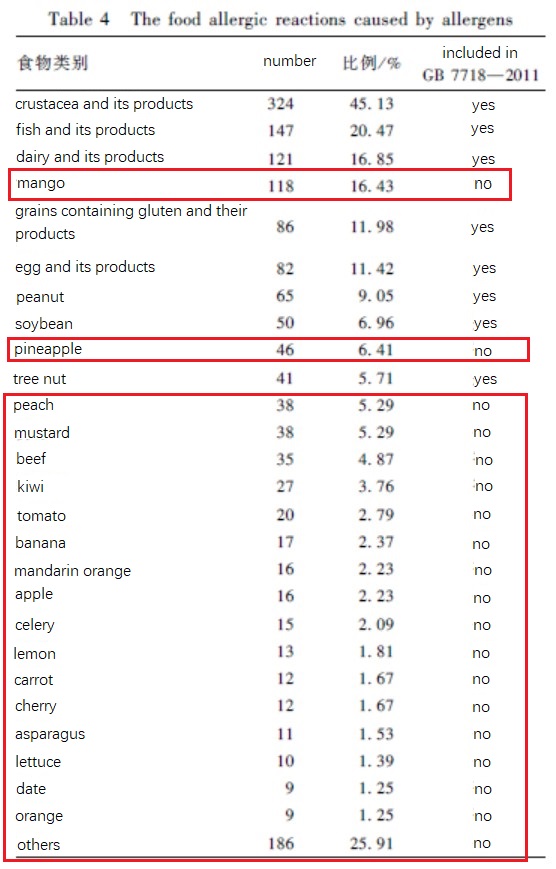
At the end of this article, the researchers concluded that China should make a food allergen list on its own instead of directly borrowing from Codex Alimentarius Commission. In addition, mandatory labeling of allergens in food should be implemented. To better implement the mandatory labeling of allergens, corresponding test methods should also be formulated.
 We provide full-scale global food market entry services (including product registration, ingredient review, regulatory consultation, customized training, market research, branding strategy). Please contact us to discuss how we can help you by