Request a Demo
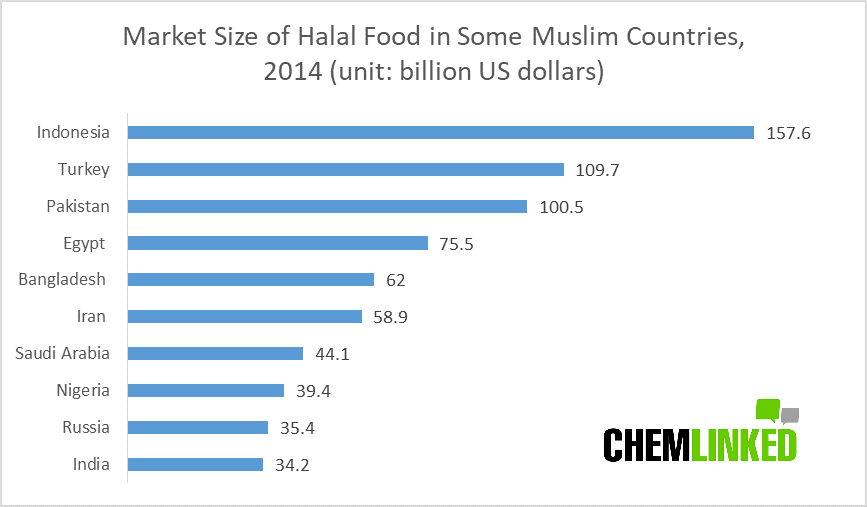
Halal food refers to food products consistent with the Islamic doctrine. It is now one of the most profitable and influential sectors of the global food industry, with an annual growth rate of 8.14%. According to the “State of the Global Islamic Economy Report 2019/2020”, the global halal food market exceeds 1300 billion US dollars, and it is expected to reach 1900 billion US dollars by 2023 [1]. Due to the large population of Muslims, Asia-Pacific regions and North Africa are the major areas for halal food consumption. It is noteworthy that in Muslim countries, most vegetables, meat products, and processed food are from overseas.
Market opportunities
The growing population and increasing consumption capability of Muslims
According to IMF data, in 2016, the Muslim population reached 1.6 billion, accounting for 24% of the world’s population. Additionally, the Muslim population's growth rate is slightly higher than that of the average global growth rate. The Pew Research Center predicted that the global Muslim population would surge to 2.76 billion by 2050. Some multinational enterprises have seen the opportunities and already expanded their production lines of halal food, such as Tesco, McDonald’s, and Nestle.
Muslim countries are also making a much greater contribution to the global economy, and their GDP growth has even surpassed most western countries. In 1987 major Islamic countries (Organization of Islamic Cooperation) accounted for just 4% of the global GDP, while this data increased to 9.6% in 2016 (global GDP of 2016 is 74 trillion US dollars, and GDP of OIC is 7.1 trillion US dollars). Muslim people now have stronger consumption capacity to pursue high-quality food products.
GDP Growth Grate of Major Islamic and Western Countries (unit: %)
Country Name | 2017 | 2018 |
Afghanistan | 2.67 | 1.03 |
Australia | 2.37 | 2.94 |
Bangladesh | 7.28 | 7.86 |
Canada | 2.98 | 1.90 |
Switzerland | 1.80 | 2.75 |
France | 2.26 | 1.72 |
Great British | 1.89 | 1.39 |
Guinea | 10.30 | 6.16 |
Indonesia | 5.07 | 5.17 |
Iceland | 4.60 | 4.61 |
Kazakhstan | 4.10 | 4.10 |
Maldives | 6.80 | 6.89 |
Malaysia | 5.74 | 4.74 |
Norway | 2.32 | 1.29 |
New Zealand | 3.13 | 2.77 |
Pakistan | 5.55 | 5.83 |
Senegal | 7.08 | 6.77 |
Turkey | 7.47 | 2.83 |
America | 2.22 | 2.93 |
Data source: The World Bank
Non-Muslims are increasing their demand for halal food.
Halal food is considered healthy and hygienic because they are subject to rigorous production standards. For example, butchers must follow strict slaughtering measures to reduce the pain of animals. Halal food must be cooked in a clean kitchen, and the knives and utensils used cannot be mixed with those used for non-halal food. Halal food cannot contain food additives harmful to health. The high-quality standards used for halal food are consistent with the consumption trend nowadays, especially in developed countries. Wang Guoliang, deputy secretary-general of the Chinese Islamic Association, stated that approximately 500 million non-Muslims were consuming halal food in 2015 [3]. Food safety accidents have also pushed consumers to consider halal foods [4].
Halal certification globally
In principle, halal food shall follow the edicts of the Islamic doctrine, such as the Quran and Sunnah. However, because some statements stipulated in these doctrines are quite obscure and open to interpretation, currently, there is no unified Halal certification standard used globally. Certain details, such as the processing method, slaughtering procedure, labeling items, etc. are subject to different standards in different countries. These differences can often represent a technical barrier to trade for exporters of Halal food.
Some countries have established a comprehensive management system for Halal food. Here is a brief introduction.
Malaysia
JAKIM (Department of Islamic Development Malaysia) is the agency responsible for halal certification. In most countries, religious organizations take charge of halal certification. Malaysia is the sole country where the government issues the halal certificates. Since 1982 Malaysia started to roll out its halal certification standard nationwide. It is now the most significant halal certification and manufacturing hub in the world. The Malaysian halal certification system is widely accepted globally and is a major reference when other countries/regions draft their own standards.
Major regulations:
Indonesia
BPJPH (Badan Penyelenggara Jaminan Produk Halal) is now the competent authority of halal certification in Indonesia. It will issue the halal certificate, but the halal evaluation is conducted by LPH (Lembaga Pemeriksa Halal), which could be established by the government and public institutions such as universities. BPJPH must authorize them before providing the halal evaluation service, and an LPH must have at least three auditors to conduct their testing.
Major regulations
Halal Products Law
New Zealand
All the food products manufactured in New Zealand must meet the requirements specified in Food Safety Law and related regulations. The halal food assurance requirements are an additional part of the specific regulation. Ministry for Primary Industries (MPI) takes charge of halal food certification in New Zealand, including drafting the animal product processing standard, managing halal certification agencies, evaluating the capability of halal food auditors, etc.
The halal assurance system in New Zealand includes two parts. The first one is that MPI will issue the official certificate if the products comply with "Halal Assurance Notice 2010”. Besides the halal certification agencies will issue the halal certificates if the products meet the requirements specified in “Overseas Market Access Requirements for Halal Assurances (OMAR)”
Major regulations:
Halal Assurance Notice 2010
Animal Products (Overseas Market Access Requirements for Halal Assurances) Notice (No.2) 2015
Enterprises should obtain the halal food certification of the targeted countries before the importation. To facilitate the global trade of halal food, nowadays, the mutual recognition of halal certification has been strengthened among different countries. As of Feb. 5, 2020, Malaysia has 84 recognized foreign halal certification bodies, that is, halal certificates issued by these recognized agencies are also well accepted by Malaysia for market access [5].
Is halal certification a mandatory requirement to export food to Muslim countries?
The requirement to have a halal certificate for imported food varies in different countries. It depends on the government's stance on halal certification and the numbers of non-Muslims living in the country.
Some countries place great emphasis on religious issues and will implement some mandatory measures to regulate halal food. For example, according to Indonesia’s Halal Product Law, all food, medicine, and cosmetics products must be granted halal certificates before entering into Indonesia.
However, halal certification is not a prerequisite to enter Malaysia. In Malaysia, Muslims account for 65% of the overall population, ethnic Chinese, about 25%, and the rest is made up of Indians Pakistanis, Western expats etc. Thus there is a strong demand for non-halal foods and beverages like pork and wine [6].
Nevertheless, we suggest food manufacturers apply for halal certificates before entering Muslim countries. On the one hand, it allows importers to access a much larger market, and on the other hand, most local importers are more willing to import food products with halal certificates.
 We provide full-scale global food market entry services (including product registration, ingredient review, regulatory consultation, customized training, market research, branding strategy). Please contact us to discuss how we can help you by